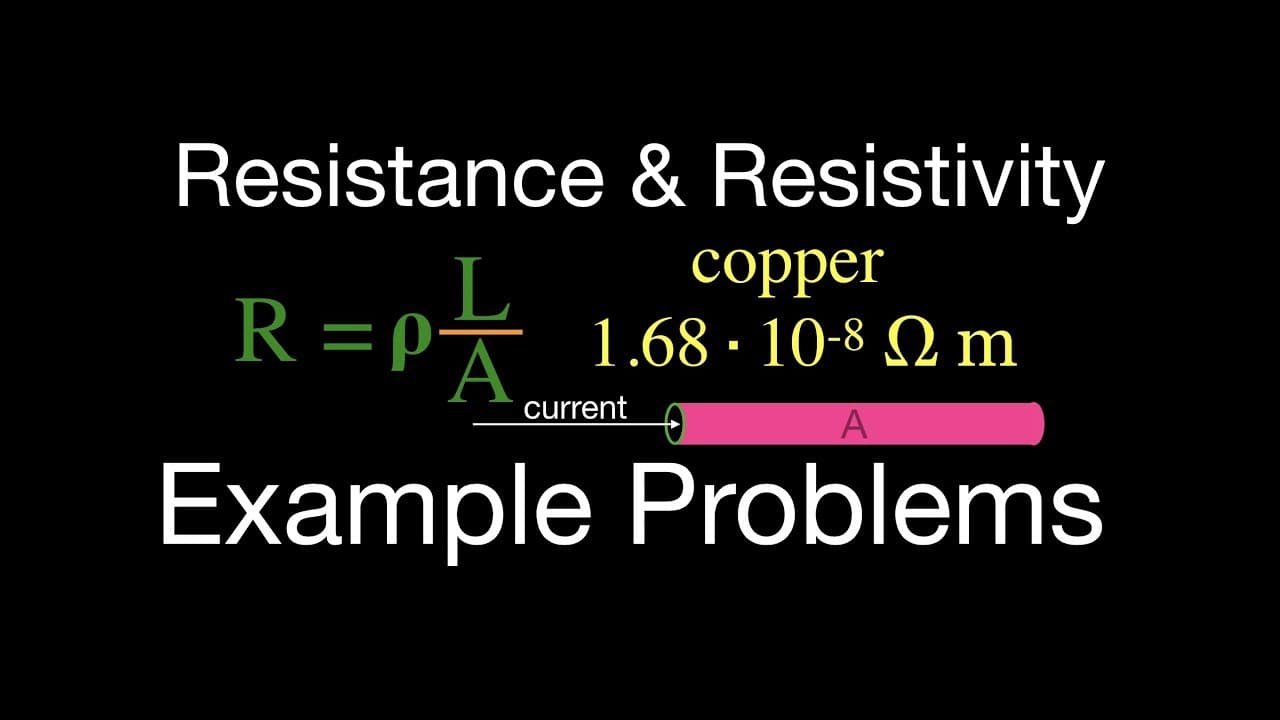
Resistance & Resistivity, Example Problems
TL;DR
Solve example problems involving resistance and resistivity using basic equations and conversions.
Transcript
in today's video we are going to go over some example problems for calculating resistance and resistivity I already have videos that I've made for an explanation of resistance and reasons Tiffany I think what goes with that also is Ohm's law and electric current and I also have videos for those which you can link to in the upper right hand corner o... Read More
Key Insights
- 🛜 Resistivity equation R = ρL/A is essential for calculating resistance in wires.
- 😵 Diameter to radius conversions are crucial when determining cross-sectional areas in circular wires.
- 🤒 Precision in unit conversions from millimeters to meters is necessary for accurate calculations.
- ❓ Understanding the relationship between resistance, length, area, and resistivity is vital in solving physics problems.
Install to Summarize YouTube Videos and Get Transcripts
Explore YouTube Video Summarizer or Get YouTube Transcript Extractor
Questions & Answers
Q: How is resistance calculated for an aluminum wire?
Resistance is calculated using the formula R = ρL/A, where ρ is resistivity, L is length, and A is the cross-sectional area. By plugging in values and converting units, the resistance can be determined.
Q: What is the process to find the length of copper wire for a specific resistance?
To find the length of copper wire, use the equation L = RA/ρ, where R is resistance, A is area obtained from radius calculation, and ρ is resistivity. Solve this algebraically for length by plugging in known values.
Q: How can the resistivity of a wire be calculated from its properties?
The resistivity can be found by rearranging the resistance formula to solve for resistivity as ρ = RA/L. By substituting values for resistance, area, and length, the resistivity of a wire can be calculated.
Q: What are the steps to determine the cross-sectional area and diameter of tungsten wire?
First, calculate the cross-sectional area using RA/ρ, then find the radius by square rooting the area divided by π. Finally, double the radius to get the diameter, converting units as needed for accurate measurements.
Summary & Key Takeaways
-
Solve resistance of an aluminum wire with given dimensions using resistivity equation.
-
Determine length of copper wire for specified resistance using resistivity and area calculations.
-
Calculate the resistivity of wire given length, resistance, and diameter using basic physics formulas.
Read in Other Languages (beta)
Share This Summary 📚
Summarize YouTube Videos and Get Video Transcripts with 1-Click
Try YouTube Summary with ChatGPT & Claude or YouTube Transcript Generator
Explore More Summaries from Step by Step Science 📚


Summarize YouTube Videos and Get Video Transcripts with 1-Click
Try YouTube Summary with ChatGPT & Claude or YouTube Transcript Generator