Electrolytic cells | Applications of thermodynamics | AP Chemistry | Khan Academy
TL;DR
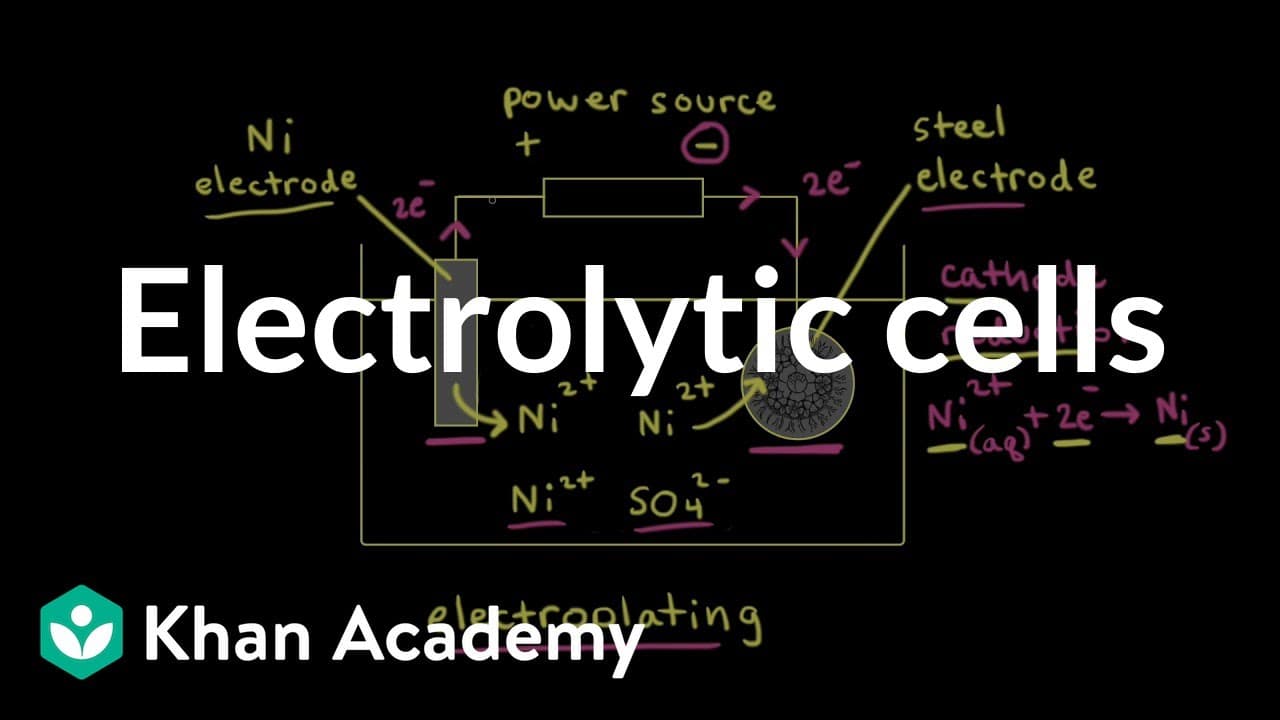
Electrolytic cells use an electric current to drive a thermodynamically unfavorable reaction, while electroplating utilizes electrolysis to plate one metal onto another.
Transcript
- [Instructor] Electrolytic cells use an electric current to drive a thermodynamically unfavorable reaction. Before we look at a diagram of electrolytic cell, let's look at the half reactions that will occur in the cell. In one half reaction, liquid sodium ions react with an electron to form liquid sodium metal. Because the liquid sodium ion is gai... Read More
Key Insights
- 😒 Electrolytic cells use an electric current to drive unfavorable reactions.
- 🫢 In the electrolysis of molten sodium chloride, liquid sodium is formed at the cathode, while chlorine gas is generated at the anode.
- 🥡 The anode is where oxidation occurs, while reduction takes place at the cathode.
- 🤔 Electroplating is a process that utilizes electrolysis to deposit a thin layer of one metal onto another.
- ✊ An electrolytic cell requires a power source to provide the electric current needed for the reaction.
- ⚾ The anode and cathode in an electrolytic cell can be determined based on the processes of oxidation and reduction.
- ❓ Galvanic cells, unlike electrolytic cells, produce electrical energy from spontaneous redox reactions.
Install to Summarize YouTube Videos and Get Transcripts
Explore YouTube Video Summarizer or Get YouTube Transcript Extractor
Questions & Answers
Q: What is the purpose of electrolytic cells?
Electrolytic cells are used to drive thermodynamically unfavorable reactions by supplying an electric current. They are commonly used in processes like electroplating and the extraction of metals from their ores.
Q: How do you determine the anode and cathode in an electrolytic cell?
The anode is the electrode where oxidation takes place, while the cathode is the electrode where reduction occurs. A useful way to remember this is through the mnemonic "an ox and a red cat."
Q: What is the main difference between electrolytic cells and galvanic (voltaic) cells?
The main difference is that electrolytic cells require an external power source to drive the reaction, while galvanic cells produce electrical energy from a spontaneous redox reaction.
Q: How does electroplating work?
In electroplating, a metal object is immersed in an electrolyte solution containing ions of the metal to be plated. When an electric current is applied, the metal ions in the solution are reduced and deposited onto the object, forming a thin layer of the desired metal.
Summary & Key Takeaways
-
Electrolytic cells use an electric current to drive a thermodynamically unfavorable reaction, such as the electrolysis of molten sodium chloride to form liquid sodium and chlorine gas.
-
Oxidation occurs at the anode, where liquid chloride anions are oxidized to chlorine gas, while reduction occurs at the cathode, where liquid sodium ions are reduced to form liquid sodium metal.
-
Electroplating is a process that uses electrolysis to plate one metal onto another, either for protection against rust or corrosion, or for decorative purposes.
Read in Other Languages (beta)
Share This Summary 📚
Summarize YouTube Videos and Get Video Transcripts with 1-Click
Try YouTube Summary with ChatGPT & Claude or YouTube Transcript Generator
Explore More Summaries from Khan Academy 📚



Summarize YouTube Videos and Get Video Transcripts with 1-Click
Try YouTube Summary with ChatGPT & Claude or YouTube Transcript Generator