Laplace transform of t^n: L{t^n} | Laplace transform | Differential Equations | Khan Academy
TL;DR
The Laplace transform of t to the n, where n is any positive integer, is equal to n factorial divided by s to the power of n+1.
Transcript
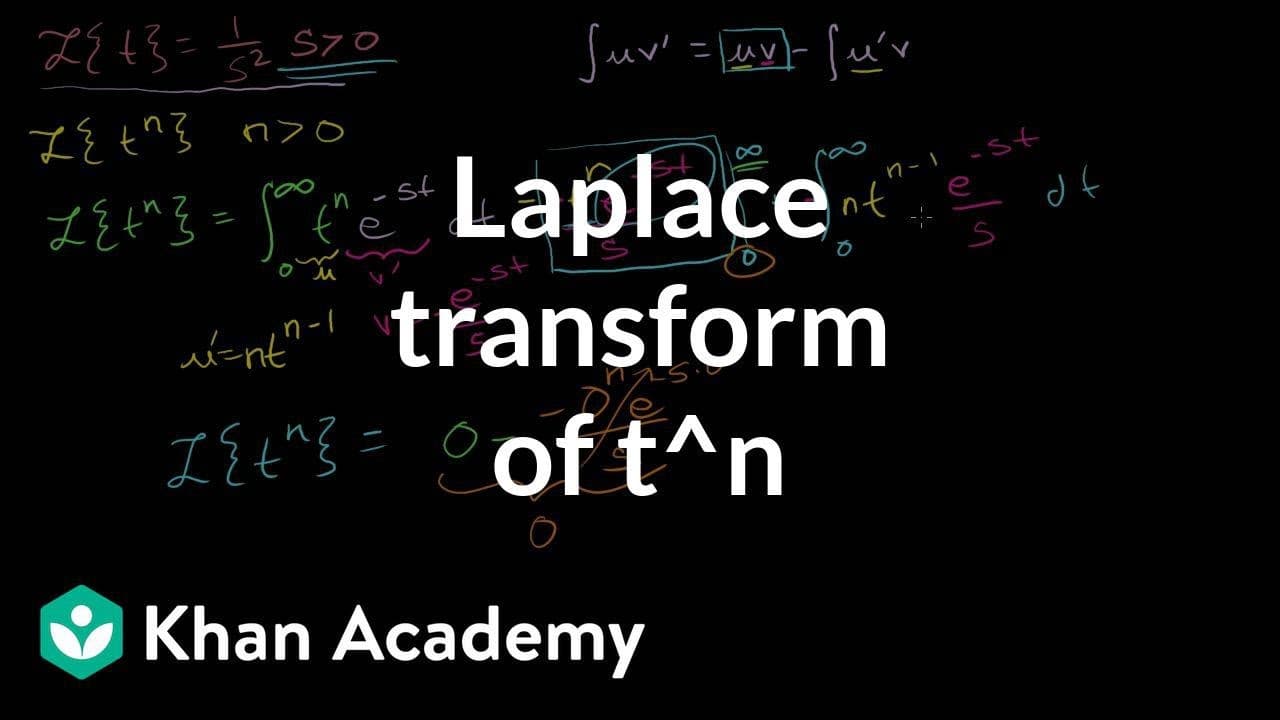
In the last video, I showed the Laplace transform of t, or we could view that as t the first power, is equal to 1/s squared, if we assume that s is greater than 0. In this video, we're going to see if we can generalize this by trying to figure out the Laplace transform of t to the n, where n is any integer power greater than 0, so n is any positive... Read More
Key Insights
- 🥳 The Laplace transform of t to the n can be derived using integration by parts.
- ⌛ The Laplace transform of t to the n simplifies to n/s times the Laplace transform of t to the n-1.
- 😃 Recursively applying the above formula leads to a generalized expression for the Laplace transform of t to the n.
- 😃 The Laplace transform of t to the n is equal to n factorial divided by s to the power of n+1.
- 😀 The assumption that s is greater than 0 is necessary for the evaluation of the Laplace transform at infinity.
- 😃 The Laplace transform of t to the n can be calculated for any positive integer n using the generalized formula.
- 🔨 The Laplace transform provides a useful tool for solving differential equations.
Install to Summarize YouTube Videos and Get Transcripts
Explore YouTube Video Summarizer or Get YouTube Transcript Extractor
Questions & Answers
Q: What is the Laplace transform of t to the n?
The Laplace transform of t to the n is equal to n factorial divided by s to the power of n+1, where n is any positive integer and s is greater than 0. This result can be derived using integration by parts and recursion.
Q: How is the Laplace transform of t to the n calculated using integration by parts?
Integration by parts is applied by choosing v prime as e^(-st)/s, and u as t to the n. The Laplace transform of t to the n can then be expressed as the product of u and v minus the integral of the product of u prime and v.
Q: What is the significance of the assumption that s is greater than 0?
The assumption that s is greater than 0 is necessary to ensure that the term e^(-st) approaches 0 as t approaches infinity. This allows for the evaluation of the Laplace transform at infinity, simplifying the calculations.
Q: Can the Laplace transform of t to the n be generalized for any positive integer n?
Yes, the Laplace transform of t to the n can be generalized for any positive integer n using the formula n factorial divided by s to the power of n+1. This result holds true based on the pattern observed in calculating the Laplace transforms of t squared, t cubed, and higher powers of t.
Summary & Key Takeaways
-
The Laplace transform of t to the n can be calculated using integration by parts.
-
By applying integration by parts, the Laplace transform of t to the n simplifies to n/s times the Laplace transform of t to the n-1.
-
Using this recursive formula, the Laplace transform of t to the n can be expressed as n factorial divided by s to the power of n+1.
Read in Other Languages (beta)
Share This Summary 📚
Summarize YouTube Videos and Get Video Transcripts with 1-Click
Try YouTube Summary with ChatGPT & Claude or YouTube Transcript Generator
Explore More Summaries from Khan Academy 📚



Summarize YouTube Videos and Get Video Transcripts with 1-Click
Try YouTube Summary with ChatGPT & Claude or YouTube Transcript Generator