What Is Particle Spin and Why Is It Important?
TL;DR
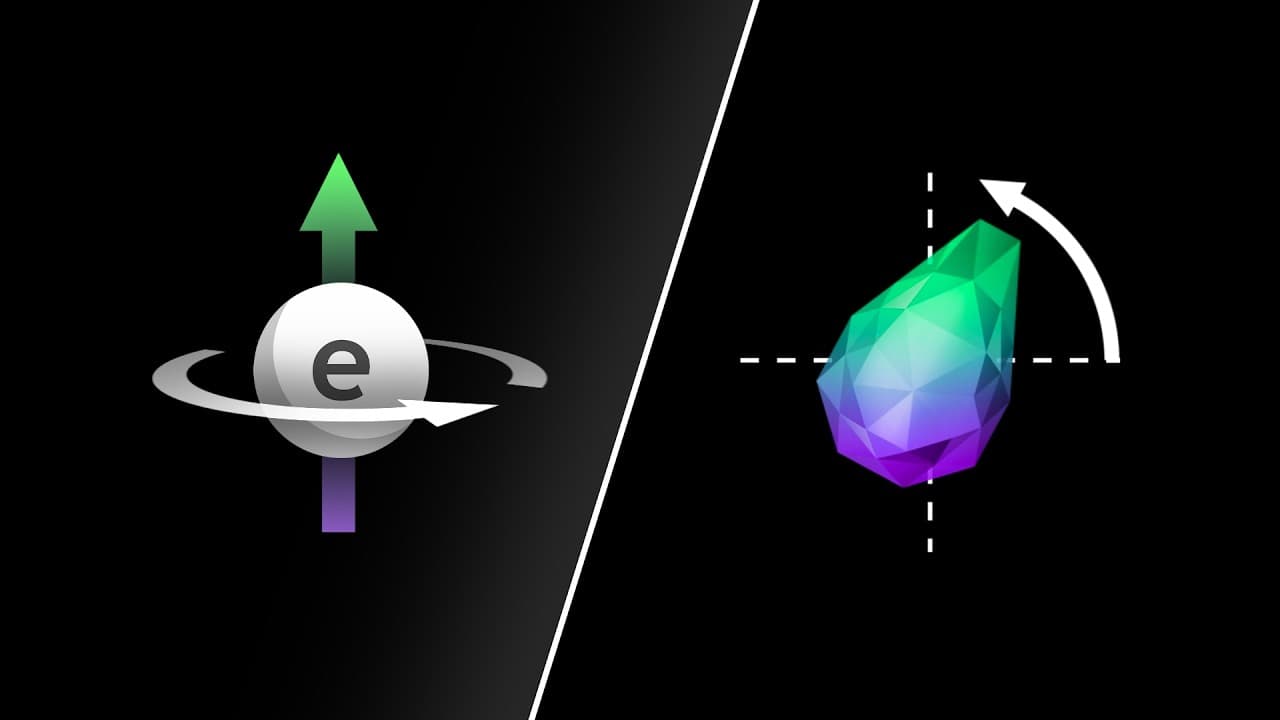
Particle spin is an intrinsic property affecting their behavior and interactions in quantum mechanics, categorized by spin numbers, including half-integer spins. This concept helps explain phenomena such as the splitting of electron beams in experiments like the Stern-Gerlach. Understanding spin requires advanced mathematics and illustrates the fundamental connections between geometry, particles, and their quantum states.
Transcript
welcome back to science click today spin at the fundamental scale matter is composed of particles that exist in different versions and which make up everything around us particles have properties a mass or an electric charge for instance which Define their behavior in 1922 the stern gar experiment identified a new property of particles when sending... Read More
Key Insights
- ❓ Particles are composed of spin, a vital property that impacts their interactions and classifications in quantum physics.
- 👥 The concept of groups and rotations helps describe the symmetries and transformations of particles in theoretical physics.
- 🦾 Quantum mechanics introduces mathematical complexities, permitting half-integer spin, which does not correspond to classical physics perceptions.
- 👻 Superposition allows particles to exist in multiple states, fundamentally changing our understanding of particle behavior and measurement.
- 🙂 Spin affects particle interactions, such as how light is polarized based on the spin state of photons, exemplifying the role of spin in practical applications.
- 🦻 The mathematical modeling of particles according to spin numbers aids physicists in predicting behaviors and interactions in advanced physics.
- ✋ High spin particles are essential for explaining phenomena in fields like particle and gravitational physics, emphasizing the connection between geometry and fundamental forces.
Install to Summarize YouTube Videos and Get Transcripts
Explore YouTube Video Summarizer or Get YouTube Transcript Extractor
Questions & Answers
Q: What is spin in the context of quantum physics?
Spin is an intrinsic property of particles that describes their angular momentum, influencing their behavior and interactions. It's not visually observed like classical rotation but quantified mathematically, affecting how particles behave in experiments. For instance, electrons have a spin of 1/2, meaning they require two full rotations to return to their original state.
Q: What was the significance of the Stern-Gerlach experiment?
The Stern-Gerlach experiment demonstrated that particles like electrons exhibit quantized spin states, experiencing deflection in a magnetic field. This experiment revealed the discrete nature of particle properties and led to the understanding that electrons have an intrinsic spin, which plays a crucial role in quantum mechanics and atomic structure.
Q: How do different spin numbers affect particle classification?
Particles can have various spin numbers, such as 0, 1, 2, or 1/2, which categorize their behaviors during rotations. For example, a spin 0 particle remains unchanged under rotation, while a spin 1 particle shows directional properties. Spin 1/2 particles like electrons display unique behaviors, complicating their descriptions and interactions.
Q: What is the difference between classical and quantum particle states?
In classical physics, objects have defined states and behaviors upon rotations. In quantum mechanics, particles can exist in superpositions, where they represent multiple potential states simultaneously until measured. This leads to scenarios where particles like electrons can appear in two states, highlighting the probabilistic nature of quantum mechanics.
Summary & Key Takeaways
-
The concept of spin in particles, an intrinsic property, influences their behavior in experimental physics, like in the Stern-Gerlach experiment.
-
Spin numbers classify particles, with integer values representing different rotational behaviors and half-integer spin indicating unique quantum states.
-
Understanding spin requires complex mathematics and the notion of superposition, culminating in explanations of particles like electrons, photons, and potential interactions in relativity.
Read in Other Languages (beta)
Share This Summary 📚
Summarize YouTube Videos and Get Video Transcripts with 1-Click
Try YouTube Summary with ChatGPT & Claude or YouTube Transcript Generator
Explore More Summaries from ScienceClic English 📚


Summarize YouTube Videos and Get Video Transcripts with 1-Click
Try YouTube Summary with ChatGPT & Claude or YouTube Transcript Generator