Quantum Field Theory visualized
TL;DR
Quantum field theory describes the evolution of particles over time by treating them as waves of probability, and it reconciles quantum mechanics with special relativity.
Transcript
welcome back to science clique today quantum field theory unlike a marble which has a definite position at the microscopic scale a particle does not really have a position its presence is distributed throughout space with more or less probability this description of particles as waves of probability is called quantum mechanics quantum mechanics all... Read More
Key Insights
- 🏑 Quantum field theory treats particles as disturbances within a field, allowing for the evolution of particles over time.
- 🏑 Special relativity imposes symmetries on the field in quantum field theory, restricting the types of mathematical objects that can be used.
- 💱 Quantum field theory explains how forces arise from the interactions between particles through the exchange of virtual particles.
- 🏑 The standard model of particle physics is a collection of fields that make up the content of our universe in quantum field theory.
- 🏑 Quantum field theory is successful in predicting phenomena with astounding precision, but it remains incomplete as it cannot be unified with general relativity.
- 👨🔬 Scientists are still searching for a unified theory that can explain the curvature of space-time and reconcile gravity with quantum mechanics.
- 🛰️ Quantum field theory allows for the prediction of phenomena in curved space times, such as the evaporation of black holes.
Install to Summarize YouTube Videos and Get Transcripts
Explore YouTube Video Summarizer or Get YouTube Transcript Extractor
Questions & Answers
Q: What is quantum field theory?
Quantum field theory is a mathematical framework that describes particles as disturbances within a field, allowing for the evolution of particles over time and reconciling quantum mechanics with special relativity.
Q: How does quantum field theory reconcile quantum mechanics with special relativity?
Quantum field theory builds a more general mathematical framework that takes into account situations where the number of particles varies over time and treats particle families as coherent entities, unlike quantum mechanics which treats particles independently.
Q: What are the symmetries imposed by special relativity?
Special relativity imposes symmetries of translation, rotation, and changing frame of reference in space-time, which restrict the types of mathematical objects that can be used to fill the field in quantum field theory.
Q: How does quantum field theory describe interactions between particles?
Quantum field theory allows particles to interact by exchanging momentum through the exchange of virtual particles, resulting in forces such as the electromagnetic force.
Key Insights:
- Quantum field theory treats particles as disturbances within a field, allowing for the evolution of particles over time.
- Special relativity imposes symmetries on the field in quantum field theory, restricting the types of mathematical objects that can be used.
- Quantum field theory explains how forces arise from the interactions between particles through the exchange of virtual particles.
- The standard model of particle physics is a collection of fields that make up the content of our universe in quantum field theory.
- Quantum field theory is successful in predicting phenomena with astounding precision, but it remains incomplete as it cannot be unified with general relativity.
- Scientists are still searching for a unified theory that can explain the curvature of space-time and reconcile gravity with quantum mechanics.
- Quantum field theory allows for the prediction of phenomena in curved space times, such as the evaporation of black holes.
- Quantum field theory presents a promising avenue for understanding the microscopic nature of our universe, but it requires further exploration and development.
Summary & Key Takeaways
-
Quantum mechanics describes particles as waves of probability, but it fails to consider situations where the number of particles varies over time or the behavior of particle families.
-
Quantum field theory builds a more general mathematical framework to reconcile quantum mechanics with special relativity.
-
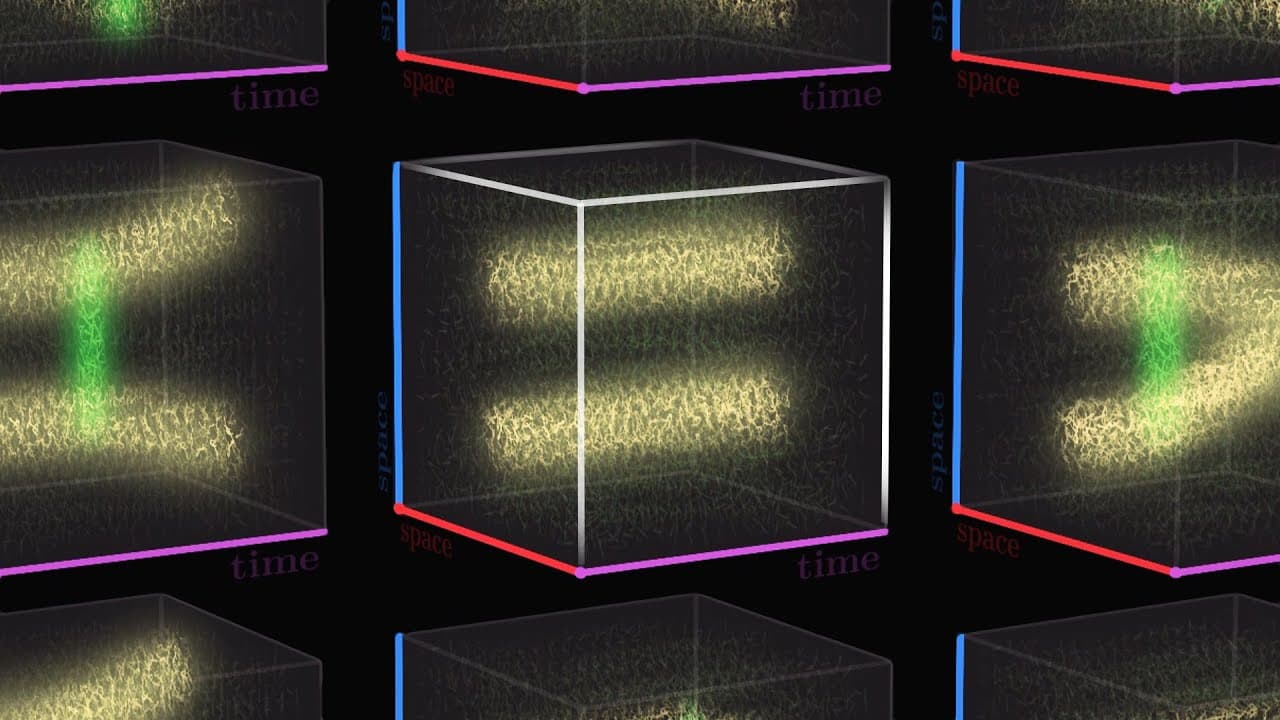
In quantum field theory, a field fills all of space-time, and particles are disturbances within that field.
Read in Other Languages (beta)
Share This Summary 📚
Summarize YouTube Videos and Get Video Transcripts with 1-Click
Try YouTube Summary with ChatGPT & Claude or YouTube Transcript Generator
Explore More Summaries from ScienceClic English 📚


Summarize YouTube Videos and Get Video Transcripts with 1-Click
Try YouTube Summary with ChatGPT & Claude or YouTube Transcript Generator