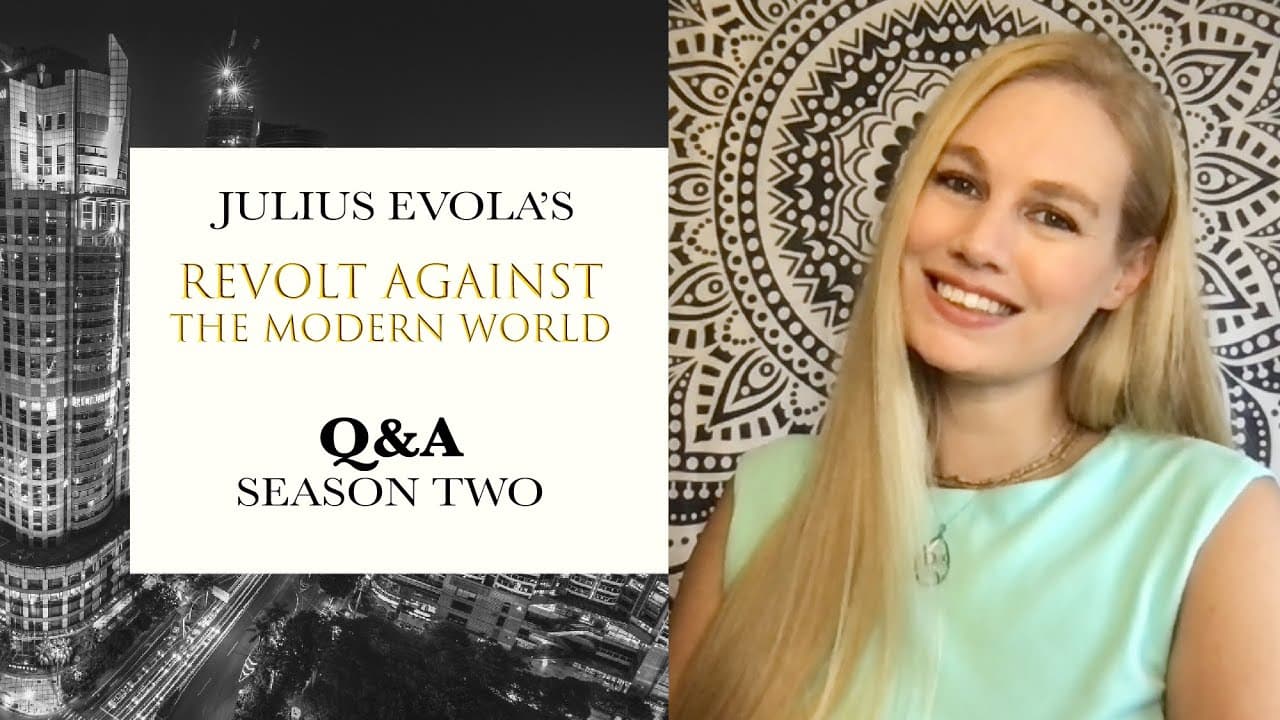
Julius Evola's Revolt Against the Modern World - Q&A Season 2
TL;DR
This content explores the significance and dangers of rituals in traditional spiritual practices.
Transcript
hi everyone how are you today i'm really excited to answer your questions today and my apologies that it has taken so long to get this video made i have like half a dozen excuses that all sound really good in my head but i think would no doubt sound very lame if i spoke them out loud so all i can say is thanks for your patience um this is going to ... Read More
Key Insights
- 🫨 Rituals are viewed as a transformative means of connecting with the divine, akin to music that harmonizes participants with spiritual forces.
- 💍 Purification is critical for individuals aiming to engage with the divine through rites, establishing a standard for spiritual preparedness.
- 🎭 Spiritual hierarchies within traditional practices dictate who is eligible to perform rites, emphasizing ancestral superiority and divine lineage.
- 👔 Spiritual ties hold primacy over blood ties, as shared spiritual values can surpass familial connections in determining relationships and community.
- 📈 Downward paths of transcendence are regarded as less legitimate compared to upward paths that align with divine will and spiritual ascent.
- 🍓 The concept of the newman represents an abstract spiritual essence underlying traditional deities, offering a critical distinction between personal gods and raw spiritual energies.
- 👪 The relationship between the daemon and the totem illustrates how individual consciousness is linked to family and collective ancestral energies, affecting posthumous existence.
Install to Summarize YouTube Videos and Get Transcripts
Explore YouTube Video Summarizer or Get YouTube Transcript Extractor
Questions & Answers
Q: What is the primary purpose of performing rituals in traditional practices?
The primary purpose of rituals is to elevate one's consciousness and connect with divine entities, not to manipulate or control them. Each rite serves as a means to harmonize the participant's being with the spiritual realm, effectively raising one's awareness and aligning them with higher truths. The act of engaging in a ritual can transform the individual and their environment, enabling a harmonious exchange with the divine.
Q: Why were certain castes restricted from participating in rites historically?
Historically, only individuals from specific castes could engage in sacred rites due to their ancestral divine connections. Those of priestly lineage were believed to have the inherent qualities required for such spiritual practices, while individuals from lower castes lacked the necessary purity or divine ancestry, thus prohibiting their participation. This differentiation highlights the importance of lineage and initiation in traditional spiritual systems.
Q: What are the spiritual implications of performing a rite incorrectly?
The incorrect performance of a rite poses significant spiritual dangers, including the invocation of chaos and harm to the divine entities involved. An improperly conducted rite may disrupt the intended divine order, resulting in spiritual backlash against the practitioner. Such errors can lead to significant consequences, including spiritual deterioration and the loss of divine favor, underscoring the need for precision in ritual practice.
Q: How does the idea of ancestors and lineage influence spiritual paths?
The status of ancestors and lineage plays a crucial role in shaping spiritual paths, with the belief that individual potential is often linked to one's divine ancestors. The spiritual connection to ancestors can enhance one’s ability to engage in higher spiritual practices. However, focusing solely on ancestral connections can limit one's potential progress; thus, aspiring for spiritual heroism is emphasized to elevate not just oneself but also one's ancestral lineage.
Summary & Key Takeaways
-
The content elaborates on the nature of rights as bonding experiences with the divine, emphasizing that they raise one’s consciousness rather than summoning lower entities.
-
It discusses the purity required for participating in rituals, highlighting that only those with a divine lineage can partake in certain rites, setting a clear spiritual hierarchy.
-
The potential consequences of improperly performed rites are detailed, addressing spiritual risks and the overall decline of traditional practices in contemporary societies.
Read in Other Languages (beta)
Share This Summary 📚
Summarize YouTube Videos and Get Video Transcripts with 1-Click
Try YouTube Summary with ChatGPT & Claude or YouTube Transcript Generator
Explore More Summaries from PhilosophiCat 📚
Summarize YouTube Videos and Get Video Transcripts with 1-Click
Try YouTube Summary with ChatGPT & Claude or YouTube Transcript Generator