Basic Operation on Discrete Time Signals (Problem 4) | Representation of Signals | Signals & Systems
TL;DR
Exploring operations on discrete-time signals through graph manipulation and mathematical transformations.
Transcript
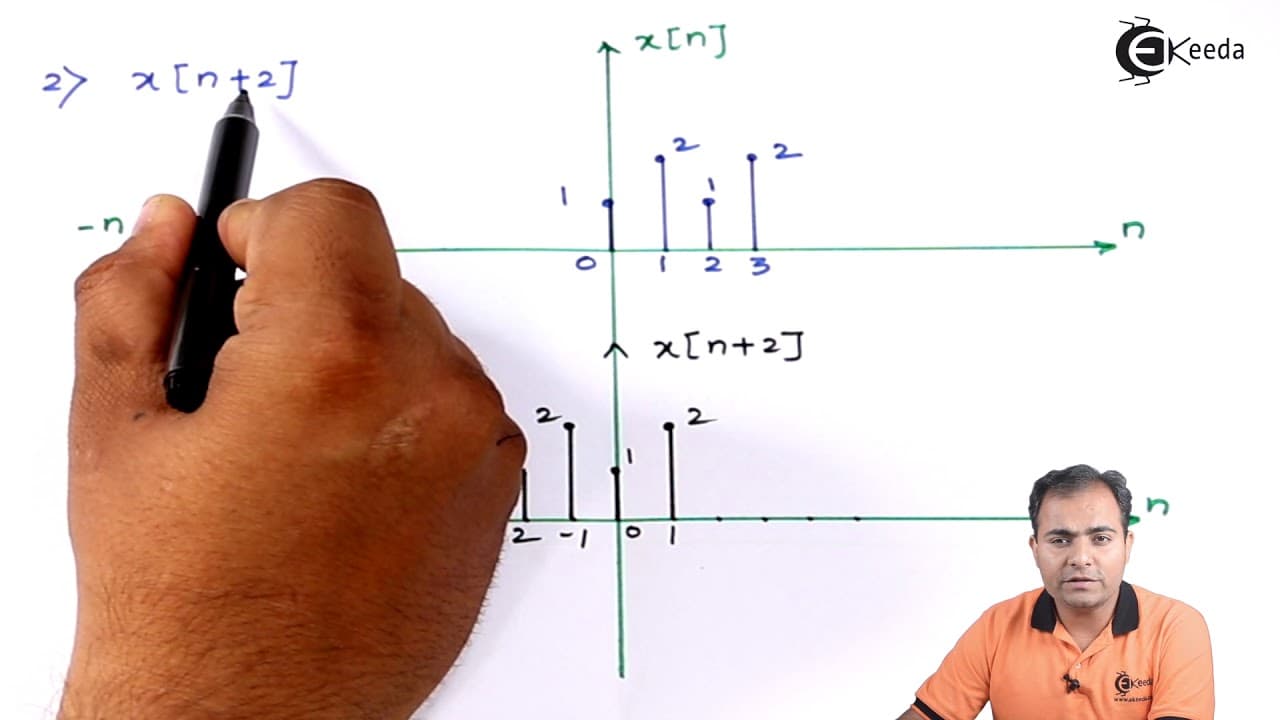
click the bell icon to get latest videos from akira other friends and today they are going to study the next part that is a problem number four on discrete-time signals now in this case one graph is already given which is exiting and we have to perform some different operations on X of n now what are those let's see the problem number four well in ... Read More
Key Insights
- ⌛ Graph manipulation and sequence analysis are fundamental in dissecting discrete-time signals for mathematical operations.
- 🖐️ Operations like time shifting and amplitude scaling play a crucial role in signal manipulation and problem-solving.
- ⌛ Understanding the principles of discrete-time signals and their graphical representations is essential for effective analysis and interpretation.
- ⌛ Mathematical transformations on discrete-time signals involve intricate calculations and sequence adjustments for accurate problem-solving.
- 📡 Exploring various operations on discrete-time signals enhances mathematical proficiency and problem-solving skills in signal analysis.
- 📡 Graph plotting is a vital aspect of analyzing discrete-time signals, aiding in visual representation and manipulation of signal properties.
- ⌛ Time scaling and amplitude adjustments are core components of transforming discrete-time signals for mathematical analysis.
Install to Summarize YouTube Videos and Get Transcripts
Explore YouTube Video Summarizer or Get YouTube Transcript Extractor
Questions & Answers
Q: How are operations performed on discrete-time signals in problem number four?
In problem number four, operations like multiplying sequences, advancing functions, time shifting, and amplitude scaling are carried out to manipulate discrete-time signals for analysis and problem-solving.
Q: What does it mean when the graph is delayed in the context of discrete-time signals?
When the graph is delayed, it signifies shifting the graph towards the right or left hand side by altering the time instances of the sequence for visualization and computation purposes.
Q: How is amplitude scaling accomplished in the context of problem number four?
Amplitude scaling involves multiplying the amplitudes of discrete-time signals by a scalar value to adjust the strength or magnitude of the signal while maintaining the overall shape and structure of the signal.
Q: How are mathematical transformations utilized in analyzing discrete-time signals in problem solving?
Mathematical transformations such as time shifting, amplitude scaling, and sequence manipulation are crucial tools in problem-solving involving discrete-time signals, allowing for in-depth analysis and interpretation of signal behavior.
Summary & Key Takeaways
-
Analyzing problem number four of discrete-time signals involving graph plotting and sequence manipulation.
-
Operations include multiplying sequences, advancing functions, performing time shifting, and amplitude scaling.
-
Demonstrates complex mathematical operations on discrete-time signals for problem-solving.
Read in Other Languages (beta)
Share This Summary 📚
Summarize YouTube Videos and Get Video Transcripts with 1-Click
Try YouTube Summary with ChatGPT & Claude or YouTube Transcript Generator
Explore More Summaries from Ekeeda 📚



Summarize YouTube Videos and Get Video Transcripts with 1-Click
Try YouTube Summary with ChatGPT & Claude or YouTube Transcript Generator