Thermodynamics: Mechanical Equivalent of Heat
TL;DR
James Joule studied how mechanical work converts to heat energy, determining specific heat values.
Transcript
so today's video is the mechanical equivalent of heat now that might not be the best title for this video I'm going to show you what might be a better title in just a moment but please don't forget before we get started to subscribe to my channel step-by-step signs get all my excellent physics chemistry and math videos of course you can give me a t... Read More
Key Insights
- 🥵 James Joule discovered the relationship between mechanical work and heat energy, leading to the concept of specific heat values.
- 🥵 The mechanical work equivalent of heat involves converting potential energy to kinetic energy through friction, resulting in heat production.
- 🥵 Specific heat values determine the amount of energy needed to change the temperature of a substance, such as water.
- ❓ Joule's experiments with energy conversion contributed to the understanding of energy conservation principles.
- 😚 Mechanical work converting to heat energy exemplifies the transfer of energy within a closed system.
- 🥵 Specific heat values are essential in calculating the energy required for temperature changes in various substances.
- 🥵 The mechanical equivalent of heat can be applied to determine the energy needed for processes like boiling water.
Install to Summarize YouTube Videos and Get Transcripts
Explore YouTube Video Summarizer or Get YouTube Transcript Extractor
Questions & Answers
Q: Who is credited with discovering the mechanical work equivalent of heat?
James Prescott Joule is credited with discovering the mechanical work equivalent of heat in the 1850s through his experiments with energy conversion.
Q: How did Joule measure the conversion of mechanical work to heat energy?
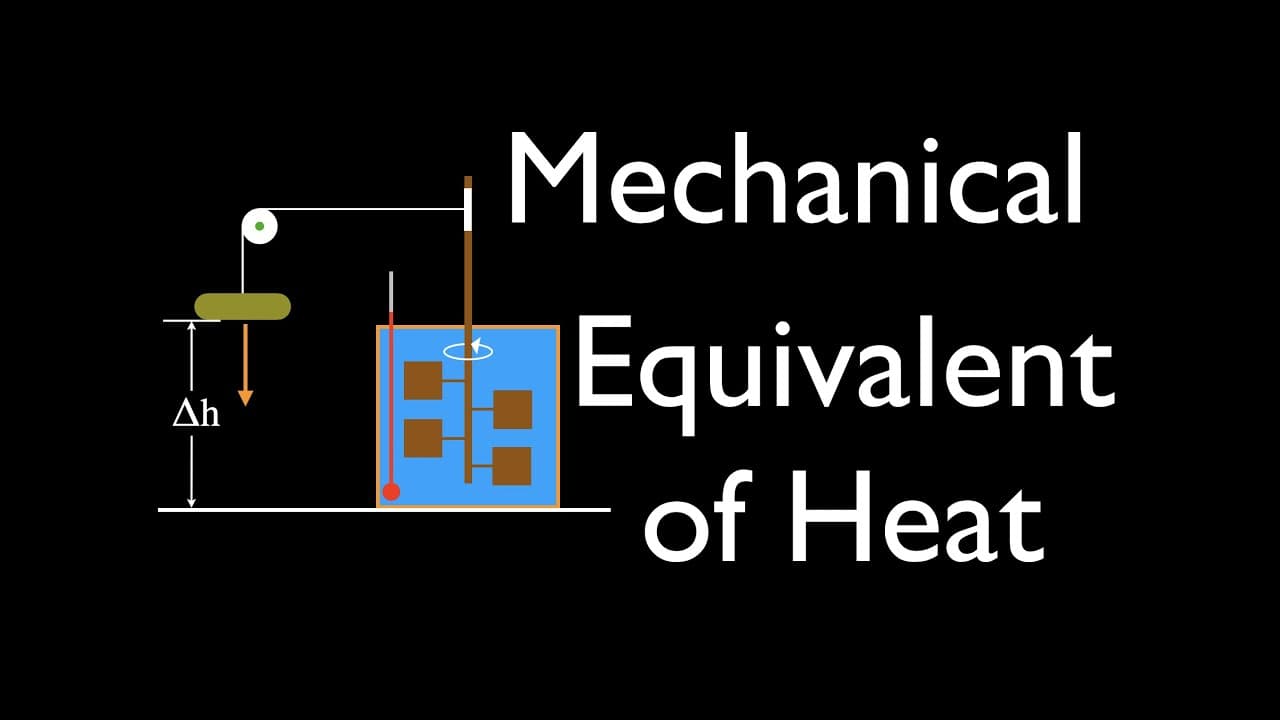
Joule used an apparatus with water, paddles, and a thermometer to measure the change in temperature as mechanical work was converted to heat energy through friction.
Q: What is the significance of specific heat in Joule's experiments?
Specific heat determines the amount of energy required to change the temperature of a certain mass by a certain degree, a value crucial in understanding the mechanical equivalent of heat.
Q: How does the mechanical equivalent of heat relate to conservation of energy?
The mechanical equivalent of heat shows the conservation of energy principle, where the energy lost by a falling mass is converted to heat energy, maintaining the total energy in the system.
Summary & Key Takeaways
-
James Joule discovered the mechanical work equivalent of heat by converting energy to heat through friction.
-
Using an apparatus with water and paddles, he measured the change in temperature to determine specific heat values.
-
Joule's work led to the relationship between mechanical work, energy, and heat, establishing the concept of specific heat.
Read in Other Languages (beta)
Share This Summary 📚
Summarize YouTube Videos and Get Video Transcripts with 1-Click
Try YouTube Summary with ChatGPT & Claude or YouTube Transcript Generator
Explore More Summaries from Step by Step Science 📚


Summarize YouTube Videos and Get Video Transcripts with 1-Click
Try YouTube Summary with ChatGPT & Claude or YouTube Transcript Generator