IIT JEE complex numbers (part 2) | Imaginary and complex numbers | Precalculus | Khan Academy
TL;DR
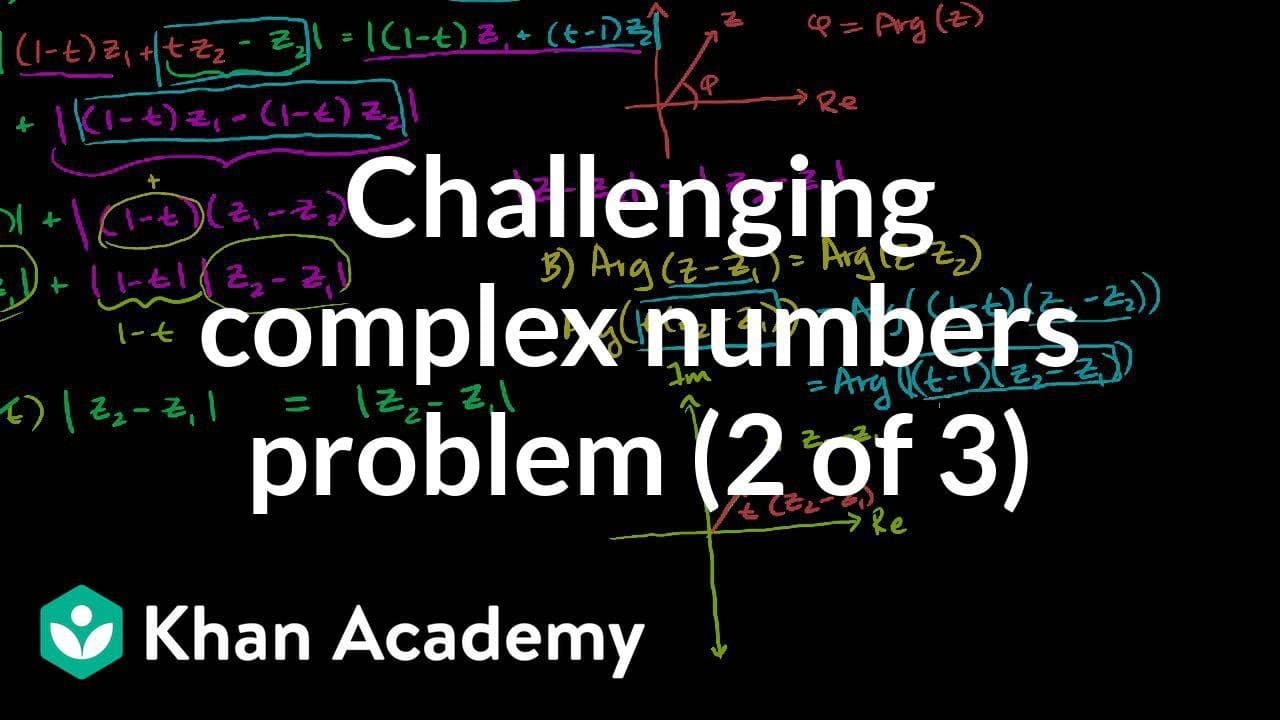
The video discusses the equivalence of arguments in complex numbers and disproves choice B while proving choice D.
Transcript
In the last video, we saw that choice A is true. Now let's see if B, C, and D are also true. So choice B, they're telling us that the argument, let me rewrite it over here-- I'll do it in another color, their choice B is telling us that the argument of z minus z1 is equal to the argument of z minus z2. Now let's think about this a little bit. We al... Read More
Key Insights
- 🛀 The presenter disproves choice B by showing that the argument of t times z2 minus z1 is not equal to the argument of t minus 1 times z2 minus z1.
- 👻 The Argand diagram allows for a geometric understanding of complex numbers and their arguments.
- 👍 Choice D is proven to be true through the comparison of arguments using an Argand diagram.
- 🖐️ Algebraic simplification and geometric reasoning play crucial roles in analyzing complex number arguments.
- #️⃣ Understanding the properties of complex numbers and their geometric interpretations is essential in solving problems involving arguments.
- #️⃣ The presenter demonstrates the usefulness of graphical representations, such as the Argand diagram, in understanding complex number concepts.
- 👎 By disproving choice B and proving choice D, the presenter establishes the importance of careful analysis and mathematical reasoning.
Install to Summarize YouTube Videos and Get Transcripts
Explore YouTube Video Summarizer or Get YouTube Transcript Extractor
Questions & Answers
Q: What does choice B claim about the arguments of two complex numbers?
Choice B claims that the argument of z minus z1 is equal to the argument of z minus z2. To disprove this claim, the presenter simplifies the expression and shows that the arguments are not equivalent.
Q: What does choice D state about the arguments of complex numbers?
Choice D states that the argument of z minus z1 is equal to the argument of z2 minus z1. The presenter uses an Argand diagram to visualize the vectors and establishes that the arguments are indeed equivalent.
Q: How does the presenter simplify the expression for z minus z1?
The presenter simplifies z minus z1 to t times z2 minus z1, leveraging previous algebraic work. By doing this, the problem is transformed into comparing the arguments of two expressions involving t and z2 minus z1.
Q: Why does the presenter use an Argand diagram to analyze the arguments?
An Argand diagram helps visualize complex numbers as vectors in the complex plane. By comparing the angles between vectors, the presenter can determine whether the arguments are equivalent.
Summary & Key Takeaways
-
In the video, the presenter analyzes choice B, which suggests that the argument of z minus z1 is equal to the argument of z minus z2.
-
By simplifying the expressions and using algebraic properties, the presenter demonstrates that choice B is not true.
-
The presenter then moves on to analyze choice D, which states that the argument of z minus z1 is equal to the argument of z2 minus z1.
-
Using an Argand diagram and geometric reasoning, the presenter proves choice D to be true.
Read in Other Languages (beta)
Share This Summary 📚
Summarize YouTube Videos and Get Video Transcripts with 1-Click
Try YouTube Summary with ChatGPT & Claude or YouTube Transcript Generator
Explore More Summaries from Khan Academy 📚



Summarize YouTube Videos and Get Video Transcripts with 1-Click
Try YouTube Summary with ChatGPT & Claude or YouTube Transcript Generator