Products
Features
YouTube Video Summarizer
Summarize YouTube videos
Web & PDF Highlighter
Highlight web pages & PDFs
Chat with PDF
Ask any PDF questions with AI
Ask AI Clone
Chat with your highlights & memories
Audio Transcriber
Transcribe audio files to text
Glasp Reader
Read and highlight articles
Kindle Highlight Export
Export your Kindle highlights
Idea Hatch
Hatch ideas from your highlights
Integrations
Obsidian Plugin
Notion Integration
Pocket Integration
Instapaper Integration
Medium Integration
Readwise Integration
Snipd Integration
Hypothesis Integration
Apps & Extensions
Chrome Extension
Safari Extension
Edge Add-ons
Firefox Add-ons
iOS App
Android App
Discover
Discover
Ideas
Discover new ideas and insights
Articles
Curated articles and insights
Books
Book recommendations by great minds
Posts
Essays and notes from readers
Quotes
Inspiring quotes collection
Videos
Curated videos and summaries
Explore Glasp
Glasp Newsletter
Weekly insights and updates
Glasp Talk
Interview series with great minds
Glasp Blog
Latest news and articles
Glasp Use Cases
Learn how others use Glasp
Build & Support
Glasp API
Access Glasp's API for developers
MCP Connector
Connect Glasp to Claude & ChatGPT
Community
Glasp Reddit Community
Students
Student discount and benefits
FAQs
Frequently Asked Questions
AboutPricing
DashboardLog inSign up

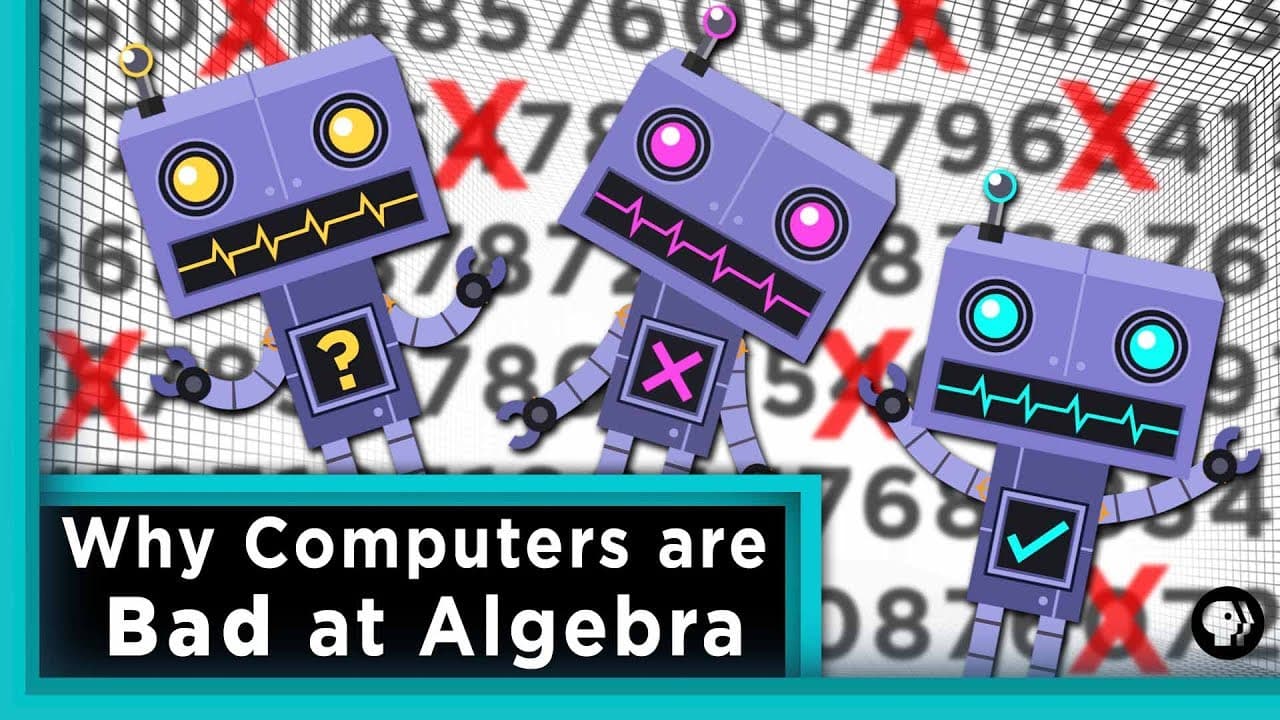
Why Computers are Bad at Algebra | Infinite Series
394.6K views
•
July 21, 2017
by
PBS Infinite Series
YouTube video player
Why Computers are Bad at Algebra | Infinite Series

TL;DR

Computers use binary to represent numbers, leading to precision trade-offs and intentional rounding.

Transcript

[MUSIC PLAYING] KELSEY HOUSTON-EDWARDS: People tend to think that computers are infallible when it comes to math. But computers make mistakes too, except they're deliberate mistakes, ones that computer scientists can exploit to develop faster computer algorithms. [THEME MUSIC] In 1994, Intel recalled, to the tune of $475 million, an early model of ... Read More

Key Insights

  • 💨 Computers exploit binary representation for faster algorithms.
  • ⚾ Binary numbers have different properties compared to base 10.
  • 😥 Trade-offs in size and precision exist in floating-point numbers.
  • 🥺 Intentional rounding in computer arithmetic can lead to errors.
  • 😥 IEEE 754 sets standards for floating-point numbers.
  • 🧑‍💼 Precision trade-offs are crucial in computer arithmetic.
  • 🫥 Understanding computer number line structure is essential for efficient computing.

Install to Summarize YouTube Videos and Get Transcripts

Explore YouTube Video Summarizer or Get YouTube Transcript Extractor

Questions & Answers

Q: Why do computers make deliberate arithmetic mistakes?

Computers exploit intentional rounding and the binary number line structure to develop faster algorithms by making calculated errors.

Q: How do computers represent numbers differently from base 10?

Computers use binary numbers with increasing powers of 2 to represent digits, leading to trade-offs in size and precision compared to base 10.

Q: What trade-offs exist in floating-point numbers on computers?

Floating-point numbers on computers have a restricted number of significant digits, leading to accurate representation of small numbers but less precision for large numbers.

Q: Why do 0.1 plus 0.1 not equal 0.2 on a computer?

Computers round numbers that are not representable on their number line, leading to surprising errors like 0.1 not being accurately represented.

Summary & Key Takeaways

  • Computers make deliberate arithmetic mistakes due to their unique binary number line structure.

  • Binary numbers in computers have a different representation than in base 10.

  • Trade-offs between size and precision exist in floating-point numbers on computers.


Read in Other Languages (beta)

English

Share This Summary 📚

Summarize YouTube Videos and Get Video Transcripts with 1-Click

Download browser extensions on:

Try YouTube Summary with ChatGPT & Claude or YouTube Transcript Generator

Explore More Summaries from PBS Infinite Series 📚
Topology Riddles | Infinite Series thumbnail
Topology Riddles | Infinite Series
PBS Infinite Series
How Many Humans Have the Same Number of Body Hairs? | Infinite Series | PBS Digital Studios thumbnail
How Many Humans Have the Same Number of Body Hairs? | Infinite Series | PBS Digital Studios
PBS Infinite Series
Splitting Rent with Triangles | Infinite Series thumbnail
Splitting Rent with Triangles | Infinite Series
PBS Infinite Series
This Video was Not Encrypted with RSA | Infinite Series thumbnail
This Video was Not Encrypted with RSA | Infinite Series
PBS Infinite Series
Building an Infinite Bridge | Infinite Series thumbnail
Building an Infinite Bridge | Infinite Series
PBS Infinite Series
Can a Chess Piece Explain Markov Chains? | Infinite Series thumbnail
Can a Chess Piece Explain Markov Chains? | Infinite Series
PBS Infinite Series

Summarize YouTube Videos and Get Video Transcripts with 1-Click

Download browser extensions on:

Try YouTube Summary with ChatGPT & Claude or YouTube Transcript Generator

Apps & Extensions

  • Chrome Extension
  • Safari Extension
  • Edge Add-ons
  • Firefox Add-ons
  • iOS App
  • Android App

Key Features

  • YouTube Video Summarizer
  • Web & PDF Summarizer
  • Web & PDF Highlighter
  • Chat with PDF
  • Ask AI Clone
  • Audio Transcriber
  • Glasp Reader
  • Kindle Highlight Export
  • Idea Hatch

Integrations

  • Obsidian Plugin
  • Notion Integration
  • Pocket Integration
  • Instapaper Integration
  • Medium Integration
  • Readwise Integration
  • Snipd Integration
  • Hypothesis Integration

More Features

  • APIs
  • MCP Connector
  • Blog & Post
  • Embed Links
  • Image Highlight
  • Personality Test
  • Quote Shots

Company

  • About us
  • Blog
  • Community
  • FAQs
  • Job Board
  • Newsletter
  • Pricing
Terms

•

Privacy

•

Guidelines

© 2026 Glasp Inc. All rights reserved.