Why Is the Sum of Rational and Irrational Numbers Irrational?
TL;DR
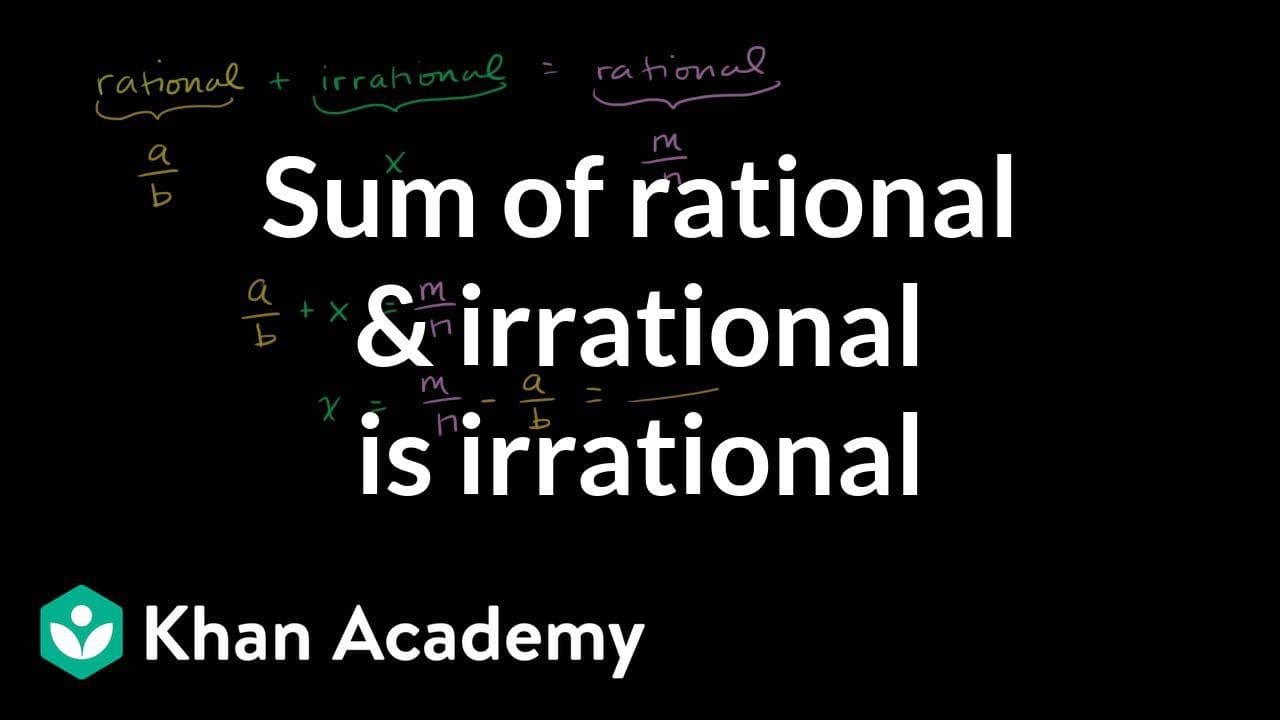
When a rational number is added to an irrational number, the result is always irrational. Assuming their sum is rational leads to a contradiction, as it implies the irrational number can be expressed as a ratio of integers, which is impossible. Therefore, the sum cannot be rational.
Transcript
So I'm curious as to what happens if I were to take a rational number and I were to add it to an irrational number. Is the resulting number going to be rational or irrational? Well, to think about this, let's just assume it's going to be rational and then see if this leads to any form of contradiction. So let's assume that this is going to give us ... Read More
Key Insights
- 🥺 Assuming that the sum of a rational and an irrational number is rational leads to a contradiction.
- 🥳 By expressing the sum as the ratio of two integers, it can be shown that the irrational number can be represented as a ratio, contradicting its irrationality.
- ❓ The product of two integers is always an integer, and the difference of two integers is also an integer.
- 🍹 Consequently, if the sum were rational, it would contradict the irrationality of the original irrational number.
- 🍹 Therefore, the correct conclusion is that the sum of a rational and an irrational number is always irrational.
- #️⃣ This concept has important implications in mathematics and helps define the nature of irrational numbers.
- 🎮 The proof provided in the video demonstrates the logical reasoning behind this conclusion.
Install to Summarize YouTube Videos and Get Transcripts
Explore YouTube Video Summarizer or Get YouTube Transcript Extractor
Questions & Answers
Q: What is the assumption made in the video?
The assumption made is that the sum of a rational number and an irrational number is a rational number.
Q: What happens when the assumption is subtracted from both sides of the equation?
When the assumption is subtracted from both sides, it leads to the expression x = m/n - a/b, which can be simplified to x = (nb - na) / (n * b).
Q: How does the contradiction arise?
The contradiction arises when it is realized that the expression (nb - na) / (n * b) is a rational number, meaning that the assumption that x is irrational was incorrect.
Q: What does the contradiction prove?
The contradiction proves that the original assumption is false and that, in fact, the sum of a rational and an irrational number is always irrational.
Summary & Key Takeaways
-
The video explores what happens when a rational number is added to an irrational number and whether the resulting sum is rational or irrational.
-
The assumption is made that the sum is rational, and a contradiction is derived.
-
The contradiction proves that the original assumption is false, and therefore, a rational plus an irrational must be irrational.
Read in Other Languages (beta)
Share This Summary 📚
Summarize YouTube Videos and Get Video Transcripts with 1-Click
Try YouTube Summary with ChatGPT & Claude or YouTube Transcript Generator
Explore More Summaries from Khan Academy 📚



Summarize YouTube Videos and Get Video Transcripts with 1-Click
Try YouTube Summary with ChatGPT & Claude or YouTube Transcript Generator