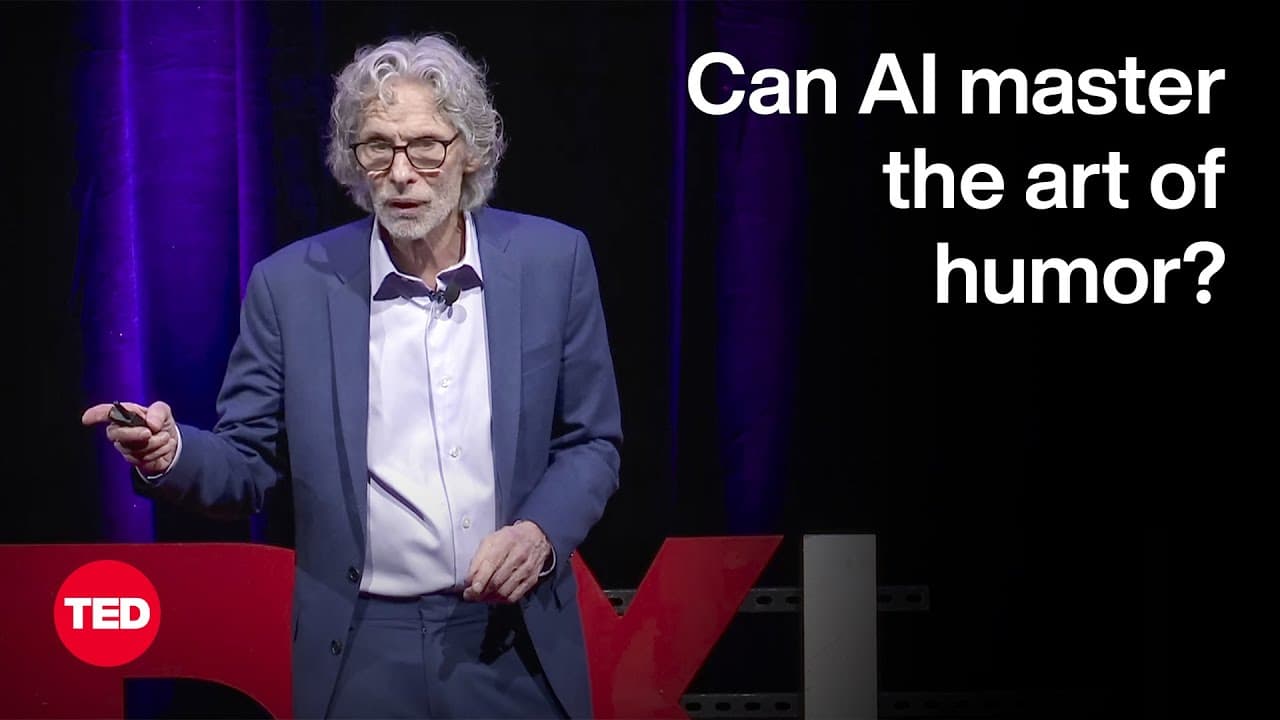
Can AI Really Understand Humor and Create Jokes?
TL;DR
AI can analyze and assist in humor creation, but it struggles to fully grasp the underlying human experiences and vulnerabilities that make humor resonate. While AI has made strides in understanding jokes, true creativity and humor remain uniquely human, as they are deeply rooted in emotional depth and societal contexts.
Transcript
Whether you're thrilled by what AI can do for us or terrified by what AI is going to do to us, whether it can be funny, is probably not top of mind for you. It is for me. I don't care if it turns all of us into paperclips, as long as they're funny paper clips. (Laughter) And the fact that it makes stuff up, hallucinates, for me, that's not a bug, t... Read More
Key Insights
- 💄 Humor is a complex interplay of cognitive theories, culture, and individual experiences, making it difficult for AI to replicate.
- 😨 Historical fears about machines and AI reflecting a cultural context inform contemporary debates about technology's role in society.
- ❓ AI has advanced significantly but still struggles with tasks requiring deep understanding and human nuances, such as humor.
- 🏆 The New Yorker caption contest provides a fascinating case study of human-AI collaboration in creativity, showcasing the strengths and limitations of both.
- 🖤 Creating humor is tied to emotional depth and human vulnerability, aspects that AI currently lacks.
- 🔇 The speaker humorously implies that AI should not replace human creativity, but rather support it as a tool.
- ❓ The relationship between technology and humor reflects broader societal anxieties regarding advancements in AI.
Install to Summarize YouTube Videos and Get Transcripts
Explore YouTube Video Summarizer or Get YouTube Transcript Extractor
Questions & Answers
Q: How does the speaker view the potential for AI to create humor?
The speaker finds the idea of AI producing humor intriguing but recognizes that while AI can assist in brainstorming and generating content, it lacks the genuine emotional depth and human experiences that shape true humor. The speaker appreciates AI's advancements but ultimately believes it cannot fully replicate the nuances of human comedy rooted in vulnerability.
Q: What are the main theories of humor mentioned in the content?
The speaker discusses several theories, including the superiority theory, which relates to feeling superior to others; the incongruity theory, which focuses on mismatches in context; and the benign violation theory, which suggests humor arises when something feels just wrong enough to be funny. Each theory provides insights into different aspects of humor and how it is perceived.
Q: What role does crowdsourcing play in the New Yorker caption contest?
Crowdsourcing has revolutionized the New Yorker caption contest by allowing online voting on captions. This method gathers a wealth of humor judgments from a broad audience, enabling better selection of finalists. Although the speaker expresses skepticism about mob rule, they acknowledge that the process generally yields high-quality captions that resonate with viewers.
Q: How does the speaker suggest using AI in the creative process?
The speaker proposes that AI can serve as a valuable brainstorming tool for artists and cartoonists. By analyzing successful past submissions and refining them, AI can enhance creativity. However, the speaker emphasizes the importance of having a human in the loop to guide and refine the outputs, ensuring quality amidst quantity in creative endeavors.
Summary & Key Takeaways
-
The speaker humorously examines AI's capabilities in the context of creativity, particularly in creating and understanding humor, suggesting that there may be potential for AI to generate jokes.
-
Historical perspectives on the fears surrounding machines replacing humans are discussed, with references to famous figures like Norbert Wiener and Elon Musk, emphasizing that concerns over AI are not new.
-
Insights from the New Yorker caption contest reveal how AI can assist but still fall short in replicating human creativity, as true humor is rooted in human experiences and vulnerabilities.
Read in Other Languages (beta)
Share This Summary 📚
Summarize YouTube Videos and Get Video Transcripts with 1-Click
Try YouTube Summary with ChatGPT & Claude or YouTube Transcript Generator
Explore More Summaries from TED 📚





Summarize YouTube Videos and Get Video Transcripts with 1-Click
Try YouTube Summary with ChatGPT & Claude or YouTube Transcript Generator