RLC Circuits (15 of 19) Parallel RC; An Explanation, Current, Impedance and Admittance
TL;DR
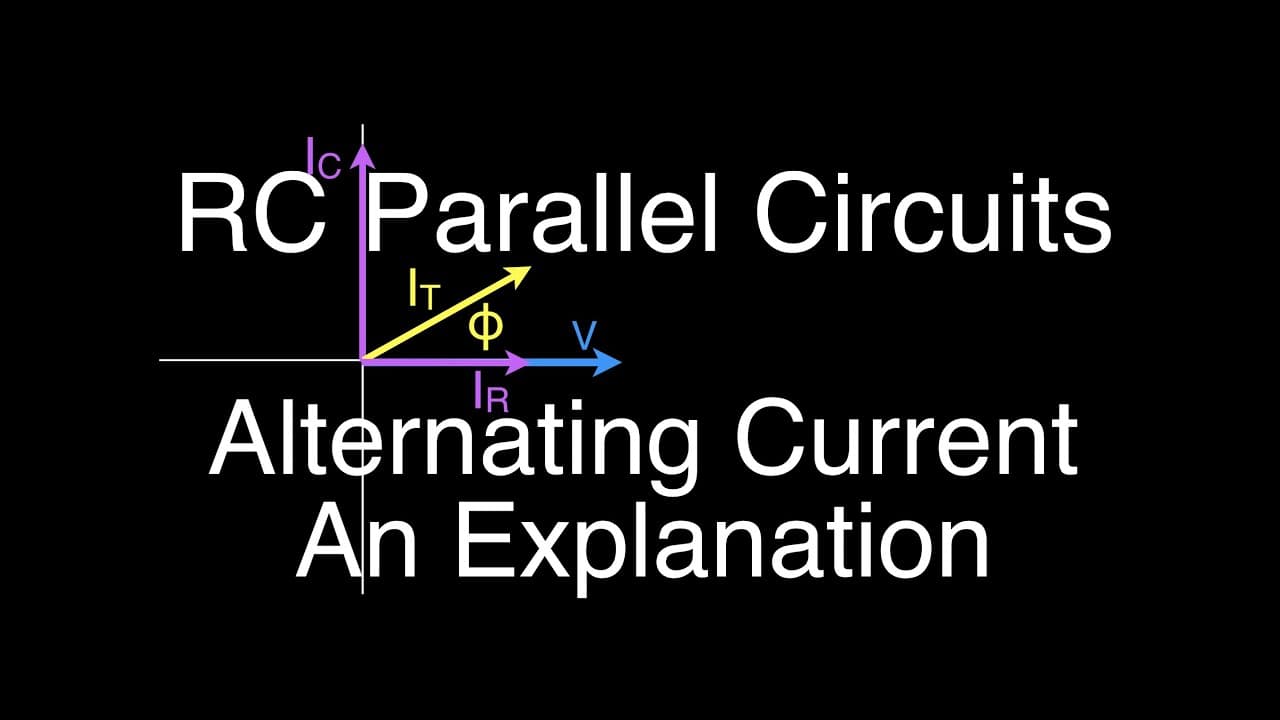
Explanation of RC parallel circuits with AC source, including current phasor diagrams, impedance calculations, and admittance triangles.
Transcript
today's video is all about RC parallel circuits with an AC voltage source now I've already made a bunch of videos which are linked in the upper right hand corner for RLC series circuits this is the first for the RLC parallel this is gonna be our C that we're in to our L and I'm gonna do our LC alright now this video is just an explanation for RC th... Read More
Key Insights
- 🪜 Total current in an RC parallel circuit is found by vectorially adding currents through the resistor and capacitor.
- ⚡ Impedance is calculated by dividing the source voltage by the total current in the circuit.
- ❓ Admittance in parallel circuits is the reciprocal of impedance, representing how much current is admitted by the circuit.
- 🤩 Conductance and susceptance are key components in calculating admittance in parallel circuits.
- ⚡ Phase angle determines the relationship between current and voltage in RC parallel circuits.
- 🔺 Admittance triangle can be used to visualize and calculate admittance in parallel circuits.
- ❓ Pythagorean theorem can be applied to find total current and impedance in RC parallel circuits.
Install to Summarize YouTube Videos and Get Transcripts
Explore YouTube Video Summarizer or Get YouTube Transcript Extractor
Questions & Answers
Q: How is the total current calculated in an RC parallel circuit with an AC voltage source?
The total current in an RC parallel circuit is obtained by vectorially adding the currents through the resistor and capacitor, using Pythagorean theorem to calculate the magnitude.
Q: What is the significance of the phase angle in RC parallel circuits?
The phase angle represents the angle by which the current leads the voltage in the circuit, and can be calculated using trigonometric functions like tangent.
Q: How is impedance calculated in an RC parallel circuit?
Impedance in an RC parallel circuit is determined by dividing the source voltage by the total current, obtained by adding resistive and capacitive reactances vectorially.
Q: What is the difference between impedance and admittance in parallel circuits?
Impedance measures how much current is impeded by a circuit, while admittance describes how much current is admitted by the circuit, with conductance and susceptance playing key roles.
Summary & Key Takeaways
-
Explanation of current phasor diagram and calculation of total current in RC parallel circuits with AC voltage.
-
Discussion on the relationship between voltage and current in resistive and capacitive circuits, and how they are calculated.
-
Overview of impedance calculations using Ohm's law and admittance triangles in parallel circuits.
Read in Other Languages (beta)
Share This Summary 📚
Summarize YouTube Videos and Get Video Transcripts with 1-Click
Try YouTube Summary with ChatGPT & Claude or YouTube Transcript Generator
Explore More Summaries from Step by Step Science 📚





Summarize YouTube Videos and Get Video Transcripts with 1-Click
Try YouTube Summary with ChatGPT & Claude or YouTube Transcript Generator