One way and Mutual Authentication | Cryptography and System Security
TL;DR
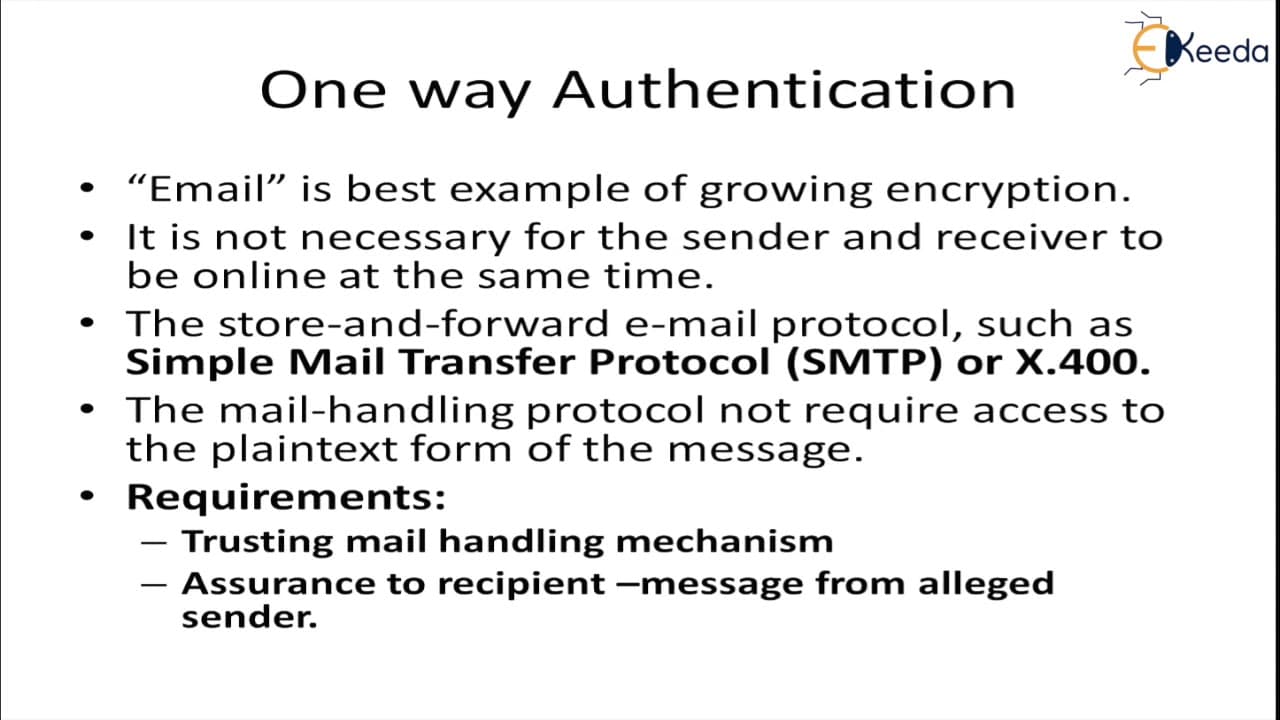
Explains one-way and mutual authentication schemes using email protocols and symmetric encryption.
Transcript
hello and welcome back to the course uh now we'll begin with the next topic that is one way and mutual authentication schemes uh okay so one way authentication is uh the best example for this is the email as all of you know that uh it is not necessary for the sender as well as recipient uh to be present online and a email can be sent across the glo... Read More
Key Insights
- 💌 One-way authentication in email protocols like SMTP ensures secure communication without access to plain text messages.
- 🤩 Symmetric encryption with a key distribution center provides confidentiality in distributed environments.
- 🤩 Mutual authentication validates identities through encrypted session key exchanges to prevent compromises.
- 🤩 The importance of timeliness and confidentiality in secure key exchanges.
- 🤩 The role of KDC in sharing secret keys for symmetric encryption.
- ❓ Mutual authentication safeguards against compromises and masquerades in secure communication.
- 🤩 Session key encryption prevents replay attacks and ensures secure communication.
Install to Summarize YouTube Videos and Get Transcripts
Explore YouTube Video Summarizer or Get YouTube Transcript Extractor
Questions & Answers
Q: What is one-way authentication and how does it use email protocols?
One-way authentication, like with SMTP, ensures trust in email communication without needing access to plain text messages. It allows for secure email exchanges between authenticated senders and recipients.
Q: How does symmetric encryption enhance authentication in distributed environments?
Symmetric encryption in distributed environments involves a key distribution center (KDC) sharing secret keys to ensure confidentiality. Each party shares a master key with the KDC to generate session keys for secure communication.
Q: What is mutual authentication and why is it important in secure communication?
Mutual authentication verifies the identities of communicative parties, ensuring confidentiality in key exchanges. It prevents compromises and masquerades by encrypting session key information for secure communication.
Summary & Key Takeaways
-
One-way authentication uses protocols like SMTP to ensure trust in email communication without needing access to plain text messages.
-
Symmetric encryption involves a key distribution center (KDC) to provide confidentiality in distributed environments.
-
Mutual authentication verifies identities through encrypted exchanges of session keys to prevent compromises and masquerades.
Read in Other Languages (beta)
Share This Summary 📚
Summarize YouTube Videos and Get Video Transcripts with 1-Click
Try YouTube Summary with ChatGPT & Claude or YouTube Transcript Generator
Explore More Summaries from Ekeeda 📚






Summarize YouTube Videos and Get Video Transcripts with 1-Click
Try YouTube Summary with ChatGPT & Claude or YouTube Transcript Generator