IVT Conjugate Poles | Z-Transform in Signals and Systems | Problem 3
TL;DR
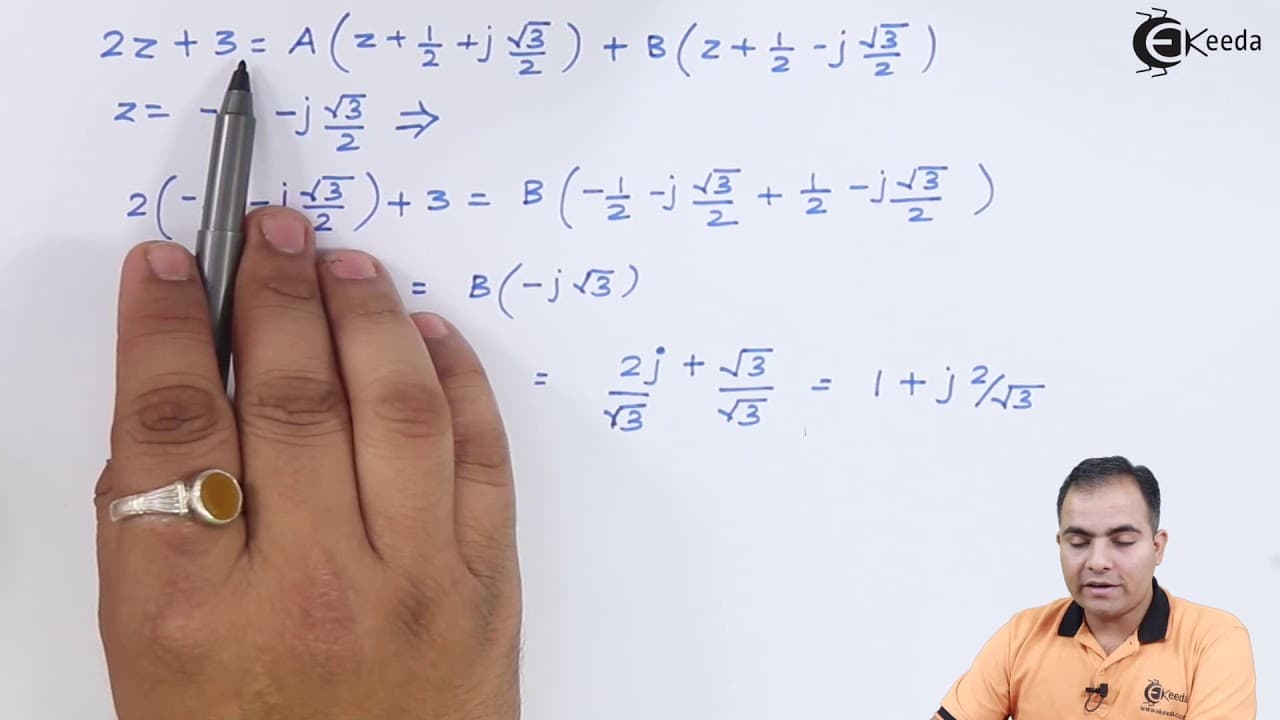
Solving the inverse Z-transform for a complex conjugate pole function using constants a and b.
Transcript
click the bell icon to get latest videos from equator hello friends and today we are going to study a last numerical which is based on in verse 8 tons of signals with the complex conjugate poles so please listen carefully this is a problem number 3 which is based on complex conjugate poles now a problem number 3 determine inverse z-transform of for... Read More
Key Insights
- 💈 Identifying complex conjugate poles indicates the presence of a pair of complex poles in the function.
- 🧟 Constants a and b are utilized to determine the coefficients required for solving the inverse z-transform.
- 😑 Time scaling property is applied to simplify the expression and derive the final answer.
- 🤪 Complex conjugate pole functions require careful handling and understanding of the inverse z-transform process.
- 🤪 The inverse z-transform involves various algebraic manipulations and partial fraction decomposition techniques.
- 🤾 Coefficient values obtained using constants a and b play a crucial role in the solution process.
- 🤪 Understanding the properties of complex conjugate poles is essential for effectively solving inverse z-transform problems.
Install to Summarize YouTube Videos and Get Transcripts
Explore YouTube Video Summarizer or Get YouTube Transcript Extractor
Questions & Answers
Q: How do you identify complex conjugate poles in a given function?
Complex conjugate poles are identified when the roots of the denominator are in the form a +/- bi, indicating a pair of complex poles.
Q: What role do constants a and b play in solving the inverse z-transform for complex conjugate poles?
Constants a and b are used to determine the coefficients in the partial fraction decomposition when complex conjugate poles are present, aiding in the solution process.
Q: How is the inverse z-transform applied after obtaining the coefficients using constants a and b?
The inverse z-transform is applied by considering time scaling properties and simplifying the expression to derive the final answer in terms of the given function.
Q: What are the key steps involved in solving the inverse z-transform for a function with complex conjugate poles?
The key steps include identifying the poles, using constants a and b to find coefficients, applying time scaling properties, and simplifying to obtain the inverse z-transform answer.
Summary & Key Takeaways
-
Explanation of identifying complex conjugate poles and necessary steps in solving the inverse z-transform.
-
Utilizing constants a and b to determine coefficient values for the inverse z-transform.
-
Applying time scaling property and simplification to derive the final answer for the given function.
Read in Other Languages (beta)
Share This Summary 📚
Summarize YouTube Videos and Get Video Transcripts with 1-Click
Try YouTube Summary with ChatGPT & Claude or YouTube Transcript Generator
Explore More Summaries from Ekeeda 📚




Summarize YouTube Videos and Get Video Transcripts with 1-Click
Try YouTube Summary with ChatGPT & Claude or YouTube Transcript Generator