What Are Dielectrics and How Do They Work?
TL;DR
Dielectrics are non-conducting insulating materials that prevent electrical current flow and localize charges, which minimizes heat dissipation. They are essential in capacitors, allowing energy storage between metal plates without causing short circuits. Examples include mica, plastic, and glass.
Transcript
hello friends in today's class we'll be studying the prerequisites for this chapter on engineering materials and applications that is dielectrics and polarization well these are the most important topics which are related to electric field and magnetic field so stay tuned dielectrics now we define dielectrics as non conducting substances which are ... Read More
Key Insights
- 🔌 Dielectrics are non-conducting insulating materials that concentrate and localize electric charges.
- 🥵 Using dielectrics reduces heat dissipation by preventing charge dispersion.
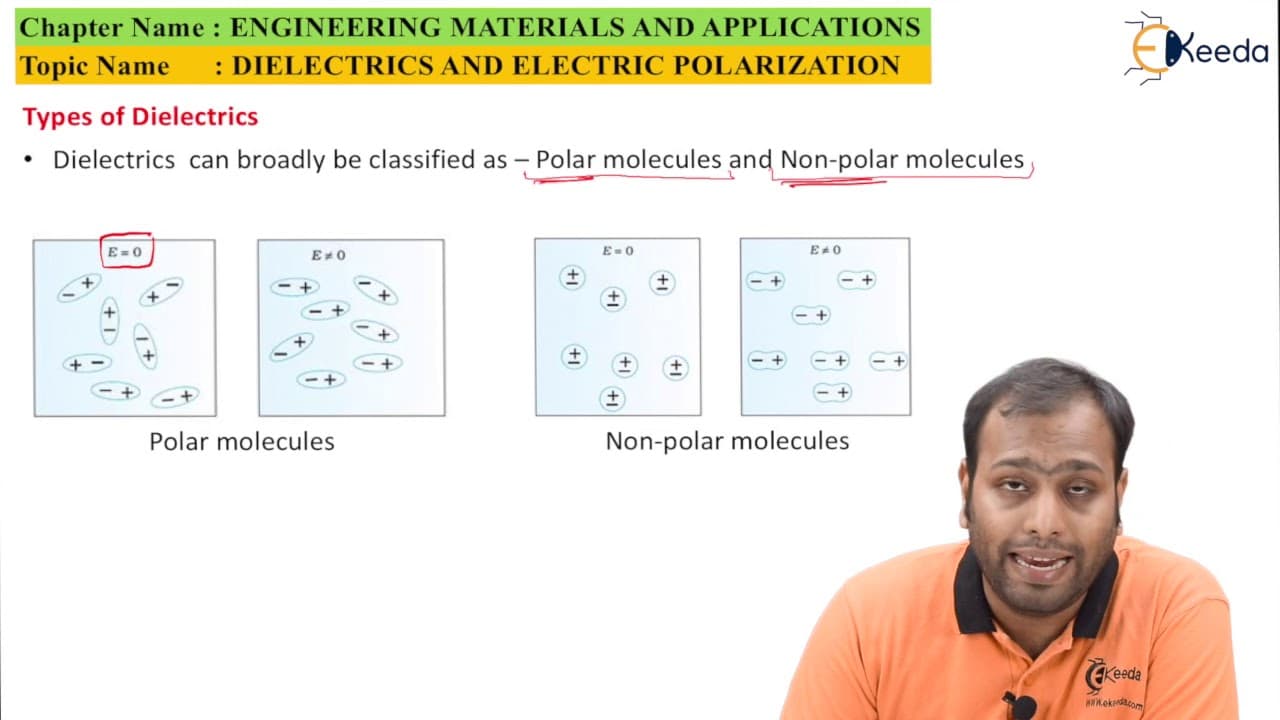
- 🐻❄️ Polar molecules in dielectrics align in electric fields, increasing separation and dipole moments.
- 💁 Nonpolar molecules do not form poles or align in electric fields.
- 🤘 Dielectrics in capacitors separate and store electric energy between metal plates.
- 😎 Examples of dielectrics include mica, plastic, glass, and various metal oxides.
- 🔌 Dielectrics prevent short circuits and provide a medium for storing electric energy as an electric field.
Install to Summarize YouTube Videos and Get Transcripts
Explore YouTube Video Summarizer or Get YouTube Transcript Extractor
Questions & Answers
Q: What are dielectrics and their primary properties?
Dielectrics are non-conducting insulating materials that do not allow electric current flow. They concentrate and localize electric charges, minimizing dissipation and heat generation.
Q: How do dielectrics compare to conducting materials in terms of charge dissipation?
Dielectrics concentrate and localize charges, reducing dissipation compared to conducting materials where charges are delocalized and dissipated throughout the material.
Q: What is the advantage of using dielectrics in terms of heat dissipation?
Dielectrics reduce heat dissipation by localizing charges, preventing the entire material surface from radiating heat, unlike conducting materials where charges travel and generate heat.
Q: How are dielectrics classified based on their molecular structure?
Dielectrics are classified as polar and nonpolar molecules. Polar molecules have poles with different charges, causing alignment in electric fields, while nonpolar molecules lack poles and do not align.
Summary & Key Takeaways
-
Dielectrics are non-conducting insulating materials that do not allow electric current flow.
-
They concentrate and localize electric charges, minimizing dissipation and heat generation.
-
Dielectrics in capacitors separate metal plates and store electric energy as an electric field.
Read in Other Languages (beta)
Share This Summary 📚
Summarize YouTube Videos and Get Video Transcripts with 1-Click
Try YouTube Summary with ChatGPT & Claude or YouTube Transcript Generator
Explore More Summaries from Ekeeda 📚



Summarize YouTube Videos and Get Video Transcripts with 1-Click
Try YouTube Summary with ChatGPT & Claude or YouTube Transcript Generator