Products
Features
YouTube Video Summarizer
Summarize YouTube videos
Web & PDF Highlighter
Highlight web pages & PDFs
Chat with PDF
Ask any PDF questions with AI
Ask AI Clone
Chat with your highlights & memories
Audio Transcriber
Transcribe audio files to text
Glasp Reader
Read and highlight articles
Kindle Highlight Export
Export your Kindle highlights
Idea Hatch
Hatch ideas from your highlights
Integrations
Obsidian Plugin
Notion Integration
Pocket Integration
Instapaper Integration
Medium Integration
Readwise Integration
Snipd Integration
Hypothesis Integration
Apps & Extensions
Chrome Extension
Safari Extension
Edge Add-ons
Firefox Add-ons
iOS App
Android App
Discover
Discover
Ideas
Discover new ideas and insights
Articles
Curated articles and insights
Books
Book recommendations by great minds
Posts
Essays and notes from readers
Quotes
Inspiring quotes collection
Videos
Curated videos and summaries
Explore Glasp
Glasp Story
How we grew from 0 to 3 million users
Glasp Newsletter
Weekly insights and updates
Glasp Talk
Interview series with great minds
Glasp Blog
Latest news and articles
Glasp Use Cases
Learn how others use Glasp
Build & Support
Glasp API
Access Glasp's API for developers
MCP Connector
Connect Glasp to Claude & ChatGPT
Community
Glasp Reddit Community
Students
Student discount and benefits
FAQs
Frequently Asked Questions
AboutPricing
DashboardLog inSign up

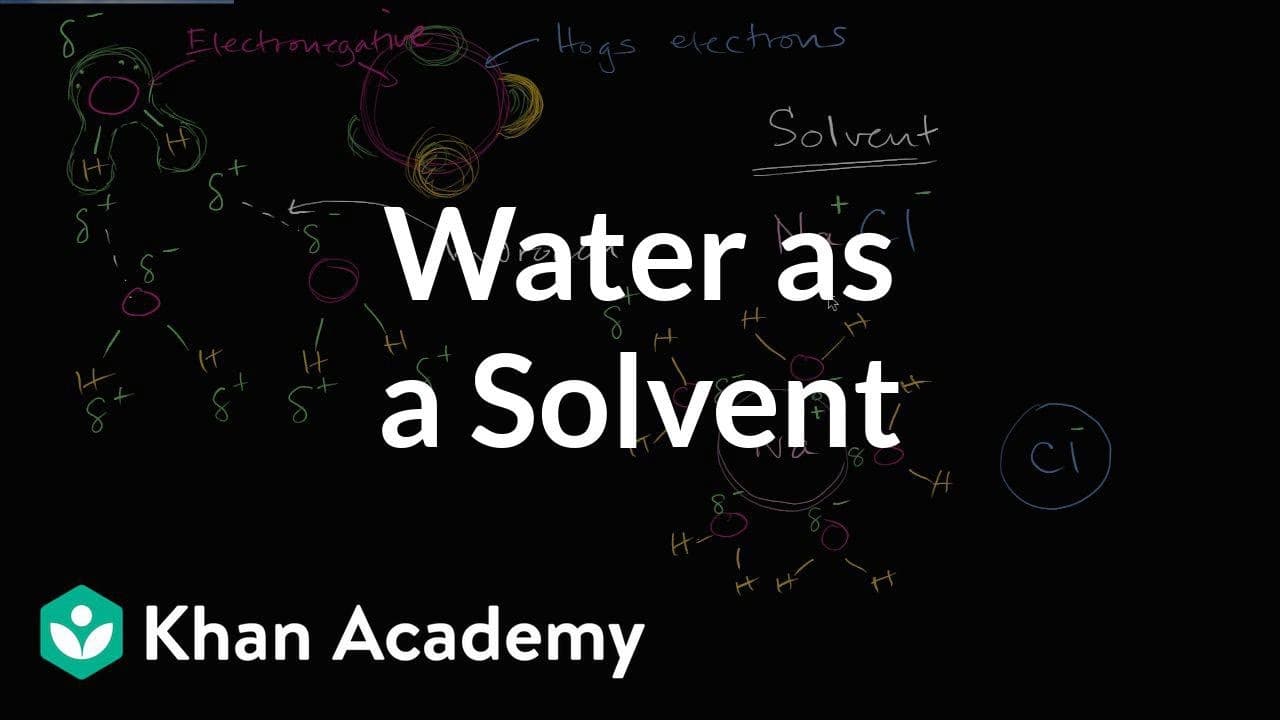
What Makes Water a Good Solvent for Molecules?
July 1, 2015
by
Khan Academy
YouTube video player
What Makes Water a Good Solvent for Molecules?

TL;DR

Water is an excellent solvent due to its polarity, allowing it to attract and dissolve charged and polar molecules like sodium chloride. Hydrophilic substances, which have charges or polarity, dissolve easily, while hydrophobic substances, such as hydrocarbons, do not dissolve well in water due to their lack of charge and polarity.

Transcript

  • [Voiceover] We've already talked about the notion that a water molecule has polarity to it. One end has a partially negative charge, and the other end has partially positive charges. And we've talked about how this leads to hydrogen bonds, and we alluded to the fact that maybe these hydrogen bonds give us all sorts of neat properties of water. An... Read More

Key Insights

  • 👻 Water's polarity allows it to form hydrogen bonds and act as a solvent for many substances.
  • 💦 Charged and polar molecules easily dissolve in water due to the attraction between their charges and the partially negative and positive ends of water molecules.
  • 🖤 Hydrophobic substances do not dissolve well in water because they lack charge and polarity.
  • 🤙 Substances that dissolve in water are called hydrophilic, while those that do not are called hydrophobic.
  • 💦 The ability of water to dissolve substances is essential for many chemical reactions and processes, including those that occur inside cells.
  • 🚾 Hydrophobic substances, like oil and fats, tend to separate from water and form distinct phases.
  • ✋ Water's ability to dissolve substances also contributes to its unique properties, such as high heat capacity and high surface tension.

Install to Summarize YouTube Videos and Get Transcripts

Explore YouTube Video Summarizer or Get YouTube Transcript Extractor

Summary & Key Takeaways

  • Water's polarity, with one end having a partially negative charge and the other end having partially positive charges, allows it to form hydrogen bonds and act as a solvent.

  • Charged and polar molecules, such as sodium chloride, easily dissolve in water because the partially negative ends of water molecules are attracted to positively charged ions and the partially positive ends are attracted to negatively charged ions.

  • Hydrophobic substances, like hydrocarbons, do not dissolve well in water because they lack charge and polarity.


Read in Other Languages (beta)

English

Share This Summary 📚

Summarize YouTube Videos and Get Video Transcripts with 1-Click

Download browser extensions on:

Try YouTube Summary with ChatGPT & Claude or YouTube Transcript Generator

Explore More Summaries from Khan Academy 📚
Cellular respiration | Food and energy in organisms | Middle school biology | Khan Academy thumbnail
Cellular respiration | Food and energy in organisms | Middle school biology | Khan Academy
Khan Academy
Calculating average value of function over interval | AP Calculus AB | Khan Academy thumbnail
Calculating average value of function over interval | AP Calculus AB | Khan Academy
Khan Academy
2011 Calculus BC free response #6a | AP Calculus BC | Khan Academy thumbnail
2011 Calculus BC free response #6a | AP Calculus BC | Khan Academy
Khan Academy
Khan Academy Ed Talks - Reimagining School with Sal Khan, Rachel E. Skiffer, & Kim Dow thumbnail
Khan Academy Ed Talks - Reimagining School with Sal Khan, Rachel E. Skiffer, & Kim Dow
Khan Academy
Ways to represent data | Data and statistics | 6th grade | Khan Academy thumbnail
Ways to represent data | Data and statistics | 6th grade | Khan Academy
Khan Academy
U03_L2_T1_we2 Representing Functions as Graphs thumbnail
U03_L2_T1_we2 Representing Functions as Graphs
Khan Academy

Summarize YouTube Videos and Get Video Transcripts with 1-Click

Download browser extensions on:

Try YouTube Summary with ChatGPT & Claude or YouTube Transcript Generator

Apps & Extensions

  • Chrome Extension
  • Safari Extension
  • Edge Add-ons
  • Firefox Add-ons
  • iOS App
  • Android App

Key Features

  • YouTube Video Summarizer
  • Web & PDF Summarizer
  • Web & PDF Highlighter
  • Chat with PDF
  • Ask AI Clone
  • Audio Transcriber
  • Glasp Reader
  • Kindle Highlight Export
  • Idea Hatch

Integrations

  • Obsidian Plugin
  • Notion Integration
  • Pocket Integration
  • Instapaper Integration
  • Medium Integration
  • Readwise Integration
  • Snipd Integration
  • Hypothesis Integration

More Features

  • APIs
  • MCP Connector
  • Blog & Post
  • Embed Links
  • Image Highlight
  • Personality Test
  • Quote Shots
  • Open Graph Checker

Company

  • About us
  • Our Story
  • Blog
  • Community
  • FAQs
  • Job Board
  • Newsletter
  • Pricing
Terms

•

Privacy

•

Guidelines

© 2026 Glasp Inc. All rights reserved.