What Makes Water a Good Solvent for Molecules?
TL;DR
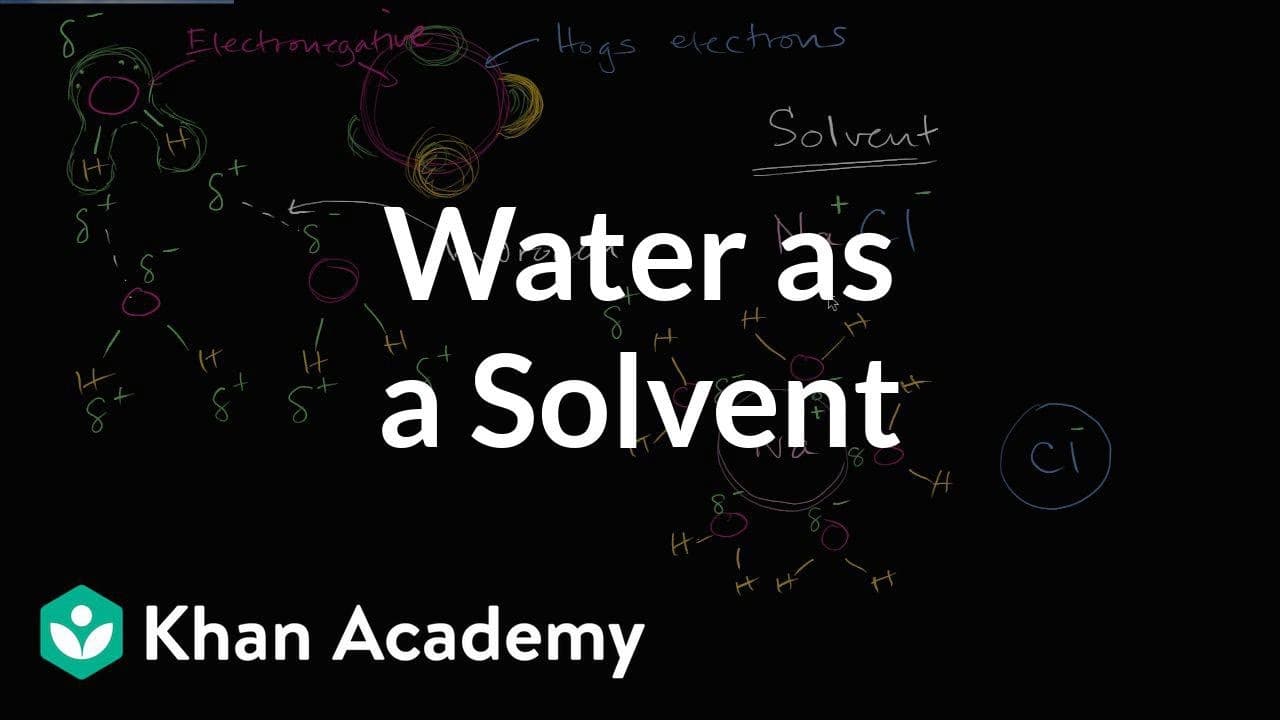
Water is an excellent solvent due to its polarity, allowing it to attract and dissolve charged and polar molecules like sodium chloride. Hydrophilic substances, which have charges or polarity, dissolve easily, while hydrophobic substances, such as hydrocarbons, do not dissolve well in water due to their lack of charge and polarity.
Transcript
- [Voiceover] We've already talked about the notion that a water molecule has polarity to it. One end has a partially negative charge, and the other end has partially positive charges. And we've talked about how this leads to hydrogen bonds, and we alluded to the fact that maybe these hydrogen bonds give us all sorts of neat properties of water. An... Read More
Key Insights
- 👻 Water's polarity allows it to form hydrogen bonds and act as a solvent for many substances.
- 💦 Charged and polar molecules easily dissolve in water due to the attraction between their charges and the partially negative and positive ends of water molecules.
- 🖤 Hydrophobic substances do not dissolve well in water because they lack charge and polarity.
- 🤙 Substances that dissolve in water are called hydrophilic, while those that do not are called hydrophobic.
- 💦 The ability of water to dissolve substances is essential for many chemical reactions and processes, including those that occur inside cells.
- 🚾 Hydrophobic substances, like oil and fats, tend to separate from water and form distinct phases.
- ✋ Water's ability to dissolve substances also contributes to its unique properties, such as high heat capacity and high surface tension.
Install to Summarize YouTube Videos and Get Transcripts
Explore YouTube Video Summarizer or Get YouTube Transcript Extractor
Questions & Answers
Q: What is water's ability to be a solvent?
Water's polarity allows it to dissolve many substances, making it an effective solvent. Charged and polar molecules readily dissolve in water, while hydrophobic substances do not.
Q: How does water interact with charged ions?
Water molecules are attracted to charged ions like sodium and chloride. The partially negative ends of water molecules are attracted to positively charged ions, while the partially positive ends are attracted to negatively charged ions.
Q: What happens when sodium chloride is dissolved in water?
When sodium chloride is added to water, the positive sodium ions are attracted to the partially negative ends of water molecules, and the negative chloride ions are attracted to the partially positive ends. This allows the sodium chloride to dissolve easily in water.
Q: Why do hydrophobic substances not dissolve well in water?
Hydrophobic substances, like hydrocarbons, lack charge and polarity, making them unable to attract water molecules. Instead, they tend to bead up and minimize contact with water.
Summary & Key Takeaways
-
Water's polarity, with one end having a partially negative charge and the other end having partially positive charges, allows it to form hydrogen bonds and act as a solvent.
-
Charged and polar molecules, such as sodium chloride, easily dissolve in water because the partially negative ends of water molecules are attracted to positively charged ions and the partially positive ends are attracted to negatively charged ions.
-
Hydrophobic substances, like hydrocarbons, do not dissolve well in water because they lack charge and polarity.
Read in Other Languages (beta)
Share This Summary 📚
Summarize YouTube Videos and Get Video Transcripts with 1-Click
Try YouTube Summary with ChatGPT & Claude or YouTube Transcript Generator
Explore More Summaries from Khan Academy 📚






Summarize YouTube Videos and Get Video Transcripts with 1-Click
Try YouTube Summary with ChatGPT & Claude or YouTube Transcript Generator