Finding The Area Using The Limit Definition & Sigma Notation
TL;DR
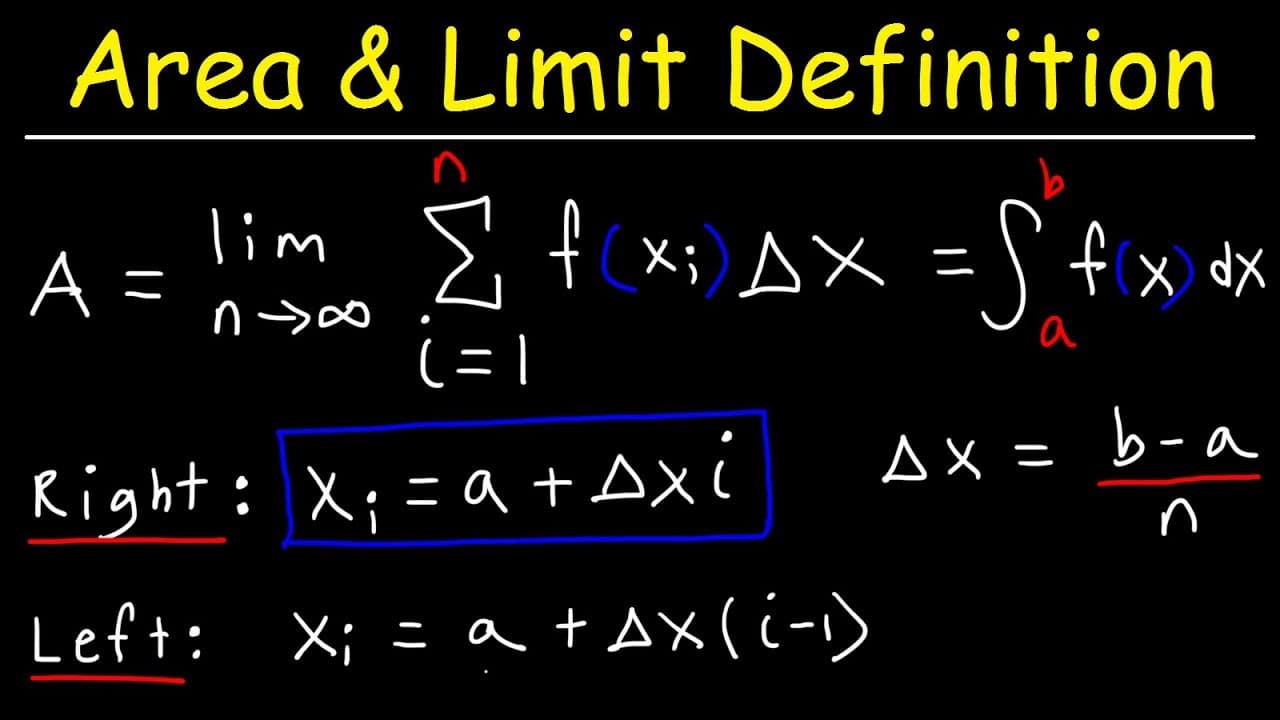
This video explains how to find the area under a curve using the limit definition, specifically focusing on the right endpoints method.
Transcript
in this video we're going to focus on finding the area using the limit definition so let's say if we have the function x cube and we want to find the area of the shaded region between the x-axis and the curve over the closed interval from zero to eight so let's draw a picture so x cube on the right side looks like this and so from 0 to 8 we want to... Read More
Key Insights
- 🛩️ The area under a curve can be approximated by dividing the interval into smaller rectangles.
- 👻 The limit definition allows us to find the exact area by increasing the number of rectangles infinitely.
- 👈 The right endpoints method is simpler than the left endpoints method for finding the value of x sub i.
Install to Summarize YouTube Videos and Get Transcripts
Explore YouTube Video Summarizer or Get YouTube Transcript Extractor
Summary & Key Takeaways
-
The area under a curve can be found using the limit definition and the formula: the limit as n approaches infinity of the sum of rectangles from 1 to n of f(x sub i) times delta x.
-
The value of x sub i depends on whether the right or left endpoints method is used, but for this example, the right endpoints method is demonstrated.
-
Delta x represents the width of each rectangle and is calculated by dividing the interval length by the number of rectangles.
Read in Other Languages (beta)
Share This Summary 📚
Summarize YouTube Videos and Get Video Transcripts with 1-Click
Try YouTube Summary with ChatGPT & Claude or YouTube Transcript Generator
Explore More Summaries from The Organic Chemistry Tutor 📚


Summarize YouTube Videos and Get Video Transcripts with 1-Click
Try YouTube Summary with ChatGPT & Claude or YouTube Transcript Generator