Acid Base Titration Curves - pH Calculations
TL;DR
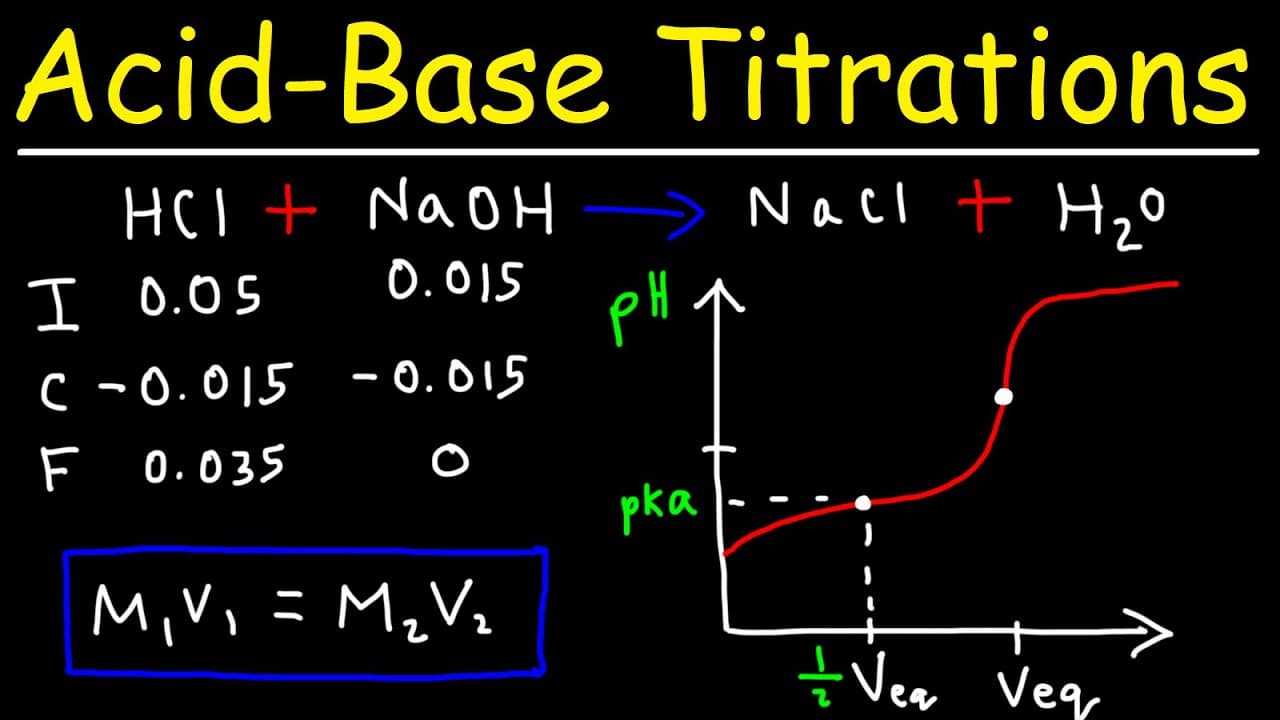
This video explains the process of acid-base titrations and demonstrates how to calculate the concentration of acids and bases, as well as the pH at various points of the titration process.
Transcript
in this video we're going to focus on acid-base titrations we're going to talk about titration curves and how to calculate the ph at various points of the acid-base titration process and some other problems as well so let's start with this one 28.9 milliliters of h2so4 was completely titrated with 38.4 milliliters of a 0.25 molar sodium hydroxide s... Read More
Key Insights
- ⚾ Acid-base titrations involve the neutralization reaction between an acid and a base.
- ❓ Concentration of an acid can be determined using stoichiometry or the equation m1v1 = m2v2.
- 😥 Titrations of strong acids with strong bases have titration curves with an equivalence point at pH 7.
- 😥 Titrations of weak acids with strong bases have titration curves with an equivalence point at a pH greater than 7.
- 😥 The pH at half the equivalence point is equal to the pKa of the acid.
- 😥 At the equivalence point, the acid and base have reacted in stoichiometric proportions, resulting in a neutral solution with a pH of 7.
- 😥 Buffer solutions can resist changes in pH and are present in the buffer region of a titration curve.
- 💪 The pH curve for a weak acid-strong base titration is similar to that of a strong acid-strong base titration, but with a slightly higher starting pH.
- 😥 The pH curve for a weak base-strong acid titration is similar to that of a strong base-strong acid titration, but with a pH below 7 at the equivalence point.
Install to Summarize YouTube Videos and Get Transcripts
Explore YouTube Video Summarizer or Get YouTube Transcript Extractor
Summary & Key Takeaways
-
Acid-base titrations involve the reaction of an acid and a base, resulting in the formation of salt and water.
-
The concentration of an acid can be determined using stoichiometry or the equation m1v1 = m2v2.
-
Titrations involving strong acids and strong bases have titration curves in which the pH rises rapidly and then tapers off, with an equivalence point at pH 7.
-
Titrations involving weak acids and strong bases have titration curves with a slightly higher starting pH and an equivalence point at a pH greater than 7.
-
The pH at half the equivalence point is equal to the pKa of the acid, and at the equivalence point, the pH is 7.
Read in Other Languages (beta)
Share This Summary 📚
Summarize YouTube Videos and Get Video Transcripts with 1-Click
Try YouTube Summary with ChatGPT & Claude or YouTube Transcript Generator
Explore More Summaries from The Organic Chemistry Tutor 📚




Summarize YouTube Videos and Get Video Transcripts with 1-Click
Try YouTube Summary with ChatGPT & Claude or YouTube Transcript Generator