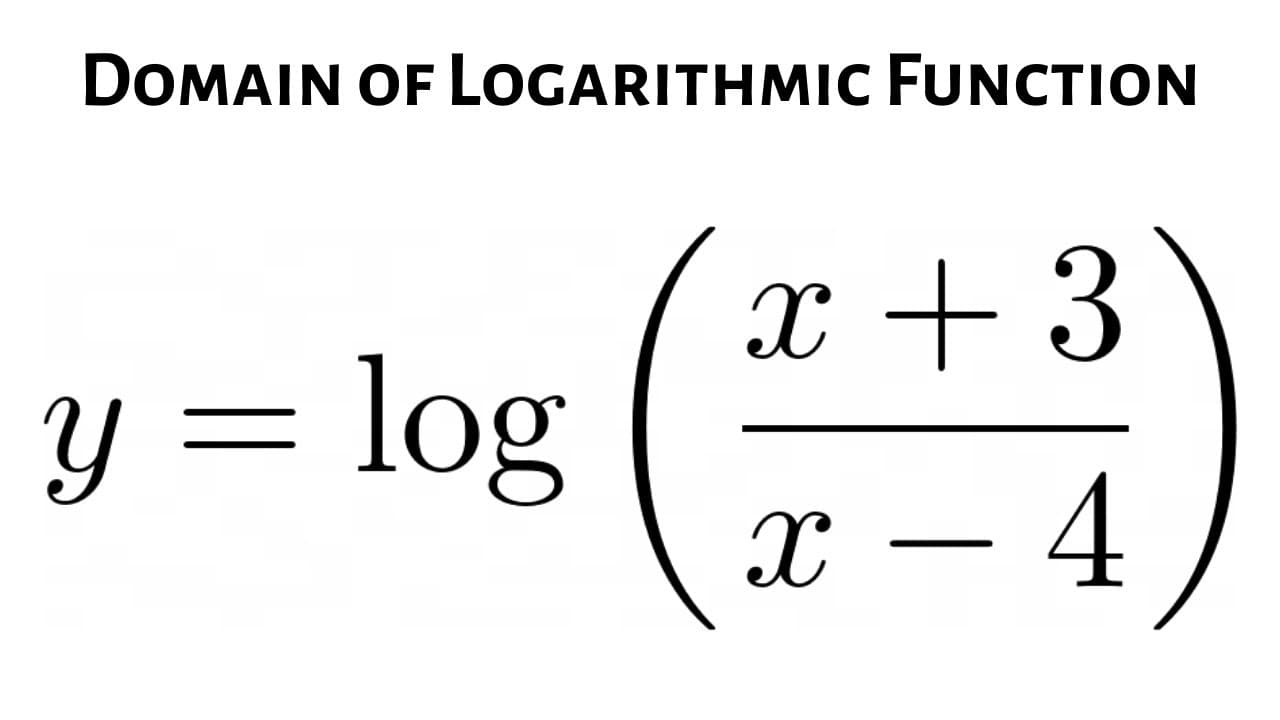
Domain of the Logarithmic Function y = log((x + 3)/(x - 4))
TL;DR
Determining the domain of a log function by setting its expression greater than zero using the test point method.
Transcript
hi everyone in this video we're going to find the domain of this function so if it was just the log of x then we know that x has to be positive you can only take the log of a positive number so the domain of log is positive numbers but here's not log here it's log of some other stuff so this whole thing here which i've circled is our x so this whol... Read More
Key Insights
- 😑 Domain of log functions requires its expression to be positive.
- 😥 Steps in the test point method involve setting terms to zero and selecting test points.
- 😥 Shortcut of using zero as a test point simplifies the domain calculation.
- 🧡 Shading pattern determines the domain range for log functions.
- 🧑💻 Positivity constraint crucial for the existence of a log function.
- 😥 Graphical and test point methods available for determining log function domain.
- 🧑💻 Consideration of strict inequalities for log function domain intervals.
Install to Summarize YouTube Videos and Get Transcripts
Explore YouTube Video Summarizer or Get YouTube Transcript Extractor
Questions & Answers
Q: How do you find the domain of a logarithmic function?
To find the domain, set the expression inside the log function greater than zero using the test point method, either graphically or by selecting test points like zero, and follow the shading pattern to determine the domain range.
Q: Why is it essential to consider positivity in determining the domain of a log function?
Positivity is crucial as you can only take the log of a positive number, so the expression inside the log function must be positive for it to have a valid domain, ensuring the function's existence.
Q: What is the significance of setting each term to zero in the test point method for finding the domain?
By setting the numerator and denominator equal to zero, you identify critical points that help determine the intervals where the log function is positive, thus aiding in correctly shading the domain.
Q: How does the test point method simplify finding the domain of a log function compared to graphical methods?
The test point method offers a quicker approach by selecting specific points like zero to evaluate the log expression, determining the domain without extensive graphing, making the process more efficient and straightforward.
Summary & Key Takeaways
-
Explanation of determining domain of log function based on positivity requirement for logs.
-
Steps involved in using the test point method to find the domain of a log function.
-
Demonstrating a shortcut using the test point method by selecting zero as a test point for the log function.
Read in Other Languages (beta)
Share This Summary 📚
Summarize YouTube Videos and Get Video Transcripts with 1-Click
Try YouTube Summary with ChatGPT & Claude or YouTube Transcript Generator
Explore More Summaries from The Math Sorcerer 📚


Summarize YouTube Videos and Get Video Transcripts with 1-Click
Try YouTube Summary with ChatGPT & Claude or YouTube Transcript Generator