LC natural response derivation 3
TL;DR
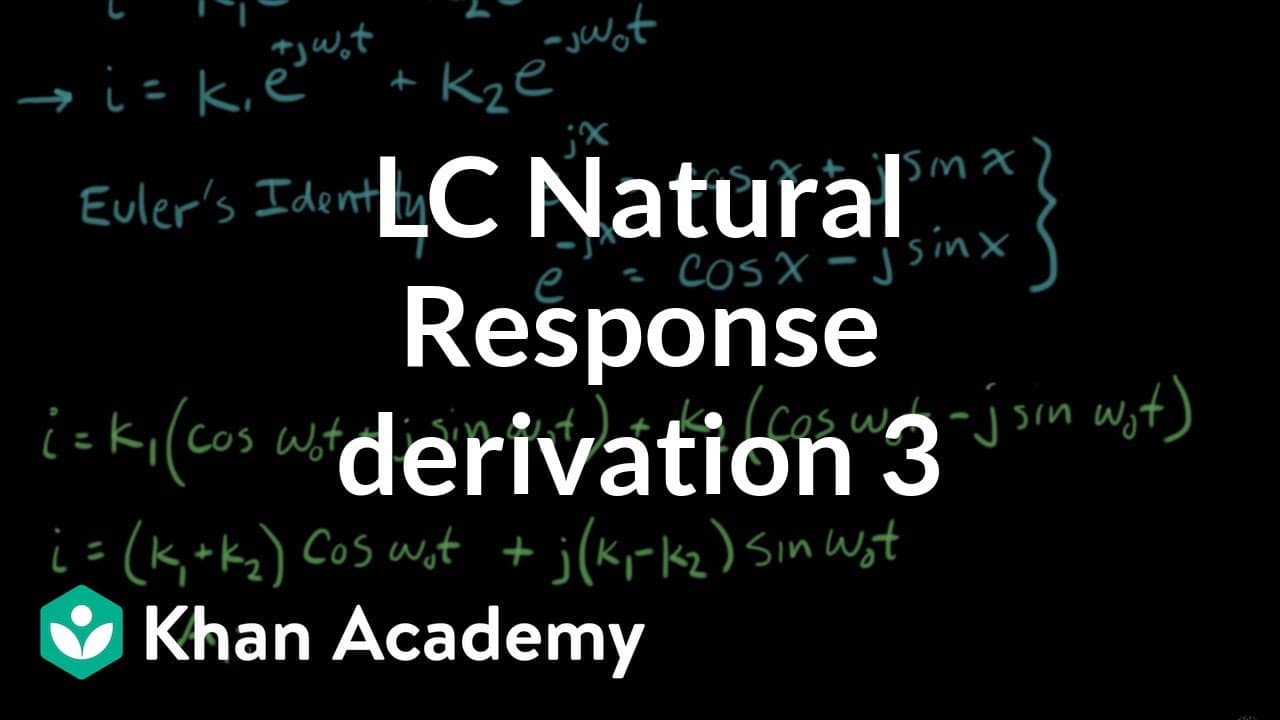
This video explains how to solve a differential equation by using Euler's Identity and demonstrates the process through an example involving an LC circuit.
Transcript
- [Voiceover] In the last video we took a guess at what the solution was for our differential equation and we came up with an exponential as our guess and as we did the analysis we developed a characteristic equation. We ended up with a complex answer for one of the adjustable parameters, the natural frequency of our circuit. So here's the form of ... Read More
Key Insights
- 😒 The video demonstrates how to use Euler's Identity to simplify complex exponential terms in solving a differential equation.
- 😑 The solution to the differential equation is expressed in terms of cosine and sine functions, representing the amplitude and phase of the current.
- ❓ Initial conditions can be used to determine the values of the constants in the solution.
Install to Summarize YouTube Videos and Get Transcripts
Explore YouTube Video Summarizer or Get YouTube Transcript Extractor
Questions & Answers
Q: How does Euler's Identity help in solving differential equations?
Euler's Identity is useful because it allows us to simplify complex exponential terms by converting them into normal complex numbers represented by cosine and sine functions. This simplification makes it easier to solve the differential equation.
Q: What is the significance of cosine and sine functions in the solution to the differential equation?
The cosine and sine functions in the solution represent the amplitude and phase of the current in the LC circuit. By determining the values of a one and a two, we can calculate the current at any given time.
Q: How can the initial conditions be used to determine the values of a one and a two?
The initial conditions, such as voltage and current values at a specific time, can be used to set up equations that help solve for the unknown constants a one and a two. By plugging in the initial conditions, we can solve for these values and obtain the complete solution to the differential equation.
Q: What are the practical applications of using Euler's Identity in solving differential equations?
Euler's Identity is widely used in various fields of mathematics and physics, particularly in analyzing oscillatory systems like the LC circuit in this example. By converting complex exponential terms into cosine and sine functions, it simplifies calculations and provides a clearer understanding of the system's behavior.
Summary & Key Takeaways
-
The video focuses on solving a differential equation using Euler's Identity and applying it to an example involving an LC circuit.
-
Euler's Identity states that e to the j x equals cosign x plus j times sine x, and e to the minus j x equals cosign of x minus j sine x.
-
The solution to the differential equation is expressed as i equals a one times cosign of omega naught t plus a two times sine of omega naught t.
Read in Other Languages (beta)
Share This Summary 📚
Summarize YouTube Videos and Get Video Transcripts with 1-Click
Try YouTube Summary with ChatGPT & Claude or YouTube Transcript Generator
Explore More Summaries from Khan Academy 📚



Summarize YouTube Videos and Get Video Transcripts with 1-Click
Try YouTube Summary with ChatGPT & Claude or YouTube Transcript Generator