Acids and Bases - Basic Introduction - Organic Chemistry
TL;DR
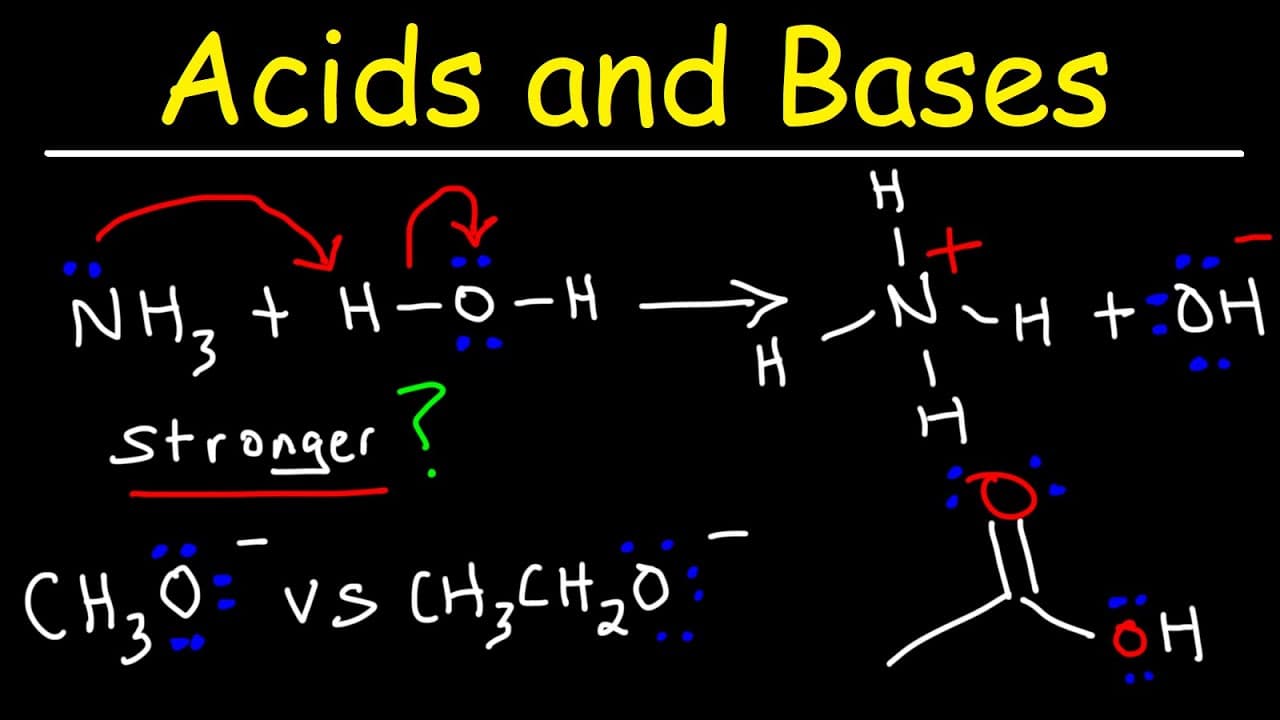
This video provides an introduction to acids and bases in organic chemistry, including identifying common acids and bases, understanding pH and acid-base reactions, and exploring the concepts of Lewis acids and bases.
Transcript
in this video we're going to go over a basic introduction into acids and bases particularly with reference to organic chemistry so first you need to be able to identify a typical acid and a typical base most acids contain hydrogen HF hydrofluoric acid that's an acid HCL hydrochloric acid that's another one nh4 Plus the ammonium ion that acts as a w... Read More
Key Insights
- 🫀 Acids in organic chemistry, such as HF and HCl, contain hydrogen atoms and are proton donors, while bases, like hydroxide and ammonia, accept protons.
- 😥 The pH scale is used to measure the acidity or basicity of a solution, with values less than 7 indicating acidity, greater than 7 indicating basicity, and 7 representing neutrality.
- ⚾ Acid-base reactions in organic chemistry follow the Brownsted-Lowry definition, where the acid donates a proton and the base accepts a proton, resulting in the formation of conjugate acids and bases.
- 🍧 The strength of an acid can be determined by its Ka value, with stronger acids having larger Ka values and weaker acids having smaller values.
- 🖐️ Lewis acids and bases, which are electron acceptors and electron donors, respectively, play a role in organic chemistry reactions.
- ⚾ Formal charges can be calculated to determine the stability of compounds in acid-base reactions.
- ⚾ Acid-base reactions can be reversible, and the direction of the reaction is determined by the relative stability of the acid and base.
- ⚾ The stability of a compound is related to its reactivity, with more stable compounds being less reactive and prone to undergo acid-base reactions.
Install to Summarize YouTube Videos and Get Transcripts
Explore YouTube Video Summarizer or Get YouTube Transcript Extractor
Questions & Answers
Q: What is the difference between an acid and a base in organic chemistry?
In organic chemistry, acids are proton donors, while bases are proton acceptors. Acids typically contain hydrogen atoms, such as HF and HCl, while bases often contain hydroxide ions or molecules that can readily accept a proton, such as ammonia.
Q: How does the pH of a solution change when an acid or base is added to water?
When an acid is added to water, the pH of the solution will be less than 7. On the other hand, when a base is added to water, the pH of the solution will be greater than 7. Water itself is neutral with a pH of approximately 7.
Q: What is the difference between a reversible and irreversible reaction?
A reversible reaction can proceed in both directions, while an irreversible reaction can only proceed in one direction. In the context of acid-base reactions, a single arrow is used to represent irreversible reactions, while a double arrow is used for reversible reactions.
Q: How can the strength of an acid be determined?
The strength of an acid can be determined by its Ka value, which is the acid association constant. Strong acids have larger Ka values, indicating a higher level of ionization, while weak acids have smaller Ka values and ionize only partially.
Summary & Key Takeaways
-
Acids are proton donors, while bases are proton acceptors. Common acids include HF, HCl, and acetic acid, while common bases include hydroxide and fluoride.
-
When an acid is placed in water, the pH of the solution will be less than 7, while the pH of a base in water will be greater than 7. Water itself is neutral with a pH of approximately 7.
-
Acid-base reactions follow the Brownsted-Lowry definition, where the acid donates a proton and the base accepts a proton. The products of the reaction are the conjugate acid and conjugate base.
Read in Other Languages (beta)
Share This Summary 📚
Summarize YouTube Videos and Get Video Transcripts with 1-Click
Try YouTube Summary with ChatGPT & Claude or YouTube Transcript Generator
Explore More Summaries from The Organic Chemistry Tutor 📚


Summarize YouTube Videos and Get Video Transcripts with 1-Click
Try YouTube Summary with ChatGPT & Claude or YouTube Transcript Generator