How to Solve Triangles Using the Law of Cosines
TL;DR
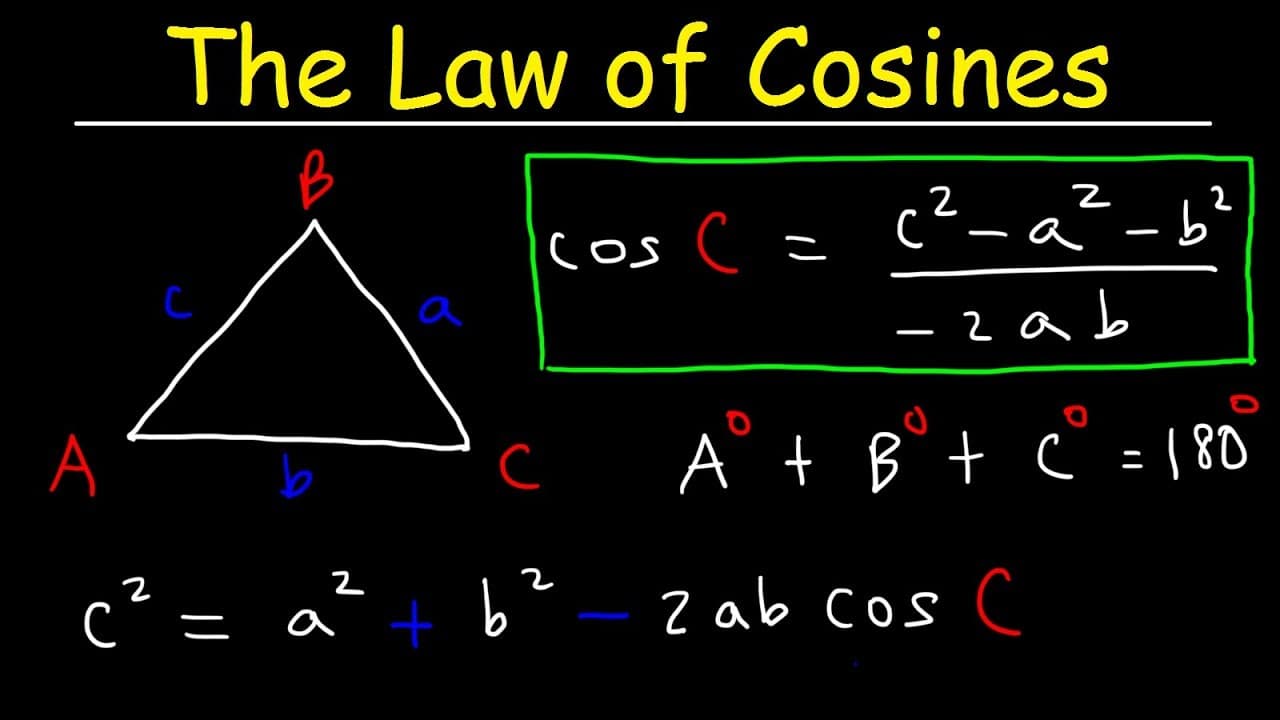
To solve a SAS or SSS triangle, use the Law of Cosines: c² = a² + b² - 2ab·cos(C). For a SAS triangle with side a = 10, side b = 20, and included angle C = 60°, this gives c = √300 ≈ 17.32; for an SSS triangle you rearrange the formula to solve for an angle first. Once you have one angle, the Law of Sines finds the rest. See both worked examples step by step below.
Transcript
let's say side a is 10 and side b is 20 and angle c is 60 degrees go ahead and solve the triangle so first let's draw it so this is angle a b and c so angle c is 60 degrees side a is 10 side b is 20. so what we have is a side angle side triangle can we use law of sines to solve the triangle in order to use law of sines you need to have two of the s... Read More
Key Insights
- 💁 The Law of Sines and Law of Cosines are essential tools in solving triangles, depending on the given information.
- 🙃 The Law of Sines requires two sides and their corresponding angles, while the Law of Cosines is used when two sides and their included angle are known.
- 🙃 The Law of Cosines can be rearranged into three different forms to solve for different sides and angles.
Install to Summarize YouTube Videos and Get Transcripts
Explore YouTube Video Summarizer or Get YouTube Transcript Extractor
Questions & Answers
Q: How do you solve a SAS triangle using the Law of Cosines?
With a side-angle-side triangle you know two sides and the angle between them, so you can't use the Law of Sines (all the letters are different). Plug the values into c² = a² + b² - 2ab·cos(C) to find the third side. For a = 10, b = 20, and C = 60°, you get 100 + 400 - 400(½) = 300, so c = √300 ≈ 17.32. Then use the Law of Sines to find the remaining angles.
Q: How do you find the angles of an SSS triangle?
When you have all three sides, start with the Law of Cosines and rearrange it to solve for an angle: cos(C) = (c² - a² - b²) / (-2ab). For sides a = 7, b = 8, c = 9, this gives (81 - 49 - 64) / (-112) = 0.2857, so angle C ≈ 73.4°. After finding the first angle, use the Law of Sines to find the others.
Q: Do you use the Law of Cosines for SAS triangles?
Yes. A SAS triangle gives you two sides and the included angle, meaning all the letters are different, so the Law of Sines won't work. In that case you must use the Law of Cosines to find the missing side, and only then can you switch to the Law of Sines.
Q: What is the Law of Cosines formula?
The formula is c² = a² + b² - 2ab·cos(C). It can be rewritten into three equivalent forms so you can solve for any side or angle: a² = b² + c² - 2bc·cos(A) and b² = a² + c² - 2ac·cos(B). You pick the form that matches the values you already know.
Q: Why can't the Law of Sines be used when all the letters are different?
The Law of Sines pairs a side with its opposite angle, so you need two of the same letter (like side a and angle A). If you only have side a, side b, and angle C, every pair in the Law of Sines is missing either a side or an angle, so it can't be solved. That's when the Law of Cosines is required.
Q: After finding one angle with the Law of Cosines, how do you find the remaining angles?
Once the Law of Cosines gives you the first angle, use the Law of Sines to find a second angle, for example c/sin(C) = a/sin(A). Then find the last angle by subtracting the two known angles from 180°. Watch for the supplementary answer from arcsine and discard it if the angles would exceed 180°.
Q: What are the angles of a triangle with sides 7, 8, and 9?
Using the Law of Cosines, angle C (opposite side 9) works out to about 73.4°. The Law of Sines then gives angle A (opposite side 7) as about 48.2°. Subtracting both from 180° gives angle B ≈ 58.4°, and only one valid triangle can be formed.
Summary & Key Takeaways
-
The Law of Sines and Law of Cosines are used to solve triangles when given different combinations of side lengths and angles.
-
If a triangle has all different letters (sides and angles), the Law of Sines cannot be used, and the Law of Cosines should be applied.
-
The formula for the Law of Cosines is c² = a² + b² - 2ab cos(C), which can be rearranged into three different forms to solve for different sides and angles.
-
When given all three side lengths, the Law of Cosines is used to find one angle, and then the Law of Sines can be used to find the remaining angles.
Read in Other Languages (beta)
Share This Summary 📚
Summarize YouTube Videos and Get Video Transcripts with 1-Click
Try YouTube Summary with ChatGPT & Claude or YouTube Transcript Generator
Explore More Summaries from The Organic Chemistry Tutor 📚




Summarize YouTube Videos and Get Video Transcripts with 1-Click
Try YouTube Summary with ChatGPT & Claude or YouTube Transcript Generator