What Are Newton's First and Second Laws of Motion?
TL;DR
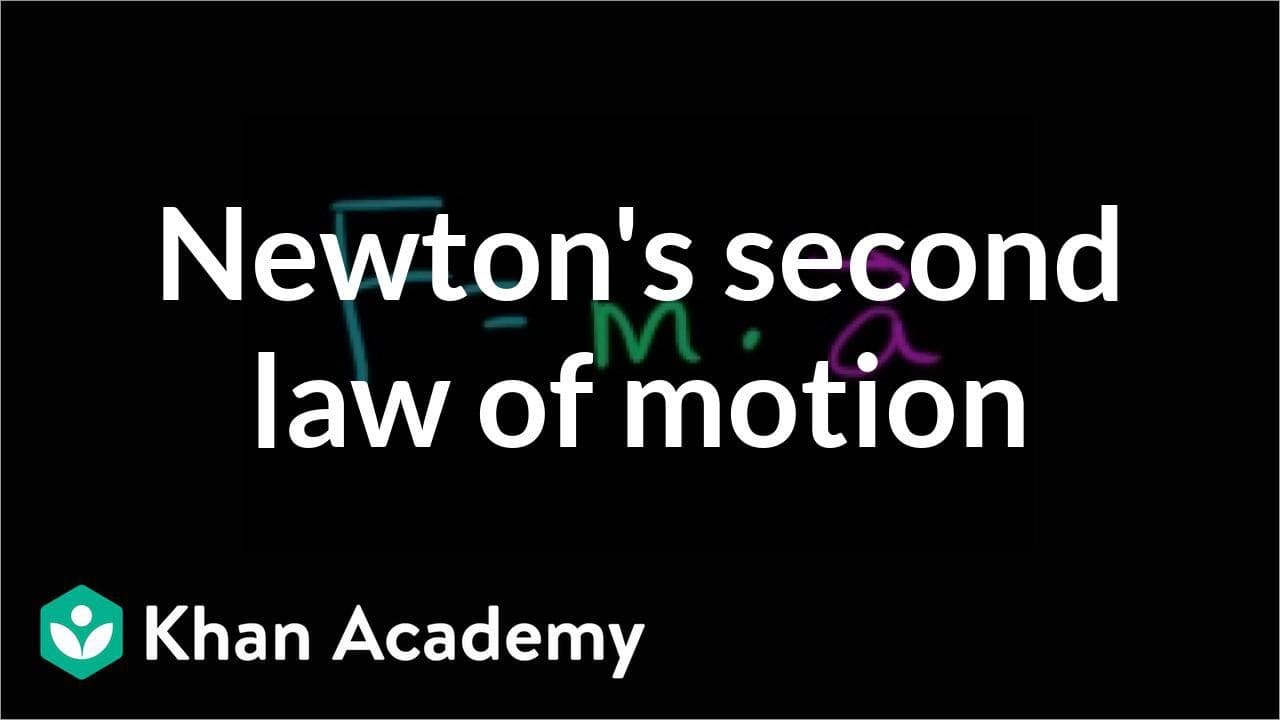
Newton's First Law states that an object at rest remains at rest, and an object in motion continues at a constant velocity unless acted upon by a net force. Newton's Second Law defines the relationship between force, mass, and acceleration with the formula F = ma, where acceleration is directly proportional to the net force applied and inversely proportional to the mass of the object.
Transcript
Newton's First Law tells us that an object at rest will stay at rest, and object with a constant velocity will keep having that constant velocity unless it's affected by some type of net force. Or you actually could say an object with constant velocity will stay having a constant velocity unless it's affected by net force. Because really, this take... Read More
Key Insights
- 💱 Newton's First Law explains the concept of inertia and the tendency of objects to resist changes in their state of motion.
- 💆 Newton's Second Law provides a quantitative relationship between force, mass, and acceleration.
- 💆 Understanding the difference between mass and weight is crucial in physics, as they have distinct definitions and units of measurement.
- 💆 Applying a net force to an object can cause it to accelerate, with the magnitude of acceleration depending on the force and mass involved.
Install to Summarize YouTube Videos and Get Transcripts
Explore YouTube Video Summarizer or Get YouTube Transcript Extractor
Questions & Answers
Q: What is Newton's First Law of Motion?
Newton's First Law, also known as the law of inertia, states that objects will remain at rest or in motion with a constant velocity unless acted upon by a net force. This law explains why objects tend to maintain their current state of motion.
Q: How does Newton's Second Law relate force, mass, and acceleration?
Newton's Second Law tells us that force is equal to mass times acceleration. This means that the force applied to an object is directly proportional to its mass and the rate at which its velocity changes, as represented by acceleration.
Q: What is the difference between mass and weight?
Mass is a measure of the amount of matter an object possesses, while weight is the force exerted on an object by gravity. Mass is constant regardless of location, but weight can vary depending on the strength of gravity.
Q: How does applying a net force affect an object's constant velocity?
Applying a net force to an object with a constant velocity will cause it to accelerate in the direction of the force. The magnitude of this acceleration depends on the strength of the force and the mass of the object.
Summary & Key Takeaways
-
Newton's First Law states that objects at rest or with a constant velocity will maintain that state unless affected by a net force.
-
Newton's Second Law introduces the formula force = mass x acceleration, illustrating the relationship between force, mass, and acceleration.
-
Mass and weight are different concepts, with mass referring to the quantity of matter an object possesses, and weight being the force of gravity acting upon an object's mass.
Read in Other Languages (beta)
Share This Summary 📚
Summarize YouTube Videos and Get Video Transcripts with 1-Click
Try YouTube Summary with ChatGPT & Claude or YouTube Transcript Generator
Explore More Summaries from Khan Academy 📚



Summarize YouTube Videos and Get Video Transcripts with 1-Click
Try YouTube Summary with ChatGPT & Claude or YouTube Transcript Generator