Problem 5 on Closure Process of Free Languages
TL;DR
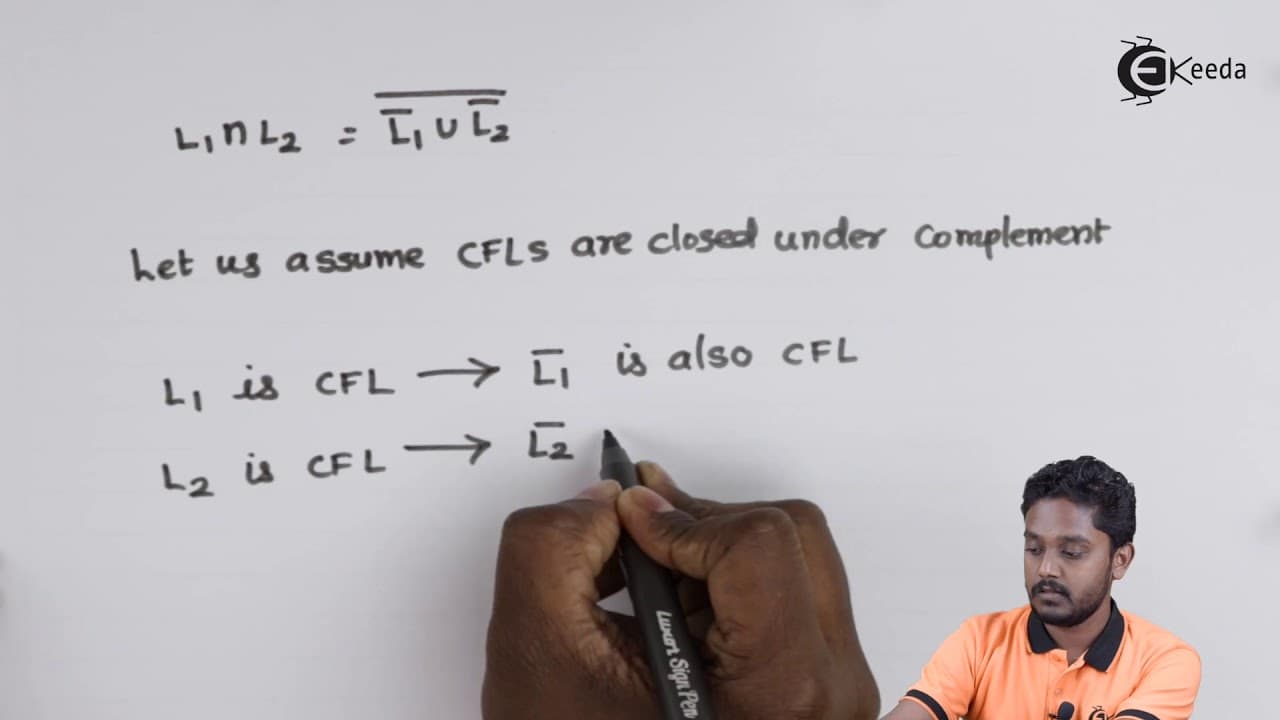
Context-free languages are not closed under complementation, proven using De Morgan's theorem and a proof by contradiction.
Transcript
click the bell icon to get latest videos from akira hello friends having proven that context-free languages are not closed under intersection we shall use that to prove that context-free languages are not too low standard complementation as well for that we will start with first the demorgan's theorum in set theory according to de Morgan's theorem ... Read More
Key Insights
- 😫 De Morgan's theorem is a fundamental concept in set theory applied to language proofs.
- ❓ Proof by contradiction is a powerful technique to establish language properties.
- 🥶 Understanding closure properties of context-free languages is crucial for language theory.
- 🥶 Context-free languages exhibit closure properties under certain operations while lacking them for others.
- 🥶 Mixing properties like intersection with regular languages showcases the complexity of context-free language operations.
Install to Summarize YouTube Videos and Get Transcripts
Explore YouTube Video Summarizer or Get YouTube Transcript Extractor
Questions & Answers
Q: What is De Morgan's theorem, and how is it applied in the proof?
De Morgan's theorem states the complement of a set intersection. In the proof, this theorem is used to show that context-free languages are not closed under complementation by contradiction.
Q: Why is the proof technique called proof by contradiction used?
Proof by contradiction is employed to assume context-free languages are closed under complementation and then show that this assumption leads to a contradiction, proving the opposite.
Q: Why is it important to understand the closure properties of context-free languages?
Understanding closure properties helps in determining the limits of operations on context-free languages and the complexity of tasks solvable by these languages.
Q: How does the proof demonstrate that context-free languages are not closed under complementation?
By showing that assuming closure under complementation leads to a contradiction regarding intersection, the proof establishes that context-free languages are not closed under complementation.
Summary & Key Takeaways
-
De Morgan's theorem states that the complement of a set intersection can be rewritten.
-
Using proof by contradiction, it is shown that context-free languages are not closed under complementation.
-
Context-free languages are closed under union and star closure but not under intersection or complementation.
Read in Other Languages (beta)
Share This Summary 📚
Summarize YouTube Videos and Get Video Transcripts with 1-Click
Try YouTube Summary with ChatGPT & Claude or YouTube Transcript Generator
Explore More Summaries from Ekeeda 📚

Summarize YouTube Videos and Get Video Transcripts with 1-Click
Try YouTube Summary with ChatGPT & Claude or YouTube Transcript Generator