Deep learning for (almost) any text classification problem (binary, multi-class, multi-label)
TL;DR
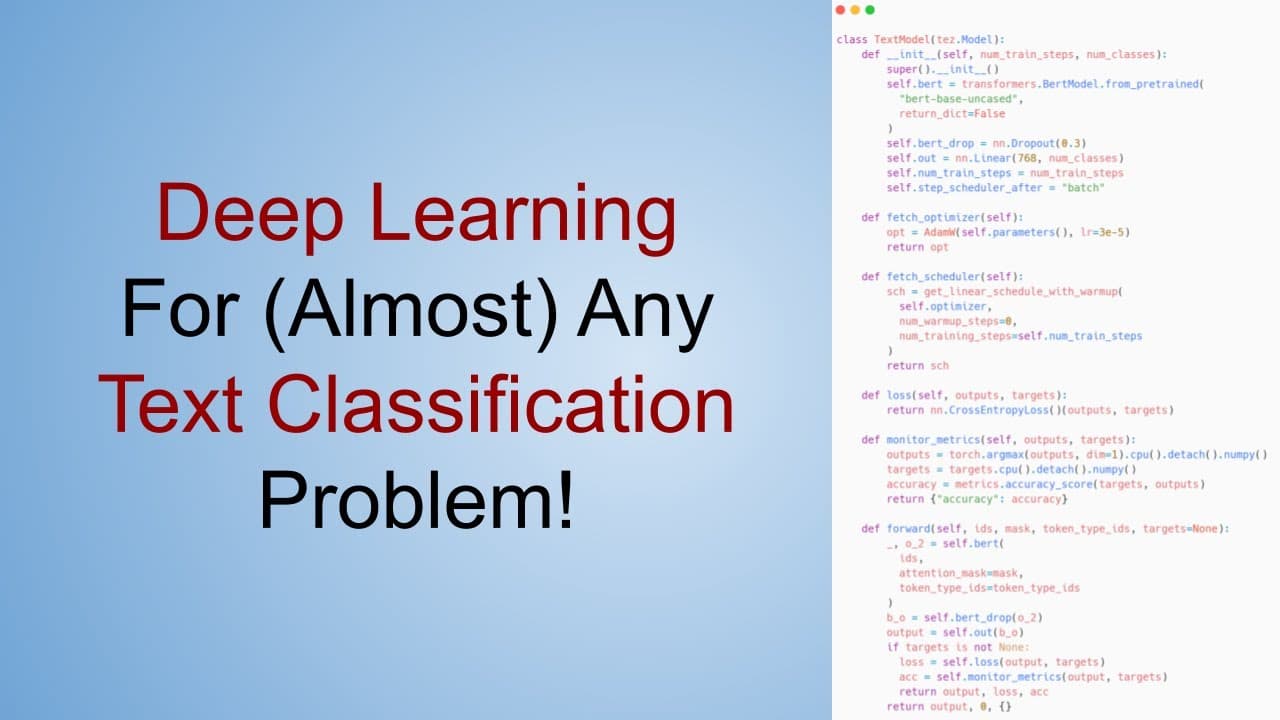
Learn how to build a text classification model using Python, PyTorch, and transfomers, with a step-by-step guide and code implementation in less than 150 lines.
Transcript
hello everyone welcome to my youtube channel in today's video i'm going to show you how we can build a text classification model using deep learning we will be using python and pytorch and we will also be using tase a small by torch trainer that we developed in our previous videos so if you haven't seen that video i would highly recommend you to go... Read More
Key Insights
- 🏛️ The video demonstrates a step-by-step process of building a text classification model using deep learning techniques.
- 😫 The dataset used is already preprocessed and split into train and validation sets.
- 🏛️ The model is built using the BERT base uncased model and leverages the transformers library.
- 🏛️ The dataset class and tokenizer are crucial components in preparing the data for training.
- ✖️ The model is initially designed for binary classification but can be easily extended to multi-class or multi-level classification problems.
- 👻 The code implementation is concise and flexible, allowing for easy modifications, such as changing the optimizer or scheduler.
- 😫 The model achieves good accuracy on the validation set and can be used for various text classification tasks.
Install to Summarize YouTube Videos and Get Transcripts
Explore YouTube Video Summarizer or Get YouTube Transcript Extractor
Questions & Answers
Q: What specific tools and libraries are used in building the text classification model?
The presenter utilizes Python, PyTorch, and transformers, which is a deep learning library, to build the model. The transformers library provides access to pre-trained models such as BERT, which is used in this tutorial.
Q: How is the dataset prepared for text classification?
The dataset used is called "IMDB set" and it contains review and sentiment columns. The data is already split into five parts using stratified k-fold. The sentiment column represents the labels to be predicted.
Q: How is tokenization applied in the model?
The tokenizer from the transformers library is used to tokenize the text. The BERT base uncased model is used, and the tokenizer method "encode_plus" is used to convert the text into input features such as input_ids, attention_mask, and token_type_ids.
Q: What modifications are required to extend the model to multi-class classification?
To extend the model to multi-class classification, the number of output classes should be adjusted. The loss function is changed to cross-entropy loss, and the prediction is obtained using the argmax function instead of sigmoid for binary classification.
Summary & Key Takeaways
-
The video tutorial demonstrates the process of building a text classification model using deep learning techniques such as Python, PyTorch, and transformers.
-
The presenter explains the necessary steps to prepare the data, build the dataset class, tokenize the text, and train the model.
-
The model is initially designed for binary classification and later extended to multi-class classification, allowing for flexibility in solving different types of text classification problems.
Read in Other Languages (beta)
Share This Summary 📚
Summarize YouTube Videos and Get Video Transcripts with 1-Click
Try YouTube Summary with ChatGPT & Claude or YouTube Transcript Generator
Explore More Summaries from Abhishek Thakur 📚

Summarize YouTube Videos and Get Video Transcripts with 1-Click
Try YouTube Summary with ChatGPT & Claude or YouTube Transcript Generator