Multiplying Radical Expressions With Different Index Numbers
TL;DR
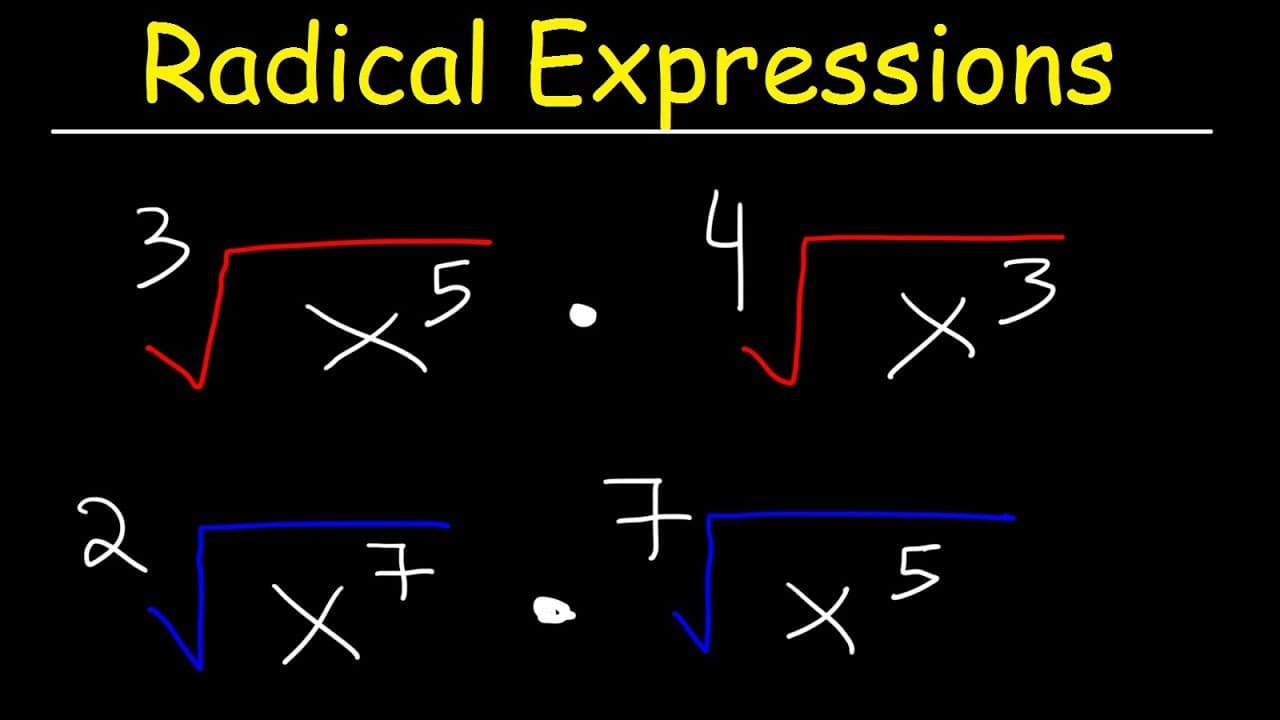
When multiplying radical expressions with different index numbers, convert them to exponential notation, find a common denominator for the exponents, add the exponents, and simplify the expression.
Transcript
what is the fifth root of x cubed multiplied by the fifth root of x to the fourth if the index number is the same you can simply multiply the stuff inside x cubed times x to the fourth is x to the seventh and then five goes into seven one time with two remaining and so that's gonna be the answer but now what if the index numbers are different let's... Read More
Key Insights
- 😑 When multiplying radical expressions with the same index, you can directly multiply the terms inside and keep the same index for the simplified expression.
- 😑 Different index numbers require converting radical expressions to exponential notation for simplification.
- 😑 Finding a common denominator for the exponents is essential to add them together when simplifying radical expressions with different index numbers.
- 😑 Simplified answers may still have radicals, depending on the given expression and its components.
- 😑 The process of simplifying radical expressions involves both mathematical skills and concept application.
- 😑 Converting to exponential notation facilitates algebraic operations on radical expressions.
- 😑 Simplifying radical expressions allows for easier calculations and a clearer understanding of the mathematical concepts involved.
Install to Summarize YouTube Videos and Get Transcripts
Explore YouTube Video Summarizer or Get YouTube Transcript Extractor
Questions & Answers
Q: How do you simplify radical expressions with different index numbers?
When the index numbers are different, you need to convert the expressions to exponential notation, find a common denominator, add the exponents, and simplify. This allows for a simplified expression in terms of the original radicals.
Q: What happens when the index numbers of radical expressions are the same?
When the index numbers are the same, you can simply multiply the expressions inside and use the same index number for the answer. It results in multiplying the terms inside the radicals without changing the index.
Q: What is the general process for simplifying radical expressions?
The general process involves converting radical expressions to exponential notation, finding a common denominator for the exponents, adding the exponents, and simplifying the expression further if possible. This helps in reducing complex radicals to simpler forms.
Q: How can exponential notation be used to simplify radical expressions?
Exponential notation allows us to convert radical expressions into expressions with exponents. This makes it easier to manipulate the expressions, particularly when dealing with different index numbers. Converting to exponential notation helps in finding a common ground for the exponents.
Summary & Key Takeaways
-
When the index numbers of radical expressions are the same, simply multiply the expressions inside and use the same index number for the answer.
-
When the index numbers are different, convert the radical expressions to exponential notation, find a common denominator, add the exponents, and simplify further if possible.
-
The process involves converting radical expressions to exponential notation, finding a common denominator, adding the exponents, and simplifying the expression.
Read in Other Languages (beta)
Share This Summary 📚
Summarize YouTube Videos and Get Video Transcripts with 1-Click
Try YouTube Summary with ChatGPT & Claude or YouTube Transcript Generator
Explore More Summaries from The Organic Chemistry Tutor 📚



Summarize YouTube Videos and Get Video Transcripts with 1-Click
Try YouTube Summary with ChatGPT & Claude or YouTube Transcript Generator