Allowing the user to upload zip to s3 bucket | NFT-Magic DevLog 9
TL;DR
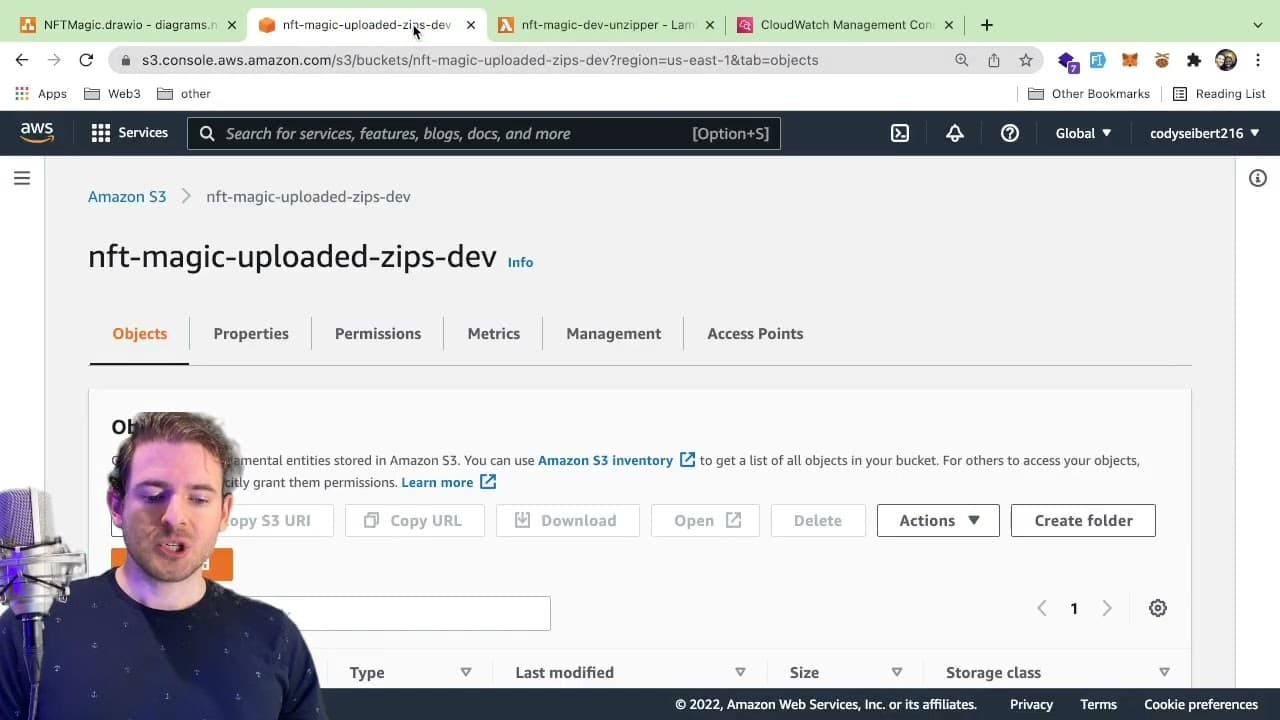
This video details the development of a serverless minting system using AWS and the Serverless Framework.
Transcript
hey everyone welcome back to another video of this series so in the last video i talked a little bit how i'm bringing in the serverless framework which is basically just an npm package you can set up and install and what this framework allows you to do is quickly create your amazon resources and kind of connect them all together so using that what ... Read More
Key Insights
- 👻 The Serverless Framework simplifies the setup of AWS resources, allowing users to deploy applications quickly.
- 🆘 Using a diagram helps visualize system architecture, improving comprehension of how components interact in the development process.
- 😑 A pre-signed URL is crucial for securely handling file uploads while maintaining private S3 bucket integrity.
- 👤 Integration of AWS Lambda enhances functionality, enabling automated processes triggered by user actions.
- 👨🔬 Next.js not only enhances performance but also ensures future scalability concerning search engine optimization.
- 🏸 Permissions management within AWS is essential to ensure the security and proper operation of the minting system.
- 💬 Adopting a structured approach to development with high-level diagrams and detailed comments can improve the clarity of project execution.
Install to Summarize YouTube Videos and Get Transcripts
Explore YouTube Video Summarizer or Get YouTube Transcript Extractor
Questions & Answers
Q: What is the purpose of a pre-signed URL in this minting system?
A pre-signed URL allows users to upload files directly to a private S3 bucket without exposing the bucket's permissions. By creating this URL, the system can securely grant temporary access to specific actions, ensuring that only authorized requests can upload files within a set timeframe and parameters.
Q: How does the Lambda function integrate with the S3 bucket?
The Lambda function acts as a backend service that handles the trigger when a new file is uploaded to the S3 bucket. This integration utilizes events from S3 to invoke the Lambda function, allowing it to perform actions such as unzipping the uploaded file or processing its contents as required for the minting system.
Q: What framework was used for the front-end development, and why?
Next.js was chosen for the front-end development because it provides benefits particularly beneficial for search engine optimization and server-side rendering. This framework allows developers to build React applications that can be statically generated, improving loading times and user experience.
Q: What role does DynamoDB play in this minting system?
DynamoDB is used to store metadata about the job lifecycle related to file uploads. It tracks the status of jobs, such as whether they are ready for processing, currently processing, or completed. This allows for efficient job management and monitoring within the minting system.
Summary & Key Takeaways
-
The video demonstrates how to create a minting system using the Serverless Framework, focusing on user file uploads to AWS S3.
-
It explains the process of generating pre-signed URLs to facilitate secure uploads to a private S3 bucket and triggers an AWS Lambda function.
-
Equipped with a UI built using Next.js, the content details the coding specifics behind the upload functionality and future plans to store metadata in DynamoDB.
Read in Other Languages (beta)
Share This Summary 📚
Summarize YouTube Videos and Get Video Transcripts with 1-Click
Try YouTube Summary with ChatGPT & Claude or YouTube Transcript Generator
Explore More Summaries from Web Dev Cody 📚

Summarize YouTube Videos and Get Video Transcripts with 1-Click
Try YouTube Summary with ChatGPT & Claude or YouTube Transcript Generator