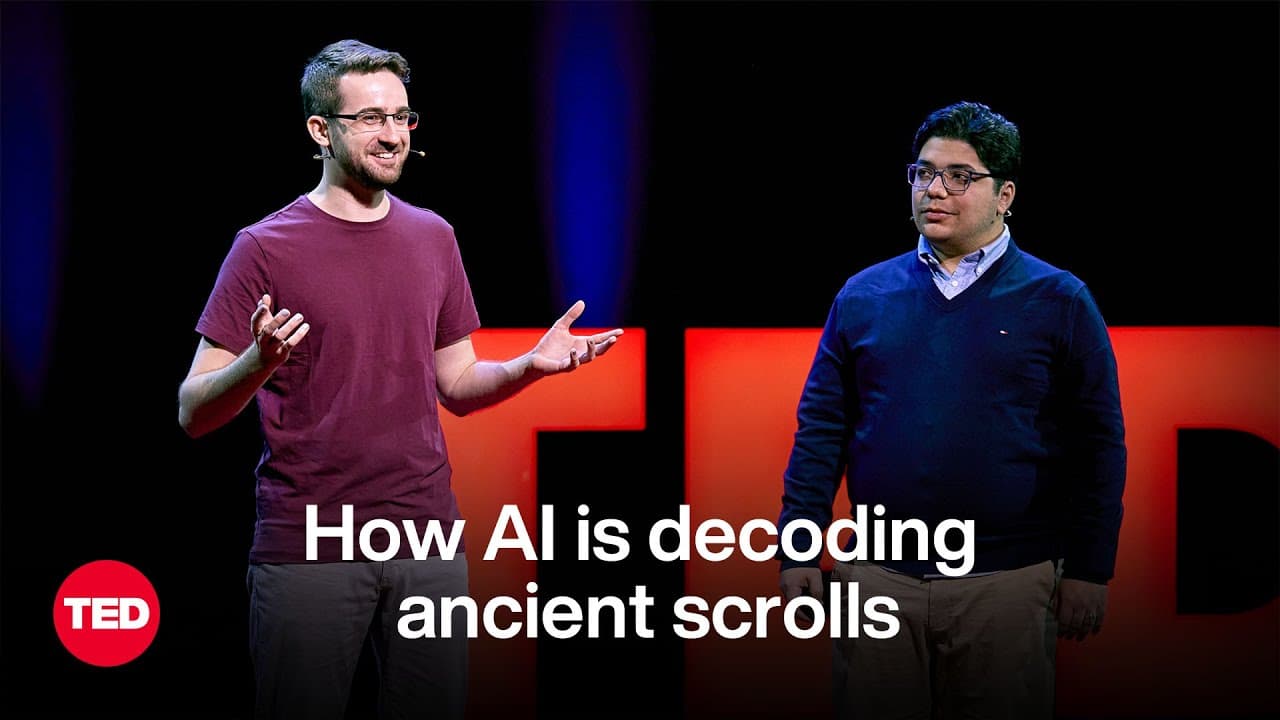
How AI Is Decoding Ancient Scrolls | Julian Schilliger and Youssef Nader | TED
TL;DR
AI is revolutionizing the recovery of ancient texts lost in the eruption of Vesuvius.
Transcript
We always think about the potential of AI changing the future. But what about the potential of AI changing the past? My name is Youssef Nader. I'm an Egyptian AI researcher and a PhD student at the Free University in Berlin, and last year, I led the Vesuvius Grand Prize winning team on exploring this very question. You see, the story starts almost ... Read More
Key Insights
- 😚 AI can dramatically alter our understanding of history by revealing lost texts from archaeological sites.
- 🥺 The collaborative effort of researchers and technology enthusiasts can lead to significant breakthroughs in ancient text recovery.
- 👻 Innovating on existing technologies, such as CT scanning, allows for enhanced exploration of fragile artifacts without physical damage.
- 🌉 Digital archaeology is increasingly reliant on machine learning, bridging cultural history with modern technology.
- 👍 Iteration and community involvement proved essential in refining algorithms for deciphering difficult text patterns.
- 👥 The use of open-source methodologies provided greater accessibility and collaboration among different groups tackling archaic challenges.
- 💨 The advancements in this project could pave the way for further studies on other similar archaeological finds around the world.
Install to Summarize YouTube Videos and Get Transcripts
Explore YouTube Video Summarizer or Get YouTube Transcript Extractor
Questions & Answers
Q: What motivated the Vesuvius Challenge?
The Vesuvius Challenge was initiated by Brent Seales and Nat Friedman to engage the global tech community in solving the problem of recovering text from ancient scrolls. The goal was to create innovative solutions that would allow digital unrolling and reading of the scrolls without causing further damage, providing an opportunity to unlock historical knowledge that has been inaccessible for centuries.
Q: How did Youssef Nader contribute to the Vesuvius Challenge?
Youssef Nader played a key role by developing algorithms to improve the computer vision techniques used for virtual unrolling of the scrolls. His contributions included optimizing existing tools, creating new algorithms, and participating actively in team discussions. His efforts significantly enhanced the segmentation processes, leading to better representations of the scrolls and, ultimately, uncovering ancient texts.
Q: What technological advancements facilitated the recovery of the scrolls?
The recovery of the scrolls was greatly aided by CT scan technology, which allowed researchers to create detailed 3D representations of the tightly rolled papyrus. Additionally, machine learning models were developed to detect faint ink patterns on the scans. These technologies combined enabled a more thorough understanding and visualization of ancient writings, pushing boundaries in digital archaeology.
Q: What challenges did researchers face when working with the scrolls?
Researchers encountered significant challenges due to the physical damage of the scrolls caused by the volcanic eruption. The carbon-based ink blended with the carbon-based papyrus made it extremely hard to detect ink patterns using conventional imaging. Furthermore, the unrolling process traditionally involved damaging the scrolls, complicating efforts to preserve their content while attempting to read them.
Q: Can you explain the iterative process used to improve the machine learning models?
The iterative process involved training machine learning models on data set improvements derived from prior iterations of the model. Researchers continuously fine-tuned the models by gradually refining the data inputs, preventing overfitting while allowing the model to learn from both its previous predictions and the ground truth. This method resulted in progressively better performance in identifying letters within the scrolls.
Q: What results did the research team achieve within nine months?
Within nine months, the research team successfully recovered over 2,000 letters from various scrolls, translating these findings into coherent text across multiple columns. The clarity of recovery was impressive, achieving around 85 percent clarity overall. These letters represent a remarkable accomplishment, providing glimpses into ancient philosophies and thoughts that had been inaccessible for nearly two millennia.
Summary & Key Takeaways
-
Youssef Nader, an AI researcher, delves into how modern tech, particularly AI, is being used to explore ancient writings from the Villa dei Papiri, buried by Mount Vesuvius.
-
The Vesuvius Challenge inspired a global effort to digitally unroll and decipher scrolls that were damaged during the eruption. Using CT scans and machine learning, researchers have made significant progress in revealing hidden texts.
-
Collective advancements led to the successful reconstruction of over 2,000 letters from these scrolls, providing new insights into historical thought and culture, and showcasing the potential of AI in archaeological studies.
Read in Other Languages (beta)
Share This Summary 📚
Summarize YouTube Videos and Get Video Transcripts with 1-Click
Try YouTube Summary with ChatGPT & Claude or YouTube Transcript Generator
Explore More Summaries from TED 📚


Summarize YouTube Videos and Get Video Transcripts with 1-Click
Try YouTube Summary with ChatGPT & Claude or YouTube Transcript Generator