The Bulgarian Language - Slavic but DIFFERENT
TL;DR
Bulgarian is a distinct Slavic language with unique features.
Transcript
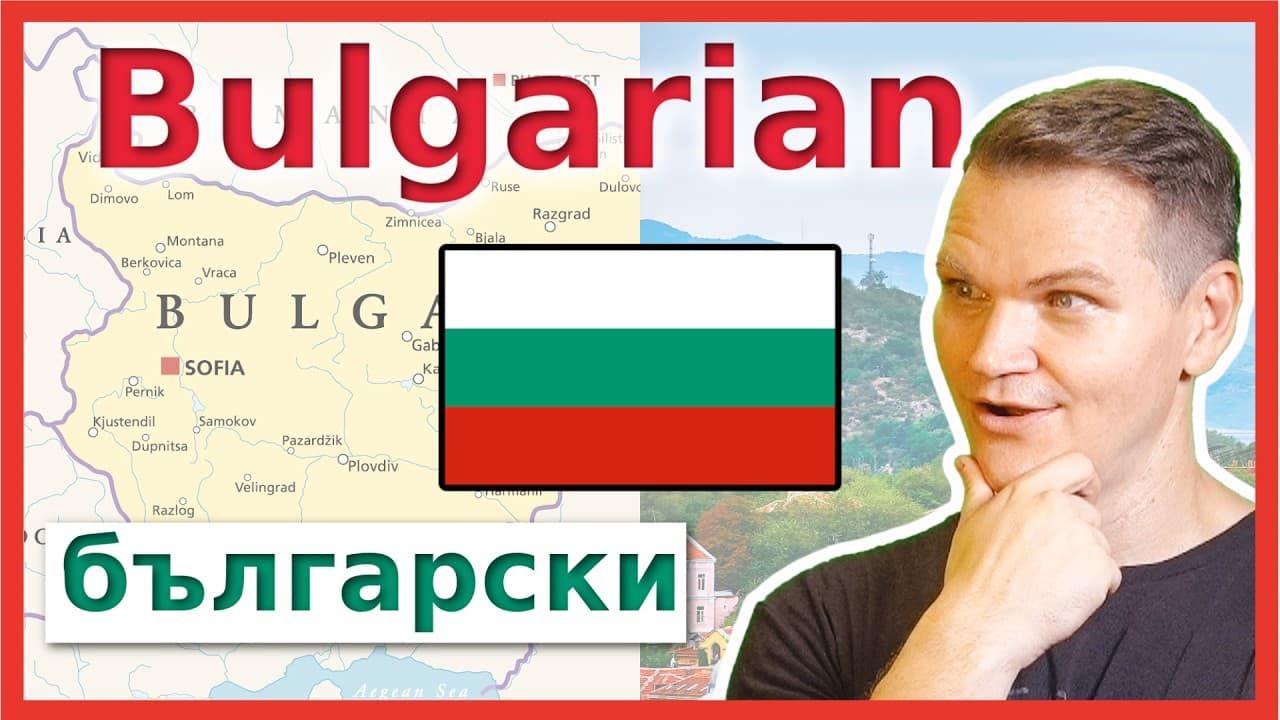
in this video we're going to focus on the Bulgarian language or Bulgari as it's called in Bulgarian as you can probably guess it's the official language of Bulgaria where it's the native language of around 85% of the population in Bulgaria there are also two main minority languages Turkish spoken by around 99.1% and Romani spoken by around 4.2% but... Read More
Key Insights
- Bulgarian is the official language of Bulgaria, spoken by 85% of the population, with Turkish and Romani as minority languages.
- It belongs to the South Slavic branch of the Slavic language family, sharing similarities with Macedonian.
- Bulgarian lacks noun cases, a feature unique among Slavic languages, relying on word order and prepositions instead.
- The language uses definite article suffixes that vary depending on the noun’s gender, number, and role in the sentence.
- Bulgarian does not have an infinitive verb form, using 'da' before the present tense to express actions.
- It employs the Cyrillic script, with a unique letter representing the vowel sound 'uh', not commonly found in other Slavic languages.
- Noun-adjective agreement is crucial in Bulgarian, with adjectives conforming to the gender and number of the nouns they describe.
- Bulgarian's grammar has undergone simplification, making it more accessible than other Slavic languages, yet retaining complex verb forms.
Install to Summarize YouTube Videos and Get Transcripts
Explore YouTube Video Summarizer or Get YouTube Transcript Extractor
Questions & Answers
Q: What makes Bulgarian distinct among Slavic languages?
Bulgarian is unique among Slavic languages because it lacks a noun case system, relying on word order and prepositions to indicate grammatical relationships. It also uses definite article suffixes that vary based on the noun's gender, number, and role in the sentence, a feature not seen in other Slavic languages.
Q: How has Bulgarian been influenced by other languages?
Bulgarian's grammar and vocabulary have been influenced by languages in the Balkan region, such as Greek. This influence contributed to the loss of noun cases and the adoption of definite article suffixes. Additionally, the language's development was shaped by historical interactions with Turkic and other Slavic peoples.
Q: Why is Bulgarian considered more accessible than other Slavic languages?
Bulgarian is considered more accessible due to its grammatical simplifications, such as the absence of a noun case system and the use of definite article suffixes. These features reduce the complexity typically associated with Slavic languages, making Bulgarian easier to learn for non-native speakers.
Q: What script is used for writing Bulgarian, and what are its unique features?
Bulgarian is written using the Cyrillic script, which is common among Slavic languages. However, it features a unique letter representing the vowel sound 'uh', which is not widely used in other Slavic languages. This letter is an integral part of Bulgarian orthography and pronunciation.
Q: How does Bulgarian handle verb forms without an infinitive?
Bulgarian does not have an infinitive verb form. Instead, it uses the particle 'da' before the present tense form of a verb to express actions. This construction is used to convey meanings similar to the infinitive in other languages, such as 'to sleep' or 'to eat'.
Q: What historical developments shaped the Bulgarian language?
The Bulgarian language evolved through various historical stages, including Old Bulgarian, influenced by the Bulgarian Empire's interactions with Slavic and non-Slavic peoples. The language's development was marked by the creation of the Cyrillic script and significant grammatical changes, such as the loss of noun cases.
Q: How does Bulgarian noun-adjective agreement work?
In Bulgarian, adjectives must agree with the nouns they describe in terms of gender, number, and definiteness. This means that the form of the adjective changes to match the noun, ensuring grammatical consistency in sentences. Such agreement is a fundamental aspect of Bulgarian grammar.
Q: What are some common phrases in Bulgarian, and how are they structured?
Common Bulgarian phrases include greetings like 'Zdraveite' (formal 'hello') and 'Zdrasti' (informal 'hi'). Phrases are structured with a focus on word order, definite article suffixes, and noun-adjective agreement. Questions often use the particle 'li' to form yes-no questions, reflecting Bulgarian's unique grammatical structure.
Summary & Key Takeaways
-
Bulgarian is a South Slavic language predominantly spoken in Bulgaria, with unique linguistic features distinguishing it from other Slavic languages. It lacks noun cases, uses definite article suffixes, and employs the Cyrillic script with a unique vowel letter.
-
The language's historical development includes influences from non-Slavic languages, contributing to its distinctive grammar, such as the absence of an infinitive verb form and the use of 'da' for expressing actions.
-
Bulgarian is considered more accessible due to its grammatical simplifications, though it retains complex verb forms. It is written in Cyrillic and features noun-adjective agreement, making it a fascinating study for language enthusiasts.
Read in Other Languages (beta)
Share This Summary 📚
Summarize YouTube Videos and Get Video Transcripts with 1-Click
Try YouTube Summary with ChatGPT & Claude or YouTube Transcript Generator
Explore More Summaries from Langfocus 📚
Summarize YouTube Videos and Get Video Transcripts with 1-Click
Try YouTube Summary with ChatGPT & Claude or YouTube Transcript Generator