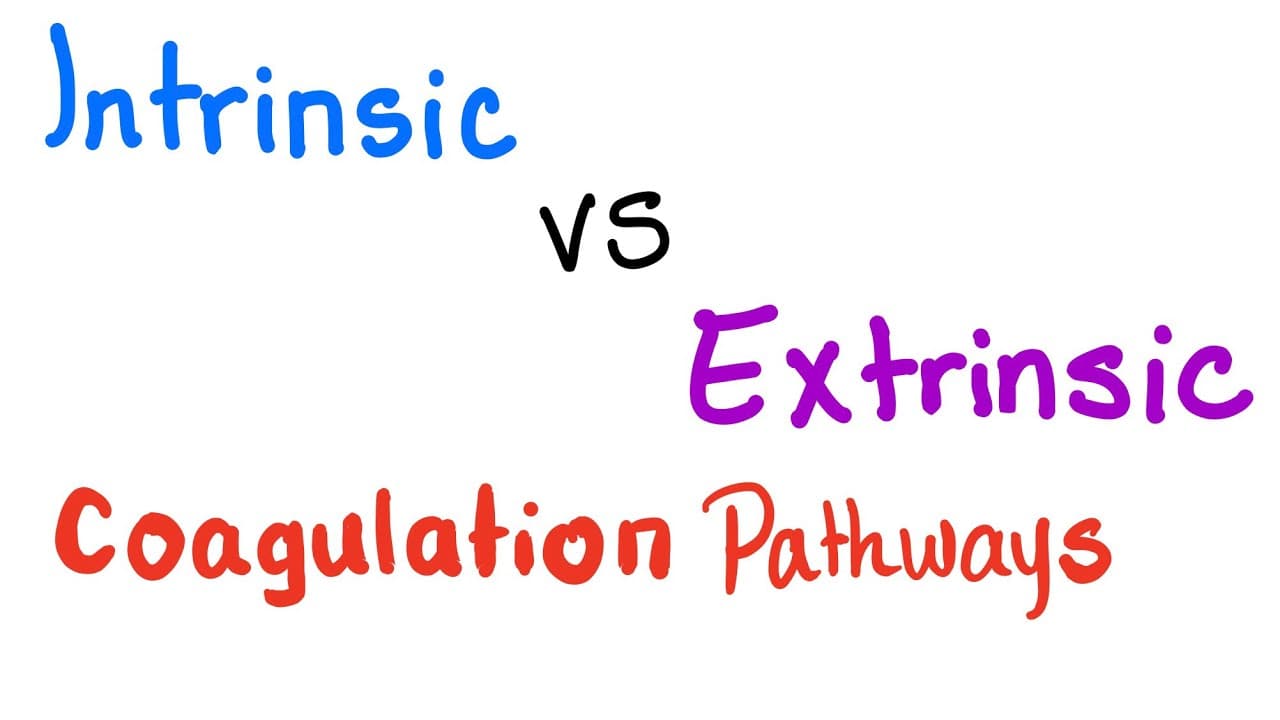
What Are Intrinsic and Extrinsic Coagulation Pathways?
TL;DR
Intrinsic coagulation involves multiple internal factors and is more efficient for hemostasis, while extrinsic coagulation is faster and relies on external tissue factors. Both pathways play crucial roles in preventing blood loss, balancing coagulation and anti-coagulation mechanisms. Understanding these differences is essential for effective bleeding management.
Transcript
hey guys it's medicos is perfection Alice where medicine makes perfect sense today we'll continue discussing our bleeding and coagulation series of lectures this is the 18th video in my series we'll talk about a comparison between the intrinsic and the extrinsic coagulation pathways and let's get started as I'... Read More
Key Insights
- Hemostasis involves vasoconstriction, primary hemostasis, coagulation, fibrinolysis, and tissue repair to prevent blood loss.
- Primary hemostasis is driven by platelets adhering to exposed subendothelial collagen via von Willebrand factor.
- Secondary hemostasis involves the coagulation cascade, forming a fibrin mesh to stabilize the platelet plug.
- Intrinsic pathway is activated by internal vessel factors, starting with factor 12 and is longer but more efficient.
- Extrinsic pathway requires external tissue factors, starting with factor 7, and is shorter but faster.
- PTT test measures intrinsic and common pathways, while PT test measures extrinsic and common pathways.
- Intrinsic pathway involves factors 12, 11, 9, and 8, while extrinsic pathway primarily involves factor 7.
- The balance between pro-coagulation and anti-coagulation factors is crucial to prevent excessive bleeding or clotting.
Install to Summarize YouTube Videos and Get Transcripts
Explore YouTube Video Summarizer or Get YouTube Transcript Extractor
Questions & Answers
Q: What are the main steps of hemostasis?
Hemostasis involves several key steps: vasoconstriction, primary hemostasis, coagulation (secondary hemostasis), fibrinolysis, and tissue repair. Vasoconstriction reduces blood flow, primary hemostasis involves platelet adhesion, coagulation forms a fibrin mesh, fibrinolysis dissolves clots, and tissue repair restores normal function.
Q: How do the intrinsic and extrinsic pathways differ in coagulation?
The intrinsic pathway is longer, involves factors 12, 11, 9, and 8, and is activated by internal vessel factors like subendothelial collagen. It is more efficient. The extrinsic pathway is shorter, involves primarily factor 7, and is activated by external tissue factors, making it faster but less efficient.
Q: What roles do platelets play in primary hemostasis?
In primary hemostasis, platelets adhere to exposed subendothelial collagen via the von Willebrand factor, leading to platelet activation. Activated platelets release substances like ADP and thromboxane A2, promoting further platelet aggregation and vasoconstriction, which helps form a temporary platelet plug to stop bleeding.
Q: What is the significance of the PTT and PT tests?
The PTT test measures the intrinsic and common pathways of coagulation, involving factors 12, 11, 9, and 8. The PT test measures the extrinsic and common pathways, primarily involving factor 7. These tests help diagnose bleeding disorders by assessing the functionality of specific coagulation pathways.
Q: Why is it important to balance pro-coagulation and anti-coagulation factors?
Balancing pro-coagulation and anti-coagulation factors is crucial to maintain normal blood flow and prevent excessive bleeding or clotting. An imbalance can lead to conditions like thrombosis or hemorrhage, which can have serious health implications. The body naturally regulates this balance to ensure proper hemostasis.
Q: What is the role of fibrinolysis in hemostasis?
Fibrinolysis is the process of breaking down fibrin in blood clots, which is crucial for restoring normal blood flow after a clot has served its purpose. It helps remove clots that are no longer needed, preventing blockages in blood vessels and contributing to the healing and repair of injured tissues.
Q: How does the intrinsic pathway gain efficiency despite being longer?
The intrinsic pathway gains efficiency through a cascade effect, where each step amplifies the preceding one. This cascade, like a waterfall, gains gravity, acceleration, and momentum, making it more efficient in forming a stable clot despite having more steps compared to the extrinsic pathway.
Q: What external resources are recommended for further learning on coagulation?
The video recommends additional resources such as 50 hematology cases available on Patreon, which provide in-depth learning and practice on platelets and bleeding disorders. It also suggests animated mnemonics from Picmonic and various courses on the Medicosis Perfectionalis website for comprehensive medical education.
Summary & Key Takeaways
-
The video discusses the intrinsic and extrinsic pathways of coagulation, essential for hemostasis, which prevents blood loss. Intrinsic pathway is longer and more efficient, starting with factor 12 and activated by internal vessel factors. Extrinsic pathway is shorter and faster, starting with factor 7 and requires external tissue factors.
-
Primary hemostasis involves platelet adhesion and activation, while secondary hemostasis involves the coagulation cascade. The intrinsic pathway is measured by PTT test and involves factors 12, 11, 9, and 8. The extrinsic pathway is measured by PT test and primarily involves factor 7.
-
A balance between pro-coagulation and anti-coagulation factors is crucial for maintaining normal blood flow and preventing excessive bleeding or clotting. The video also promotes additional resources and case studies available on Patreon for further learning.
Read in Other Languages (beta)
Share This Summary 📚
Summarize YouTube Videos and Get Video Transcripts with 1-Click
Try YouTube Summary with ChatGPT & Claude or YouTube Transcript Generator
Explore More Summaries from Medicosis Perfectionalis 📚
Summarize YouTube Videos and Get Video Transcripts with 1-Click
Try YouTube Summary with ChatGPT & Claude or YouTube Transcript Generator