Introduction to Neuroanatomy - Learn the Basics - Neuroanatomy Playlist
TL;DR
Comprehensive guide to understanding neuroanatomy fundamentals for medical students.
Transcript
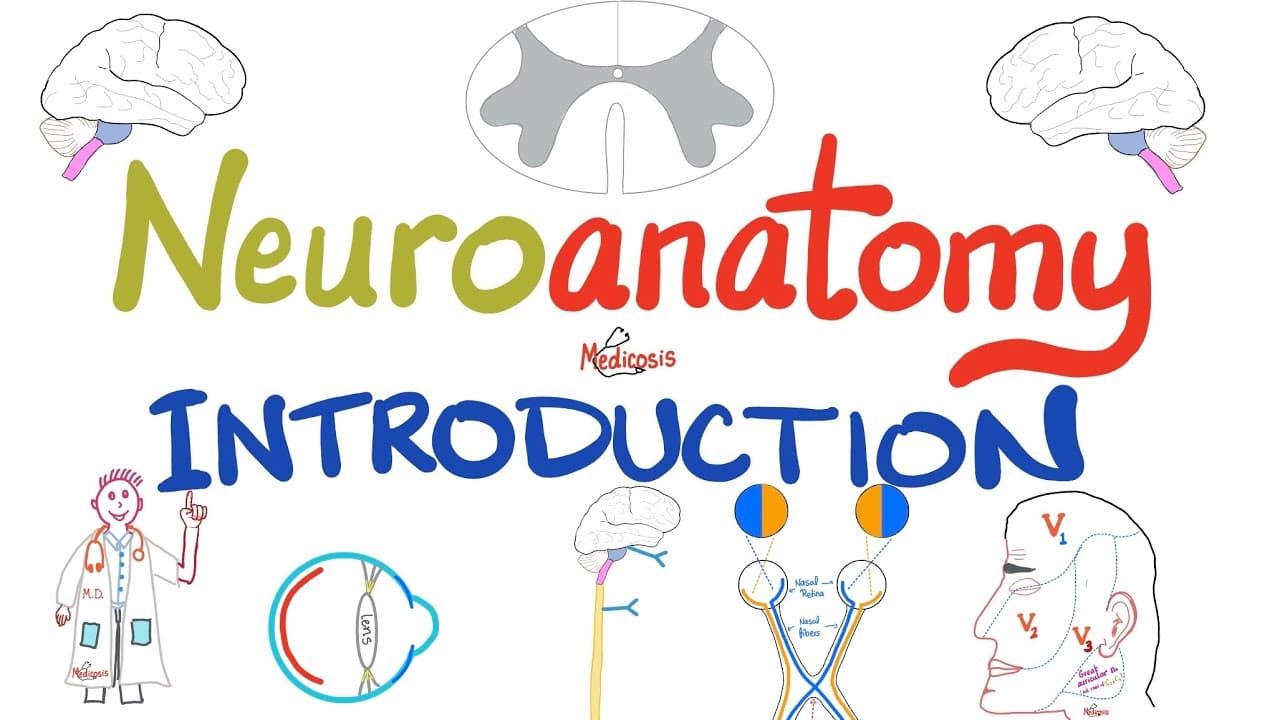
hello wonderful people it's medicosis perfect Snus where medicine makes perfect sense welcome to a new playlist medicosis neuroanatomy making sense of one of the most challenging subjects in medicine if you watch this playlist neuroanatomy in its entirety I promise you you will understand the subject better than 95% of doctors first let's get organ... Read More
Key Insights
- 😟 Understanding the differences between the central nervous system and peripheral nervous system is foundational in neuroanatomy.
- 😷 The Ten Commandments of Neuroanatomy serve as a guide for medical students to primarily grasp concepts of motor and sensory pathways and their implications in clinical practice.
- 🥺 Myelin, produced by oligodendrocytes in CNS and Schwann cells in PNS, is crucial for faster signal transmission; damage to these can lead to disorders.
- 🤕 Cranial nerves are integral to sensory and motor functions in the head and neck, each serving specific roles in sensory perception, muscle movement, and autonomic functions.
- 🧠 The organization of nuclei in brain structures aids in understanding the functional aspects of various cranial nerves and their relationships to other brain regions.
- 😟 Grasping the embryological development of the nervous system enriches understanding of congenital neuroanatomical issues, influencing clinical approaches.
- 🫠 Knowledge of the reflex arc, which involves sensory and motor pathways, is vital for understanding both fundamental and complex neurological responses.
Install to Summarize YouTube Videos and Get Transcripts
Explore YouTube Video Summarizer or Get YouTube Transcript Extractor
Questions & Answers
Q: What are the main components of the central and peripheral nervous systems?
The central nervous system (CNS) consists solely of the brain and spinal cord, while the peripheral nervous system (PNS) includes all the nerves that branch out from the brain and spinal cord, encompassing cranial and spinal nerves. Each plays vital roles in transmitting signals and reflexes throughout the body, with the CNS being the control center and the PNS facilitating communication between the CNS and the rest of the body.
Q: What are the "Ten Commandments of Neuroanatomy" mentioned in the content?
The "Ten Commandments" serve as foundational principles for mastering neuroanatomy. They cover the differentiation between motor (efferent) and sensory (afferent) pathways, understanding the distinction between CNS and PNS, knowing about myelinated versus unmyelinated fibers, and grasping the terminology associated with neural structures, like nuclei, ganglia, and tracts. Mastery of these concepts is essential for delving deeper into neuroanatomy.
Q: Can you explain the significance of myelination in the nervous system?
Myelination is crucial in the nervous system as it increases the speed of electrical impulses along axons, enhancing neuronal communication. Myelinated fibers, which appear white, are found mostly in white matter, while unmyelinated fibers, appearing gray, are located in gray matter. This distinction is vital for understanding the physiological functions and the implications of demyelinating diseases like multiple sclerosis, which impair nerve conduction.
Q: What are the main functions of the autonomic nervous system?
The autonomic nervous system (ANS) regulates involuntary bodily functions such as heart rate, digestion, and respiratory rate. It consists of sympathetic (fight or flight), parasympathetic (rest and digest), and enteric systems, each responsible for different physiological responses. Understanding this system is key in clinical settings as it helps determine the body's reaction to stress, stimuli, and restorative processes.
Summary & Key Takeaways
-
The content presents a detailed overview of neuroanatomy, focusing on the central and peripheral nervous systems, and key distinctions between motor and sensory pathways.
-
Ten commandments of neuroanatomy are outlined, emphasizing foundational concepts essential for mastery, such as the differentiation of CNS from PNS and understanding of neural structures.
-
Key topics include cranial nerves, brain organization, myelination, autonomic functions, and embryological development of the nervous system, providing a comprehensive resource for students.
Read in Other Languages (beta)
Share This Summary 📚
Summarize YouTube Videos and Get Video Transcripts with 1-Click
Try YouTube Summary with ChatGPT & Claude or YouTube Transcript Generator
Explore More Summaries from Medicosis Perfectionalis 📚


Summarize YouTube Videos and Get Video Transcripts with 1-Click
Try YouTube Summary with ChatGPT & Claude or YouTube Transcript Generator