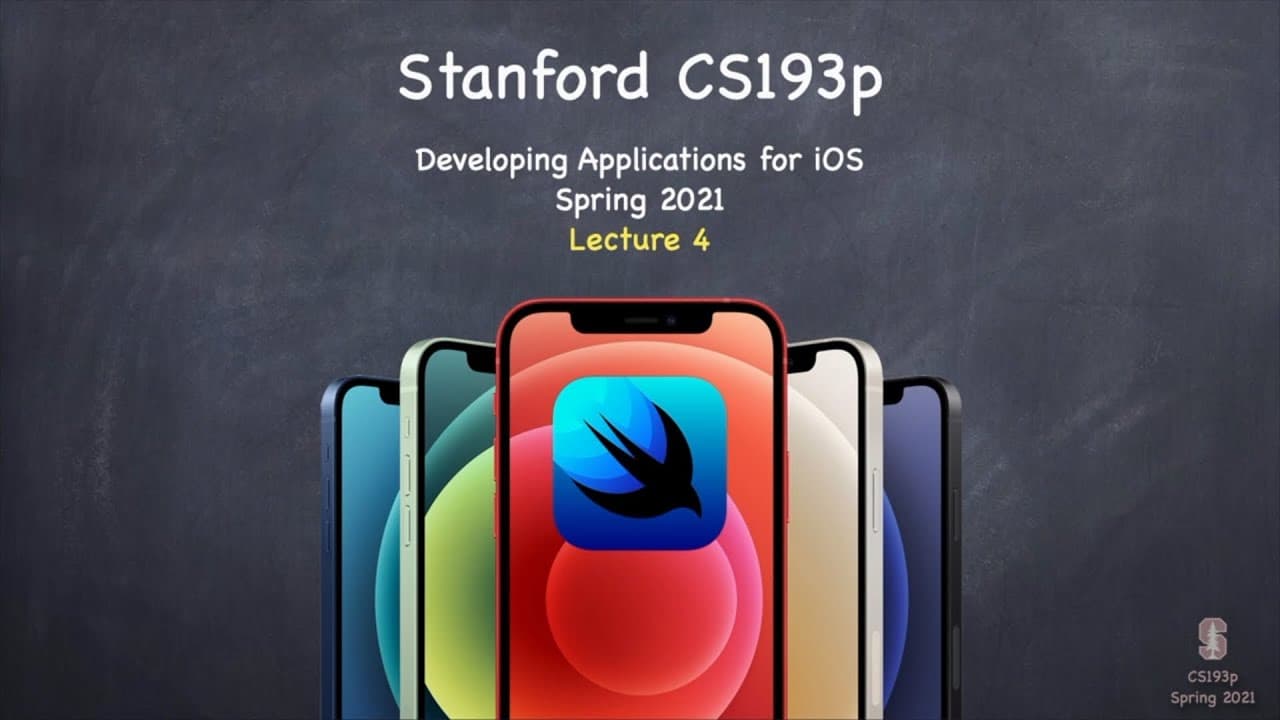
Lecture 4: Memorize Game Logic
TL;DR
This content provides a demo of implementing the Model-View-ViewModel (MVVM) architecture in Swift, with a focus on using Optional and Array functions.
Transcript
- [Narrator] Stanford University. - [Instructor] We are back for lecture four. Stanford CS193p, spring of 2021. We're going to start right off with the demo and complete what we started with this MVVM architecture. We've done the Model, we've done the ViewModel. Now we need to hook all that up to our View. After we get that working, I'm gonna come ... Read More
Key Insights
- 👨💻 The MVVM architecture provides a structured approach to separate concerns and create reusable and testable code.
- 😫 Optionals are used to represent values that may or may not be set, providing a type-safe way to handle potential nil values.
Install to Summarize YouTube Videos and Get Transcripts
Explore YouTube Video Summarizer or Get YouTube Transcript Extractor
Questions & Answers
Q: What is the difference between using an exclamation point and an if let statement to unwrap an Optional value?
Using an exclamation point is called forced unwrapping and assumes that the Optional is not nil. If it is nil, it will crash the app. On the other hand, an if let statement safely unwraps the Optional and provides a default value if it is nil, without crashing the app.
Q: Why is the firstIndex(where:) function used instead of the index(of:) function in the code?
The firstIndex(where:) function allows for more complex comparisons and evaluations to find the index of an element in an Array. It provides flexibility and the ability to customize the comparison logic.
Q: Can an Optional have multiple associated values?
No, an Optional can only have one associated value. It represents a value that is either set or not set, rather than multiple possible values.
Summary & Key Takeaways
-
The video starts with a demo of hooking up the MVVM architecture using the Model, ViewModel, and View. The focus is on connecting the View to the ViewModel and updating the UI based on the Model.
-
The code is then updated to use Optional and Array functions. The index(of:) function is modified to return an Optional and the firstIndex(where:) function from the Array is introduced to find the index of a card in the Array.
-
Finally, an overview of Optionals and their usage is provided, including how to declare, set values, and unwrap Optionals using exclamation points or if let statements.
Read in Other Languages (beta)
Share This Summary 📚
Summarize YouTube Videos and Get Video Transcripts with 1-Click
Try YouTube Summary with ChatGPT & Claude or YouTube Transcript Generator
Explore More Summaries from Stanford 📚




Summarize YouTube Videos and Get Video Transcripts with 1-Click
Try YouTube Summary with ChatGPT & Claude or YouTube Transcript Generator