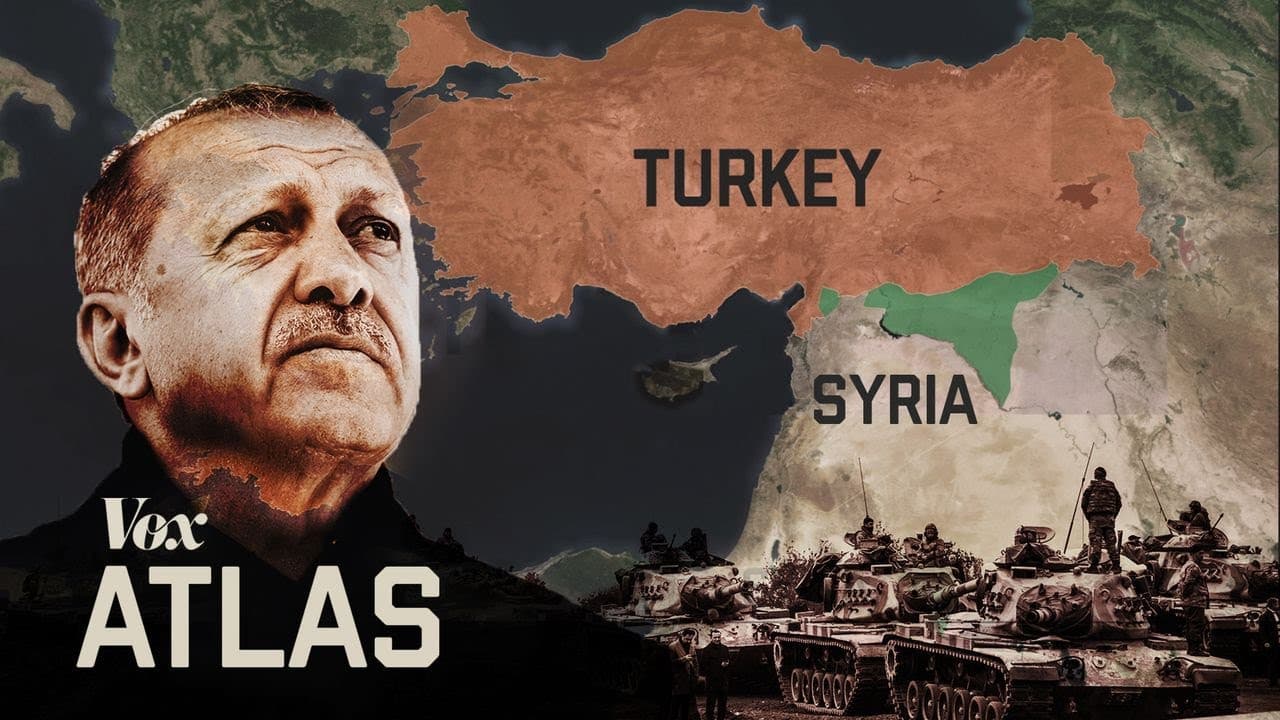
Why Turkey is invading Syria
TL;DR
Turkey invaded Syria to establish a safe zone amid political pressure.
Transcript
This plume of smoke is rising from a town in Syria. A similar scene unfolded in another town about a hundred kilometers away. These attacks were the result of Turkish airstrikes on October 9th 2019, when Turkey's invasion of northern Syria began. The long-planned Turkish military operation in Northeast Syria has been launched. Turkey pushing ever d... Read More
Key Insights
- Turkey's invasion of northeastern Syria began on October 9, 2019, following the withdrawal of US troops, aiming to establish a safe zone.
- The safe zone is intended to serve as a buffer against the Syrian War and manage the Kurdish influence, which Turkey views as a threat.
- Turkey's President Erdoğan faces internal political pressure due to economic downturns and the presence of Syrian refugees, influencing his aggressive policy.
- The Syrian Democratic Forces (SDF), backed by the US, were instrumental in defeating ISIS but are now under threat from Turkish forces.
- The US withdrawal from Syria has created a power vacuum, leading to new alliances and uncertainty in the region's future.
- Turkey's actions have resulted in significant displacement and humanitarian crises, with thousands of civilians fleeing the conflict zones.
- Erdoğan’s plan to resettle Syrian refugees in the safe zone is controversial and has not gained international support.
- The conflict has reshaped alliances, with Kurdish forces seeking support from Syria and Russia amid the US's retreat.
Install to Summarize YouTube Videos and Get Transcripts
Explore YouTube Video Summarizer or Get YouTube Transcript Extractor
Questions & Answers
Q: What triggered Turkey's invasion of Syria in 2019?
Turkey's invasion of Syria in 2019 was triggered by the US's decision to withdraw troops from northern Syria. This move removed the primary obstacle preventing Turkey from launching its military operation aimed at establishing a safe zone to counter Kurdish influence and manage the Syrian conflict's spillover.
Q: Why does Turkey view the Kurdish forces in Syria as a threat?
Turkey views the Kurdish forces in Syria, particularly the Syrian Democratic Forces (SDF), as a threat due to their perceived alignment with the PKK, a Kurdish separatist group in Turkey. The Turkish government fears that a Kurdish-governed territory in Syria could inspire similar separatist movements among Kurds in Turkey.
Q: How has the US withdrawal affected the power dynamics in Syria?
The US withdrawal from Syria has significantly altered the power dynamics in the region. It created a power vacuum, leading to new alliances and uncertainties. The Syrian Democratic Forces, previously backed by the US, are now vulnerable to Turkish attacks and have sought support from the Syrian government and Russia to counterbalance Turkey's influence.
Q: What are the humanitarian impacts of Turkey's invasion of Syria?
Turkey's invasion has led to severe humanitarian impacts, including the displacement of at least 160,000 civilians from the border areas. The conflict has overwhelmed Kurdish hospitals, and thousands of families are desperately trying to escape the violence. The invasion has also destabilized the region, with reports of ISIS prisoners escaping due to the chaos.
Q: What is the purpose of the safe zone proposed by Turkey?
The safe zone proposed by Turkey is intended to serve as a buffer zone to manage the Syrian conflict's effects and counter Kurdish influence. President Erdoğan also aims to resettle Syrian refugees in this area, reducing the economic and social pressures within Turkey. However, the plan has faced international criticism and lacks broad support.
Q: How has domestic politics in Turkey influenced Erdoğan's decision to invade Syria?
Domestic politics in Turkey have significantly influenced Erdoğan's decision to invade Syria. Facing economic challenges and public discontent over the large number of Syrian refugees, Erdoğan sought to regain political popularity by taking decisive action. The invasion aims to address these issues by creating a safe zone to resettle refugees and reduce internal pressures.
Q: What role did the Syrian Democratic Forces play in the Syrian conflict?
The Syrian Democratic Forces (SDF), a coalition of Kurdish and non-Kurdish militias, played a crucial role in the Syrian conflict by effectively combating and pushing back ISIS. With US support, they established a Kurdish-led territory in northern Syria, contributing to the region's stability until Turkey's recent invasion disrupted the balance.
Q: What are the potential long-term effects of Turkey's invasion on the region?
The long-term effects of Turkey's invasion could include further destabilization of the region, shifts in alliances, and prolonged humanitarian crises. The power vacuum left by the US withdrawal might lead to increased influence from other regional powers like Russia and Syria. The invasion could also exacerbate ethnic tensions and hinder efforts for a peaceful resolution.
Summary & Key Takeaways
-
Turkey launched an invasion into northeastern Syria on October 9, 2019, following the US troop withdrawal. The operation aimed to establish a safe zone, which Turkey argues is necessary to counter the Kurdish influence and manage the Syrian War's spillover effects.
-
President Erdoğan's decision to invade is influenced by domestic political pressures, including economic challenges and public discontent over Syrian refugees. The invasion has caused significant humanitarian issues, with many civilians displaced.
-
The US's withdrawal has altered the power dynamics in the region, leading to new alliances and uncertainties. The SDF, previously supported by the US, now faces threats from Turkish forces, while the Kurds seek alliances with Syria and Russia.
Read in Other Languages (beta)
Share This Summary 📚
Summarize YouTube Videos and Get Video Transcripts with 1-Click
Try YouTube Summary with ChatGPT & Claude or YouTube Transcript Generator
Explore More Summaries from Vox 📚




Summarize YouTube Videos and Get Video Transcripts with 1-Click
Try YouTube Summary with ChatGPT & Claude or YouTube Transcript Generator