Sampling distribution of the difference in sample proportions | AP Statistics | Khan Academy
TL;DR
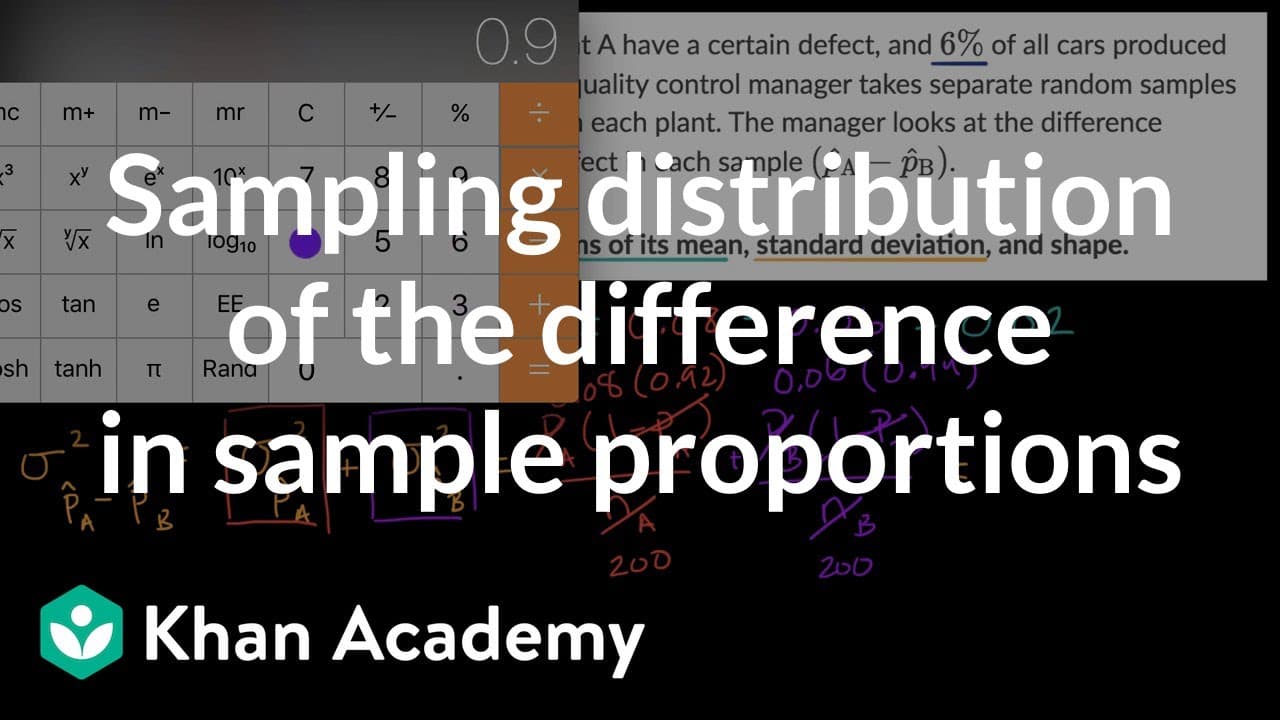
The distribution of the difference in sample proportions between two plants is approximately normal, with a mean of 0.02 and a standard deviation of 0.025.
Transcript
- [Instructor] We're told, suppose that 8% of all cars produced at plant A have a certain defect, and 6% of all cars produced at plant B have this defect. Each month, a quality control manager takes separate random samples of 200 of the over 3000 cars produced from each plant. The manager looks at the difference between the proportions of cars with... Read More
Key Insights
- 🟰 The mean of the difference in sample proportions is equal to the difference in population proportions.
- 🌱 The standard deviation of the difference in sample proportions can be calculated by taking the square root of the sum of the variances of each plant's sample proportion.
- 🌥️ The distribution of the difference in sample proportions is approximately normal if the sample sizes are large enough and there are at least 10 successes and 10 failures in each sample.
- ✋ The difference in sample proportions can be negative, indicating a higher proportion in the second plant.
- 👋 The formula used to estimate the variances of the sample proportions is a good approximation, even without replacement, if the sample size is less than 10% of the population size.
- 🛀 The distribution graph of the difference in sample proportions shows a normal distribution centered around the mean with a standard deviation that determines the spread.
- ☠️ The distribution allows for both positive and negative values, reflecting the possibility of different defect rates between the two plants.
Install to Summarize YouTube Videos and Get Transcripts
Explore YouTube Video Summarizer or Get YouTube Transcript Extractor
Questions & Answers
Q: How is the mean of the difference in sample proportions calculated?
The mean is calculated by subtracting the population proportion of the second plant from the population proportion of the first plant. In this case, it would be 8% - 6% = 2%.
Q: How is the standard deviation of the difference in sample proportions calculated?
The standard deviation is calculated by taking the square root of the sum of the variances of each plant's sample proportion. The variances can be estimated by using the population proportion multiplied by 1 minus the population proportion, divided by the sample size.
Q: Can the difference in sample proportions be negative?
Yes, the difference in sample proportions can be negative. It is possible for the sample proportion from the second plant to be larger than the sample proportion from the first plant by random chance.
Q: What is the shape of the distribution of the difference in sample proportions?
The distribution is approximately normal, as long as the sample sizes are large enough and there are at least 10 successes and 10 failures in each sample. The distribution has a mean of 0.02 and a standard deviation of 0.025.
Summary & Key Takeaways
-
The content discusses the distribution of the difference in sample proportions between two plants.
-
The mean of the difference in sample proportions is equal to the difference in the population proportions of the two plants.
-
The standard deviation of the difference in sample proportions can be calculated by taking the square root of the sum of the variances of each plant's sample proportion.
Read in Other Languages (beta)
Share This Summary 📚
Summarize YouTube Videos and Get Video Transcripts with 1-Click
Try YouTube Summary with ChatGPT & Claude or YouTube Transcript Generator
Explore More Summaries from Khan Academy 📚



Summarize YouTube Videos and Get Video Transcripts with 1-Click
Try YouTube Summary with ChatGPT & Claude or YouTube Transcript Generator