Electoral college | American civics | US History | Khan Academy
TL;DR
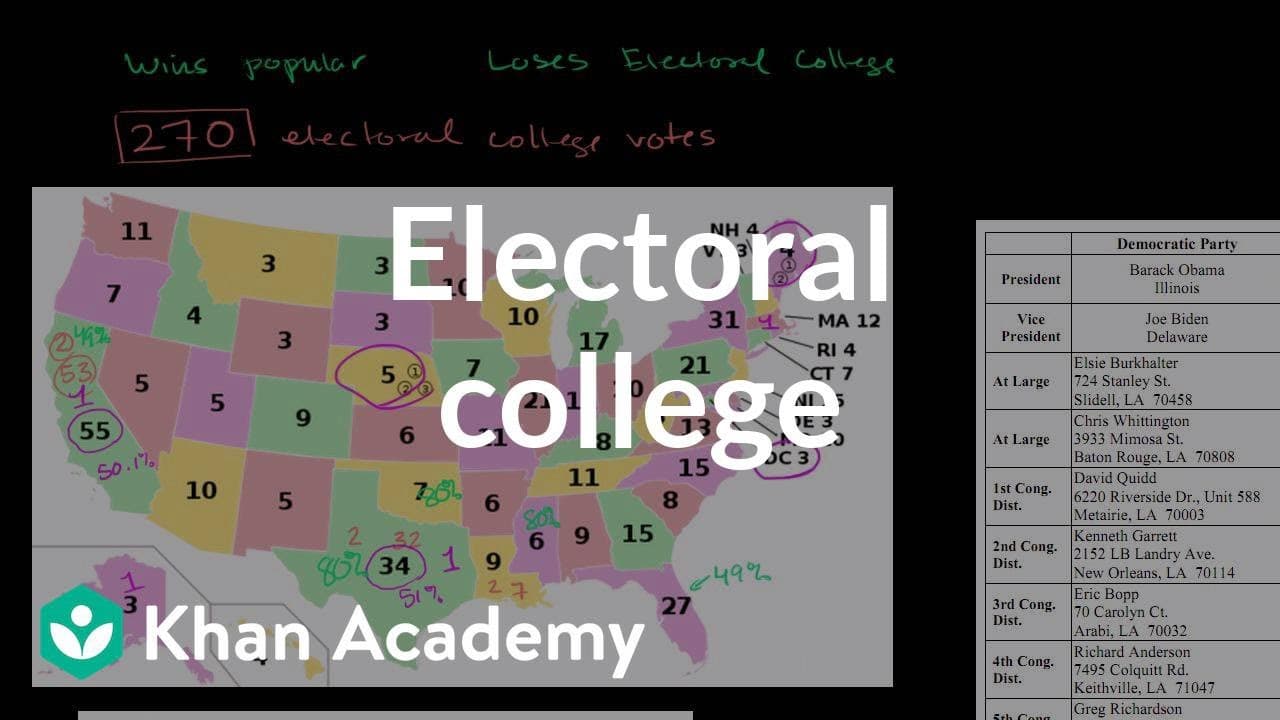
The US uses the Electoral College system to elect its president, where voters indirectly vote for a slate of electors who promise to vote for their chosen candidate.
Transcript
In the US, we don't directly vote for our president or vice president. Instead, we use something called the Electoral College. So when you show up to vote on Election Day-- and an election day will happen in November of an election year. And it could happen as early as November 2, and it could happen as late as November 8. And it's going to be the ... Read More
Key Insights
- ❓ The US does not directly vote for the president; instead, voters choose electors who pledge to vote for their preferred candidate.
- 🏆 Most states use a winner-take-all system, where the candidate who wins the majority of votes receives all of the state's electoral votes.
- 😉 The Electoral College system can lead to distortions, such as a candidate winning the popular vote but losing in the Electoral College.
- 😒 Some states, like Nebraska and Maine, use a proportional system for allocating electoral votes.
- 🍧 The representation in the Electoral College is disproportionate, with smaller states having more influence per capita.
- 🥳 Candidates tend to focus their attention and campaign spending on swing states, neglecting states that are likely to vote reliably for one party.
- 🤪 If no candidate receives the majority of Electoral College votes, the decision goes to the US House of Representatives on a state-by-state voting basis.
Install to Summarize YouTube Videos and Get Transcripts
Explore YouTube Video Summarizer or Get YouTube Transcript Extractor
Questions & Answers
Q: How does the Electoral College system work in the US?
The Electoral College system in the US involves voters indirectly casting their votes for a slate of electors who promise to vote for their chosen candidate. The number of electors each state has is based on its number of congressmen.
Q: Is the Electoral College system proportional in most states?
No, in most states, except for Maine and Nebraska, the winner-take-all system is followed. This means that even if a candidate wins with a slight majority, they receive all of the state's electoral votes.
Q: What happens if no candidate receives the majority of Electoral College votes?
If no candidate reaches the threshold of 270 Electoral College votes, the decision goes to the US House of Representatives. Each state gets only one vote, and the process continues until a candidate receives a majority of votes by state.
Q: Can a candidate win the popular vote but lose in the Electoral College?
Yes, this scenario can happen because of the winner-take-all system. If a candidate wins states by large majorities but loses closely in big states, they may end up with fewer Electoral College votes despite winning the popular vote.
Summary & Key Takeaways
-
The US uses the Electoral College system to determine the president and vice president, instead of directly voting for them.
-
Each state has a certain number of electors based on its total number of congressmen.
-
Most states follow a winner-take-all system, where the candidate who gets the majority of votes in a state receives all of its electoral votes.
Read in Other Languages (beta)
Share This Summary 📚
Summarize YouTube Videos and Get Video Transcripts with 1-Click
Try YouTube Summary with ChatGPT & Claude or YouTube Transcript Generator
Explore More Summaries from Khan Academy 📚



Summarize YouTube Videos and Get Video Transcripts with 1-Click
Try YouTube Summary with ChatGPT & Claude or YouTube Transcript Generator