What Are the Differences Between Analog and Digital Signals?
TL;DR
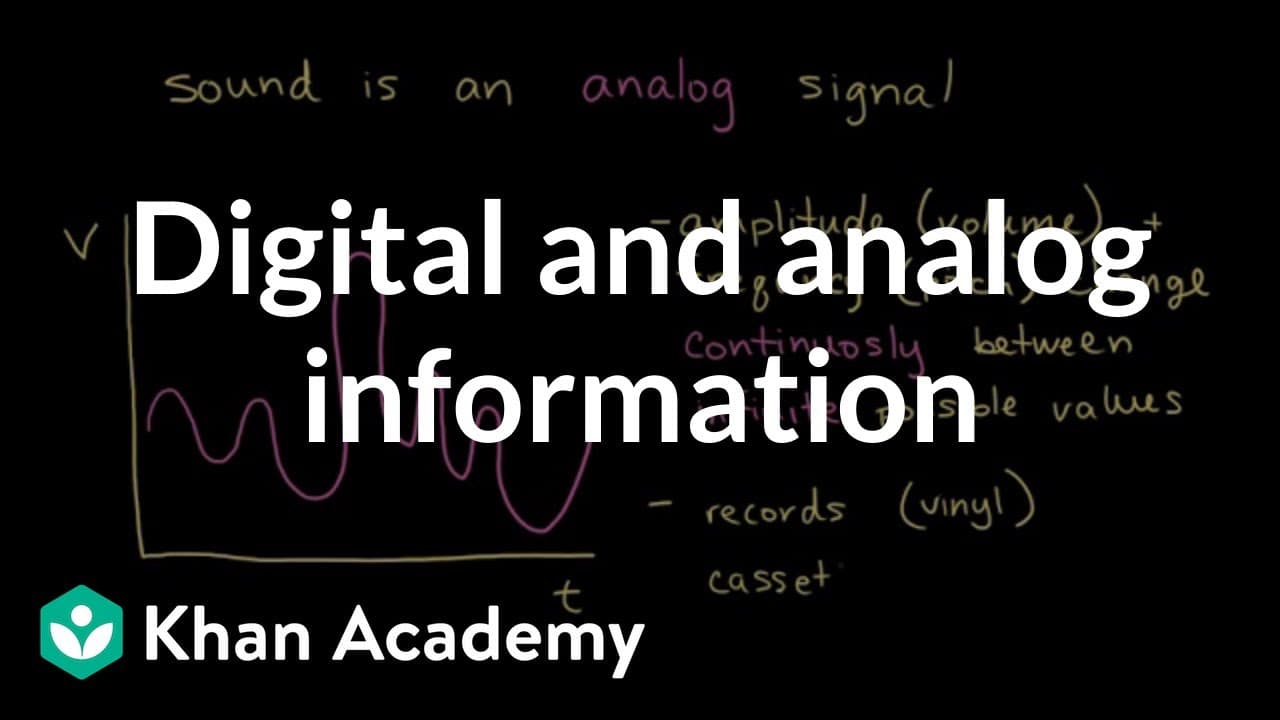
Analog signals can represent any value within a range, while digital signals are confined to distinct, finite levels. The smooth waveform of analog signals contrasts with the step-like waveform of digital signals, making digitization essential for reliable sound storage and processing.
Transcript
- [Instructor] In this video, we're going to talk about analog versus digital. Something that's analog can be any value within a given range while something digital is represented by a number of discreet or separate levels. To distinguish these two ideas, I like to think about clocks. An analog clock has the numbers in the hands and it's analog bec... Read More
Key Insights
- 📡 Analog signals can represent infinite possible values, while digital signals have a finite number of discreet levels.
- 📡 Analog signals have smooth, continuous waveforms, while digital signals have step-like, square waveforms.
- 🥺 Sound waves were originally recorded and reproduced in analog format, but advancement in technology led to digitization.
- 👻 Digitizing sound waves allows for more reliable storage, processing, and communication using computers.
- 💁 Information stored digitally may lose some information in translation, but the quality of the digitized waveform will not degrade.
- 📡 Analog signals can represent any of infinite possible values, while digital signals are limited to discreet levels.
- 😄 Humans prefer to store information, such as sound, digitally due to its reliability and ease of processing.
Install to Summarize YouTube Videos and Get Transcripts
Explore YouTube Video Summarizer or Get YouTube Transcript Extractor
Questions & Answers
Q: What is the difference between analog and digital signals?
Analog signals can take on any value within a range, while digital signals are represented by specific discreet levels.
Q: What is the difference between the waveforms of analog and digital signals?
Analog signals have a smooth, continuous waveform, while digital signals have a step-like, square waveform.
Q: How were sound waves originally recorded and reproduced?
Sound waves were originally imprinted directly onto vinyl records or cassette tapes, preserving the analog waveform.
Q: Why did sound waves become digitized?
Digitizing sound waves allowed for more reliable storage, processing, and communication using computers, as they are represented by numbers instead of physical imprints.
Summary & Key Takeaways
-
Analog signals can take on infinite possible values within a given range, while digital signals can only be at specific discrete levels.
-
Analog waves have a smooth, continuous waveform, while digital waves have a step-like, square waveform.
-
Sound waves were originally recorded and reproduced in analog format, but technology advanced and sound waves became digitized.
Read in Other Languages (beta)
Share This Summary 📚
Summarize YouTube Videos and Get Video Transcripts with 1-Click
Try YouTube Summary with ChatGPT & Claude or YouTube Transcript Generator
Explore More Summaries from Khan Academy 📚



Summarize YouTube Videos and Get Video Transcripts with 1-Click
Try YouTube Summary with ChatGPT & Claude or YouTube Transcript Generator