How to Derive Half-Life Equations for Chemical Reactions
TL;DR
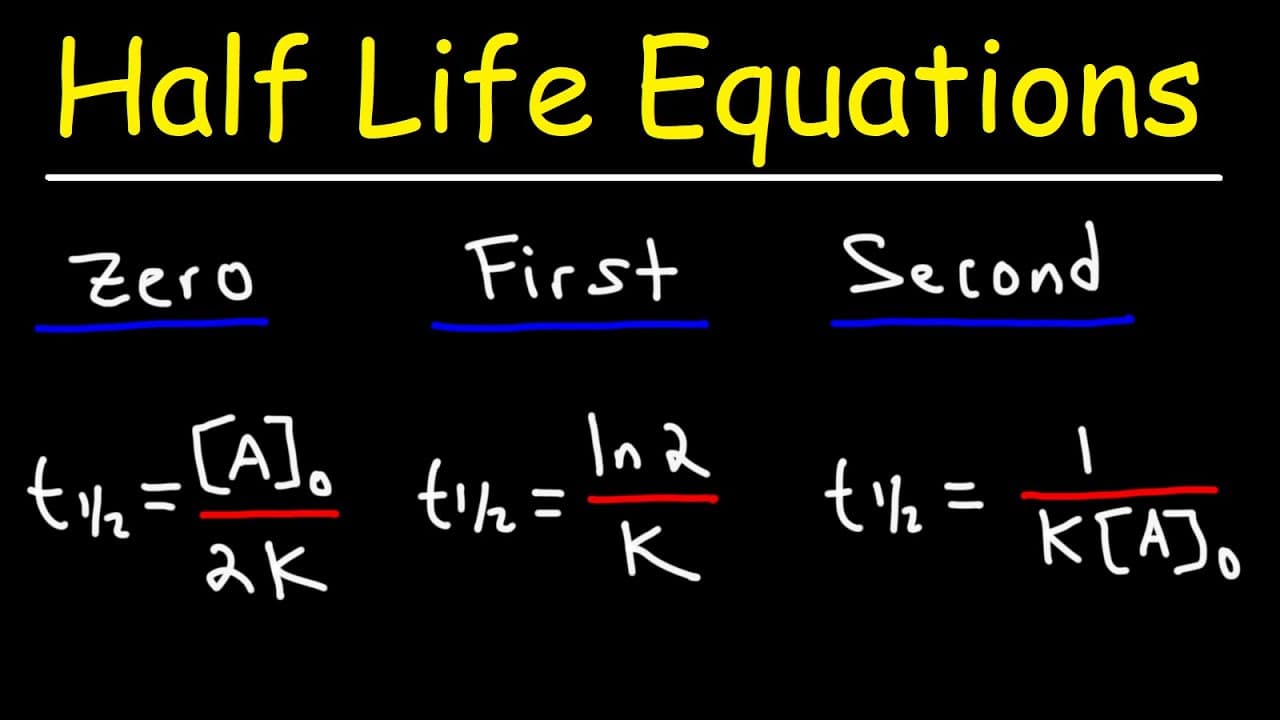
To derive half-life equations, start with the formulas for zero-order, first-order, and second-order reactions. For first-order reactions, the half-life is given by ln(2)/k; for zero-order, it's A_initial/2k; and for second-order, it's 1/(A_initial * k). The half-life is inversely related to the rate constant for all reaction types.
Transcript
in this video we're going to talk about how we can derive the equation for half-life so we're going to start with this equation a is equal to p e raised to the RT so this equation is associated with exponential growth particularly when that growth is compounded continuously p is the principle a is the future value of the account R is the interest r... Read More
Key Insights
- 😀 The equation A = P * e^(RT) describes exponential growth in continuous compounding.
- 🛟 The equation A final = A initial * e^(-KT) is used for exponential decay in half-life problems.
- 🧑💻 The natural log of both sides and log properties help derive the integrated rate law expressions for different reaction orders.
- 🛟 The half-life equation for a first-order reaction is ln2/K.
- 🛟 The half-life equation for a zero-order reaction is A initial / 2K.
- 😉 The half-life equation for a second-order reaction is 1 / (A initial * K).
- ☠️ The half-life is inversely related to the rate constant for all three reaction orders.
Install to Summarize YouTube Videos and Get Transcripts
Explore YouTube Video Summarizer or Get YouTube Transcript Extractor
Questions & Answers
Q: What does the equation A = P * e^(RT) represent?
This equation represents exponential growth in continuous compounding, where A is the future value, P is the principle, R is the interest rate or growth rate, T is the time, and e is the number 2.71828.
Q: How can you derive the equation for half-life in exponential decay?
Start with the equation A final = A initial * e^(-KT) and take the natural log of both sides to get Ln A final = Ln A initial - KT Ln e. Simplify further to Ln A final = -KT + Ln A initial, which is the integrated rate law expression for a first-order reaction.
Q: How is the half-life equation different for zero-order reactions?
The half-life equation for a zero-order reaction is t1/2 = A initial / 2K. It is different because the half-life is dependent on the initial concentration, whereas for a first-order reaction, it only depends on the rate constant.
Q: What is the effect of increasing the initial concentration on the half-life of a second-order reaction?
Increasing the initial concentration in a second-order reaction decreases the half-life. Conversely, decreasing the initial concentration increases the half-life. This relationship is opposite to that of a zero-order reaction.
Summary & Key Takeaways
-
The equation A = P * e^(RT) describes exponential growth in continuous compounding.
-
The equation A final = A initial * e^(-KT) is used for exponential decay in half-life problems.
-
Taking the natural log of both sides and using log properties helps derive the integrated rate law expressions for different reaction orders.
Read in Other Languages (beta)
Share This Summary 📚
Summarize YouTube Videos and Get Video Transcripts with 1-Click
Try YouTube Summary with ChatGPT & Claude or YouTube Transcript Generator
Explore More Summaries from The Organic Chemistry Tutor 📚


Summarize YouTube Videos and Get Video Transcripts with 1-Click
Try YouTube Summary with ChatGPT & Claude or YouTube Transcript Generator