XGBoost Part 4 (of 4): Crazy Cool Optimizations
TL;DR
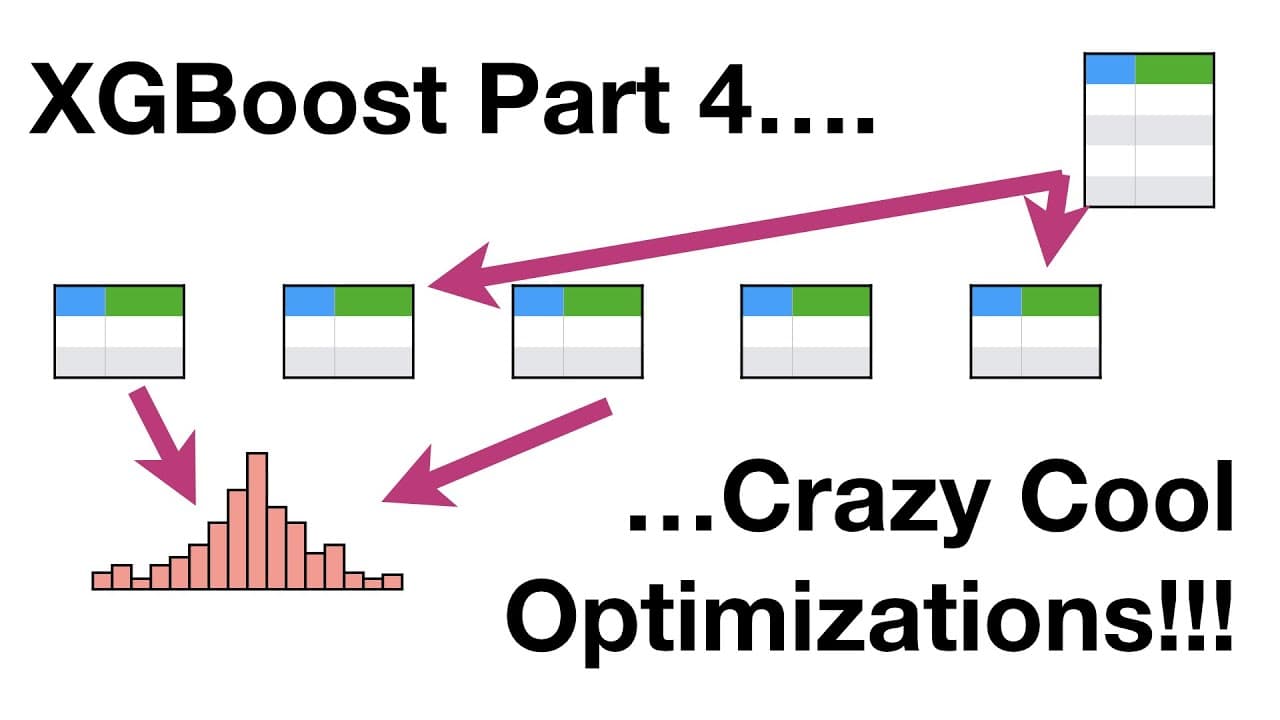
XG Boost optimizations include parallel learning, weighted quantile sketch, cache-aware access, and out-of-core computation for fast processing.
Transcript
I want to do things fast want to do things faster uh XG booze got crazy optimizations they're gonna blow your mind you better watch out cuz they're so crazy stack west hello I'm Josh Starman welcome to stack West today we're going to talk about XG boost part 4 optimizations note this stack quest assumes that you are already familiar with how XG Boo... Read More
Key Insights
- 😒 XG Boost uses an approximate greedy algorithm for speedy tree building on large datasets.
- 🏋️ Weighted quantile sketch assigns weights based on confidence levels for better data partitioning.
- 🏪 Cache-aware access optimizes memory usage by storing essential data in cache memory.
- 💯 Out-of-core computation with sharding minimizes disk access time for efficient data processing.
- 👻 XG Boost allows building trees with random subsets of data and features for faster computation.
- 🎰 These optimizations make XG Boost more than just a statistical technique, enhancing machine learning performance.
- 🐎 XG Boost optimizations encompass various hardware-related techniques for enhanced speed and efficiency.
Install to Summarize YouTube Videos and Get Transcripts
Explore YouTube Video Summarizer or Get YouTube Transcript Extractor
Questions & Answers
Q: How does XG Boost handle large training datasets?
XG Boost employs an approximate greedy algorithm, parallel learning, and a weighted quantile sketch to efficiently build trees on massive datasets, improving speed and performance.
Q: What is the significance of the weighted quantile sketch in XG Boost?
The weighted quantile sketch ensures accurate predictions by assigning weights based on confidence levels, enabling better data partitioning and tree building in XG Boost for regression and classification tasks.
Q: How does XG Boost optimize memory usage in computations?
XG Boost utilizes cache-aware access to store gradients and Hessians in cache memory for rapid calculations, leading to improved processing speed by maximizing the use of faster memory.
Q: How does XG Boost handle out-of-core computation for large datasets?
XG Boost implements out-of-core computation by compressing data and using sharding to distribute data across multiple drives, minimizing hard drive access time for efficient processing of extensive datasets.
Summary & Key Takeaways
-
XG Boost uses an approximate greedy algorithm for fast tree building on large data sets.
-
Weighted quantile sketch improves classification predictions by considering confidence levels.
-
Cache-aware access and out-of-core computation optimize memory usage for faster processing.
Read in Other Languages (beta)
Share This Summary 📚
Summarize YouTube Videos and Get Video Transcripts with 1-Click
Try YouTube Summary with ChatGPT & Claude or YouTube Transcript Generator
Explore More Summaries from StatQuest with Josh Starmer 📚



Summarize YouTube Videos and Get Video Transcripts with 1-Click
Try YouTube Summary with ChatGPT & Claude or YouTube Transcript Generator