How to Calculate Average Velocity and Speed in Physics
TL;DR
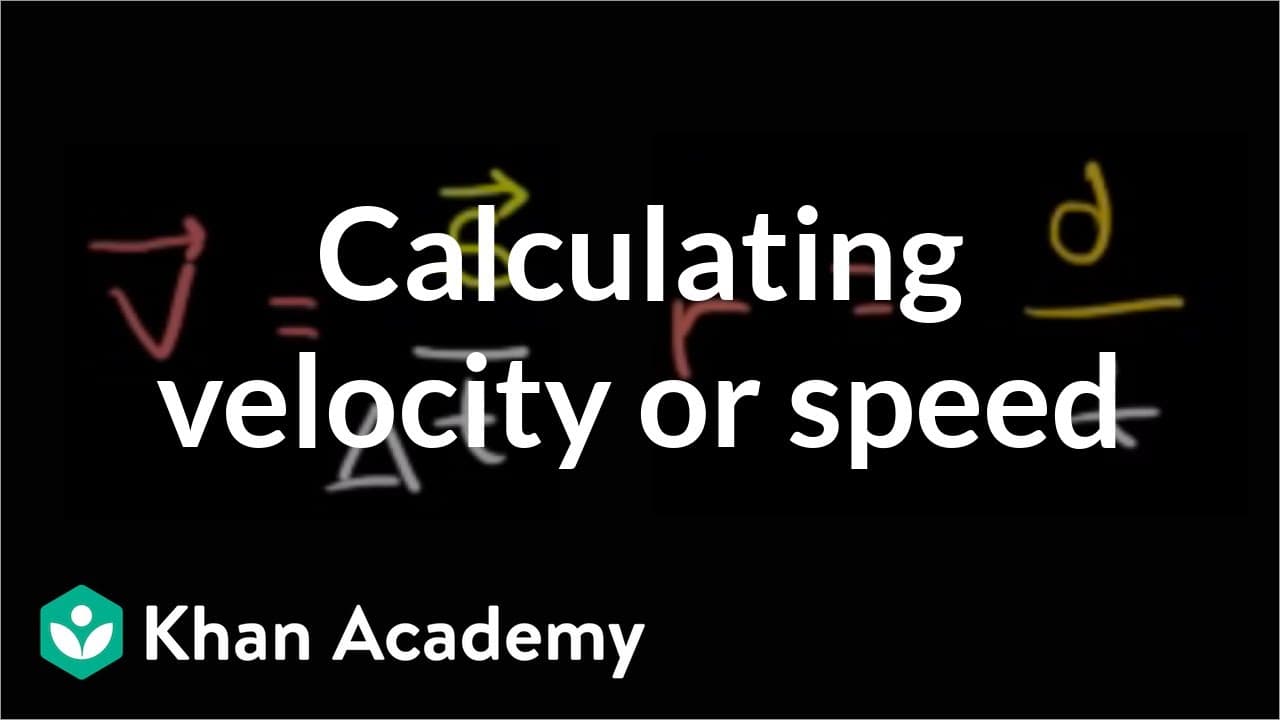
To calculate average velocity, divide displacement by time, and include direction. For example, if a car travels 5 kilometers north in 1 hour, the average velocity is 5 kilometers per hour to the north. Speed, a scalar, is the distance traveled over time; in this case, it would also be 5 kilometers per hour, without direction.
Transcript
Now that we know a little bit about vectors and scalars, let's try to apply what we know about them for some pretty common problems you'd, one, see in a physics class, but they're also common problems you'd see in everyday life, because you're trying to figure out how far you've gone, or how fast you're going, or how long it might take you to get s... Read More
Key Insights
- ❓ Vectors have both magnitude and direction, while scalars only have magnitude.
- ⌛ Velocity is a vector quantity that represents the change in position over time, while speed is a scalar quantity that represents the distance traveled over time.
- 🇦🇪 Unit conversions between different systems can be done using dimensional analysis.
- ☠️ Displacement (S) and velocity are vector quantities, while distance and speed (rate) are scalar quantities.
Install to Summarize YouTube Videos and Get Transcripts
Explore YouTube Video Summarizer or Get YouTube Transcript Extractor
Questions & Answers
Q: What is the difference between a vector and a scalar quantity?
Vector quantities have both magnitude and direction, while scalar quantities only have magnitude.
Q: How is velocity different from speed?
Velocity is a vector quantity that considers both the distance traveled and the direction, while speed is a scalar quantity that only considers the distance traveled.
Q: How can you convert units from kilometers per hour to meters per second?
To convert, you can use dimensional analysis and cancel out the appropriate units. For example, 1 hour is equal to 3,600 seconds, so you can multiply the given value in kilometers per hour by 1,000 and divide it by 3,600 to get the value in meters per second.
Q: Why do we use S for displacement instead of D?
The choice to use S for displacement instead of D is to avoid confusion with the derivative operator D, which is commonly used in calculus.
Summary & Key Takeaways
-
Vectors have both magnitude and direction, while scalars only have magnitude.
-
Velocity is a vector quantity that represents the change in position over time.
-
Speed or rate is a scalar quantity that represents the distance traveled over time.
-
Converting units from kilometers per hour to meters per second involves canceling out dimensions using dimensional analysis.
Read in Other Languages (beta)
Share This Summary 📚
Summarize YouTube Videos and Get Video Transcripts with 1-Click
Try YouTube Summary with ChatGPT & Claude or YouTube Transcript Generator
Explore More Summaries from Khan Academy 📚



Summarize YouTube Videos and Get Video Transcripts with 1-Click
Try YouTube Summary with ChatGPT & Claude or YouTube Transcript Generator