What Is the Number e and Its Role in Interest Calculations?
TL;DR
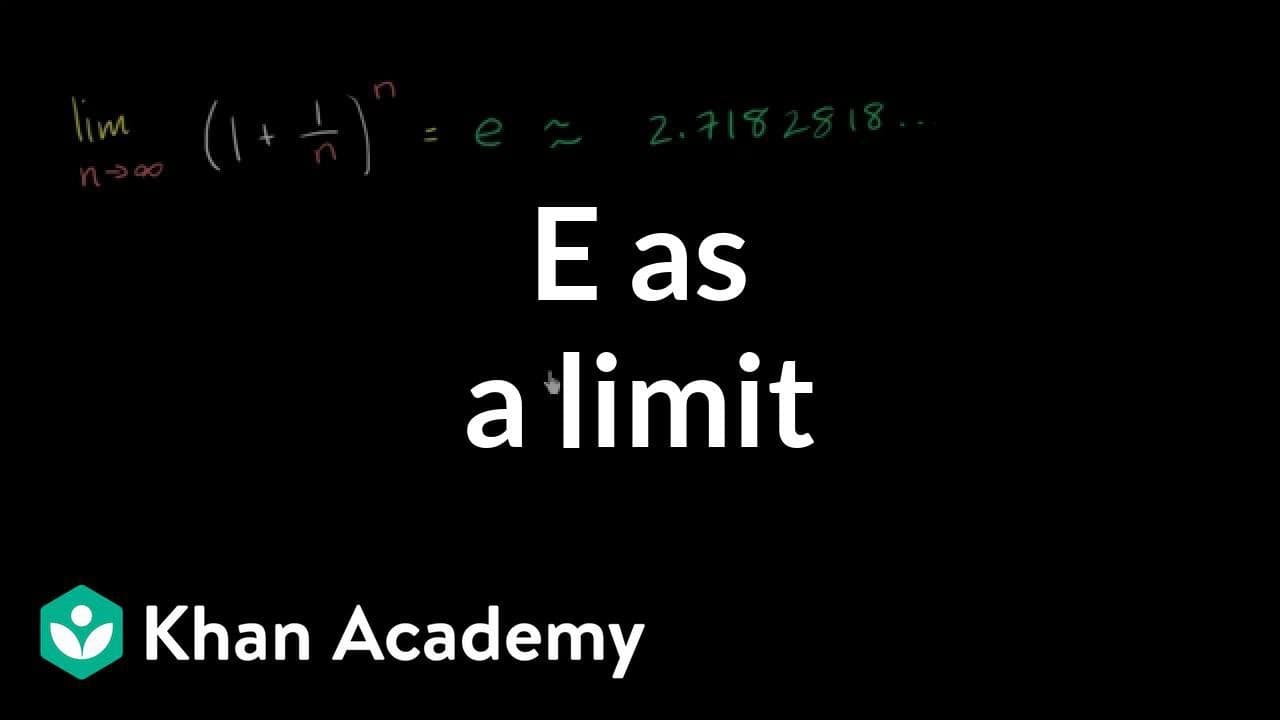
The number e, approximately 2.71828, emerges in finance through the concept of continuously compounded interest. As the number of compounding periods approaches infinity, the expression (1 + 1/n)^n approaches e, illustrating how exponential growth occurs in financial contexts. e is a key mathematical constant that connects deeply with other fundamental concepts like Pi.
Transcript
Narrator: In a previous video when we were looking at a very simple case of compounding interest, we got the expression (1+1/n)^n and the way we got this, we saw an example where a loan shark is charging 100% interest and that's where this 1 is, and then if they only compound once in the year, so it's 100% over the year, then n is 1. So, you get 1+... Read More
Key Insights
- 🤑 Compound interest calculations involve the growth of money through continuous compounding over multiple periods.
- 🤑 The expression (1+1/n)^n describes the growth of money in compound interest calculations.
- #️⃣ As the number of periods (n) increases, the expression approaches the number "e."
- 🚟 "e" is a mystical and magical number that also relates to Pi and the imaginary unit in profound ways.
Install to Summarize YouTube Videos and Get Transcripts
Explore YouTube Video Summarizer or Get YouTube Transcript Extractor
Questions & Answers
Q: What is the significance of the expression (1+1/n)^n in compound interest calculations?
The expression (1+1/n)^n represents the growth of money in compound interest calculations. It shows how the amount of money to be paid back increases as the number of compounding periods (n) increases.
Q: What happens to the expression (1+1/n)^n as n approaches infinity?
As n approaches infinity, the expression (1+1/n)^n approaches the number "e." This means that continuously compounding interest over an infinite number of periods results in the amount of money to be paid back converging to a specific value.
Q: How does the number "e" emerge from compound interest calculations?
The number "e" emerges as the limit of the expression (1+1/n)^n as n approaches infinity. It is a mathematical constant that represents the base of the natural logarithm and is used in various mathematical and scientific applications.
Q: What is the relationship between "e," Pi, and the imaginary unit?
"e," Pi, and the imaginary unit are all interconnected in a mystical way. "e" is a fundamental mathematical constant, Pi represents the ratio of the circumference to the diameter of a circle, and the imaginary unit is defined as the square root of -1. These numbers have profound significance in various areas of mathematics and science.
Summary & Key Takeaways
-
Compound interest calculations involve continuously compounding interest, resulting in larger amounts of money to be paid back.
-
The expression (1+1/n)^n represents the growth of money in compound interest calculations.
-
As the number of periods (n) approaches infinity, the expression approaches the number "e," which is approximately 2.71828.
Read in Other Languages (beta)
Share This Summary 📚
Summarize YouTube Videos and Get Video Transcripts with 1-Click
Try YouTube Summary with ChatGPT & Claude or YouTube Transcript Generator
Explore More Summaries from Khan Academy 📚






Summarize YouTube Videos and Get Video Transcripts with 1-Click
Try YouTube Summary with ChatGPT & Claude or YouTube Transcript Generator