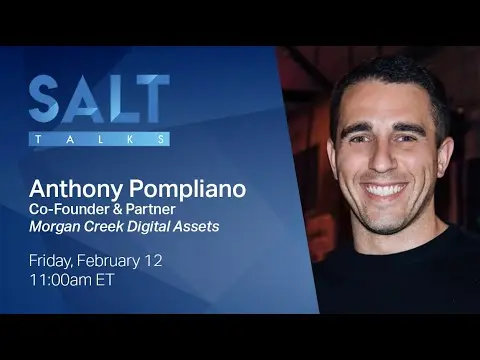
Fixing Wall Street: Digital Assets To Solve Economies, Markets & Banks | SALT iConnections New York

TL;DR
The digital asset infrastructure is disrupting traditional banking and financial systems, enabling market access, programmatic money, and transparency.
Transcript
foreign we are here to talk about the digital asset infrastructure and how it's fixing Wall Street like it or not Finance is being changed and digitally transformed by the disruption of the status quo we've seen a substantial shift in the financial sector traditional Banking and Financial systems are being disrupted by digital Innovations a lot of ... Read More
Key Insights
- 💳 Web3 technology enables market access and credit opportunities in developing markets, promoting financial inclusion.
- 💨 Stable coins provide a way to hedge against inflation and protect wealth from devaluation.
- 🇨🇷 Blockchain technology reduces overhead costs and enhances transparency in financial systems.
- 📼 Digital assets have the potential to tokenize illiquid assets, such as patents and land deeds, unlocking their value.
- 👨💼 The regulatory landscape for digital assets varies globally, with some countries providing clearer guidance and attracting crypto businesses.
- 🇺🇸 The United States, despite current regulatory challenges, is expected to play a significant role in the digital asset industry in the long run.
- 🤑 The digital asset infrastructure has the potential to fulfill the original vision of the internet as a place for identity and digital money.
Install to Summarize YouTube Videos and Get Transcripts
Explore YouTube Video Summarizer or Get YouTube Transcript Extractor
Questions & Answers
Q: How does web3 technology enable market access and credit opportunities in developing markets?
Web3 technology, such as stable coins and crypto rails, allows individuals from developed markets to access credit opportunities in developing markets, bridging the gap between regions and providing financial inclusion.
Q: What advantages do stable coins offer in protecting against inflation?
Stable coins provide a fungible way to transfer wealth into currencies and assets that can withstand inflation, ensuring that hard-earned money is not lost due to devaluation.
Q: How does the digital asset infrastructure address the issues of overhead and transparency in traditional financial systems?
Blockchain technology reduces overhead costs by eliminating the need for analog input and output in processes such as mortgage reconciliation. Additionally, blockchain enables transparency by creating a tamper-proof and linear data structure, mitigating the risk of inaccurate risk assessments.
Q: How are blockchain and digital assets transforming the banking and financial services industries?
Blockchain technology offers a new tech stack that can enhance existing banking infrastructure. It allows for experimentation with concepts like tokenization, stable coins, and 24/7 access, leading to more efficient, transparent, and customer-centric financial services.
Summary & Key Takeaways
-
The digital asset infrastructure is revolutionizing the financial sector by providing more accessibility, efficiency, and transparency.
-
Web3 technology allows for market access and credit opportunities in developing markets through stable coins and crypto rails.
-
Stable coins offer a way to hedge against inflation and transfer wealth into currencies and assets easily accessible to everyone.
Read in Other Languages (beta)
Share This Summary 📚
Summarize YouTube Videos and Get Video Transcripts with 1-Click
Try YouTube Summary with ChatGPT & Claude or YouTube Transcript Generator
Explore More Summaries from SALT 📚





Summarize YouTube Videos and Get Video Transcripts with 1-Click
Try YouTube Summary with ChatGPT & Claude or YouTube Transcript Generator