What is the "best way" to develop software applications?
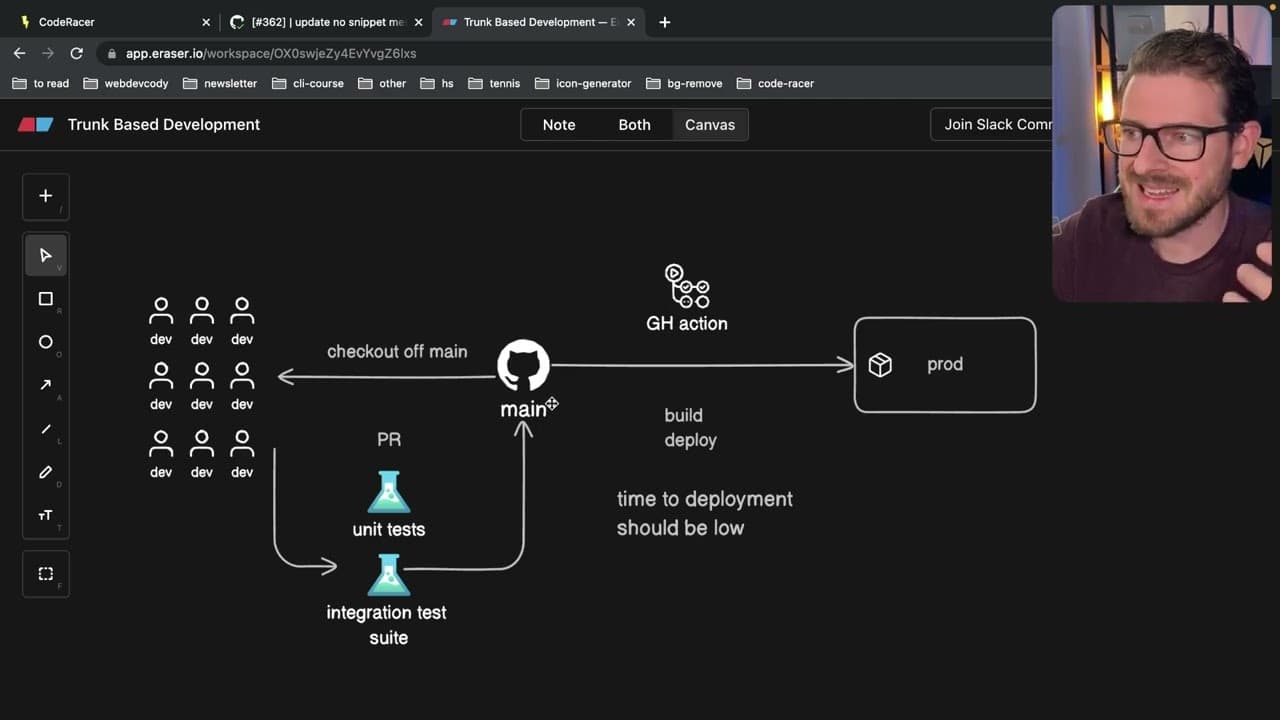
TL;DR
Trunk-based development enhances software integration but has trade-offs like potential bugs in production.
Transcript
all right so my last video where I just rambled and Drew diagrams did really well and got a lot of views so I'm going to do the exact same thing in this video this video is kind of an extension on the last one I kind of show the process that I do at work kind of using a git flow approach to software development but some people might see that and be... Read More
Key Insights
- 🥺 Trunk-based development streamlines the integration process by reducing the number of branches, leading to faster feature releases.
- 😤 Merging code daily can enhance team collaboration but may also introduce a higher risk of bugs in production if not properly managed.
- 👨💻 Automation through testing and continuous integration is essential to successfully implement trunk-based development and maintain code quality.
- 👻 Smaller pull requests in trunk-based development allow for quicker reviews, reducing the complexity involved in assessing larger code changes.
- 😤 The approach promotes knowledge sharing among team members as developers regularly interact with each other's code.
- 🇳🇴 Using feature flags helps manage the deployment of incomplete features, providing a way to test changes safely before full rollout.
- 🥺 The simplicity of trunk-based development can lead to complications in larger projects where multiple teams are involved if not structured properly.
Install to Summarize YouTube Videos and Get Transcripts
Explore YouTube Video Summarizer or Get YouTube Transcript Extractor
Questions & Answers
Q: What is trunk-based development, and how does it differ from other approaches?
Trunk-based development focuses on merging code into a single main branch frequently, promoting rapid feedback and collaboration. In contrast, approaches like feature branching involve working on separate branches, which can delay integration and lead to extensive merge conflicts.
Q: What are the advantages of using trunk-based development?
The primary advantages include continuous integration, rapid feedback on features, reduced chances of substantial merge conflicts, and smaller pull requests that facilitate easier code reviews. This approach encourages collaboration and knowledge sharing among developers as changes are integrated frequently.
Q: What could be a significant drawback of trunk-based development?
A major drawback is the risk of merging bugs or unfinished features directly into production. If a developer pushes problematic code to the main branch, it can disrupt the entire team, especially if all developers are pulling the latest version regularly.
Q: How can teams mitigate the risks associated with trunk-based development?
Teams can implement robust automated testing, including unit and integration tests, to ensure that code is functioning correctly before merging. Additionally, deploying systems like feature flags allows teams to control when new features are visible to users, thereby reducing the impact of potential bugs.
Q: What roles do automated tests play in trunk-based development?
Automated tests serve as a safeguard in trunk-based development by ensuring that each piece of code meets quality standards before being merged into the main branch. They help catch bugs early, preventing flawed code from affecting the entire team and production environment.
Q: Can you explain the deployment strategy commonly used with trunk-based development?
Typically, when code is merged into the main branch, a deployment process is triggered using tools such as GitHub Actions or CI/CD services. This process automates the build and deployment of the code into a production environment, promoting rapid release cycles for new features or fixes.
Q: What are feature flags, and how do they function in this development approach?
Feature flags are a deployment strategy that allows teams to enable or disable features at runtime without redeploying code. This method provides control over how new functionality is rolled out to users, enabling testing and gradual exposure to new features while mitigating risk.
Q: Why might a team prefer using feature branches instead of trunk-based development?
Teams might choose feature branches if they are risk-averse or dealing with complex changes that require extensive modifications across the codebase. Feature branches allow developers to work independently without affecting the stability of the main branch until their work is fully ready for integration.
Summary & Key Takeaways
-
This content discusses trunk-based development, a software development strategy where code is merged frequently into the main branch, promoting continuous integration and rapid feedback.
-
The approach contrasts with feature branching, which can lead to delayed integration and increased merge conflicts, potentially complicating the development process.
-
While trunk-based development has benefits, such as small pull requests and enhanced collaboration, it also carries risks, including the possibility of deploying unfinished features or bugs into production.
Read in Other Languages (beta)
Share This Summary 📚
Summarize YouTube Videos and Get Video Transcripts with 1-Click
Try YouTube Summary with ChatGPT & Claude or YouTube Transcript Generator
Explore More Summaries from Web Dev Cody 📚


Summarize YouTube Videos and Get Video Transcripts with 1-Click
Try YouTube Summary with ChatGPT & Claude or YouTube Transcript Generator