Why people get so excited about a total solar eclipse
TL;DR
Total solar eclipses are rare and awe-inspiring celestial events.
Transcript
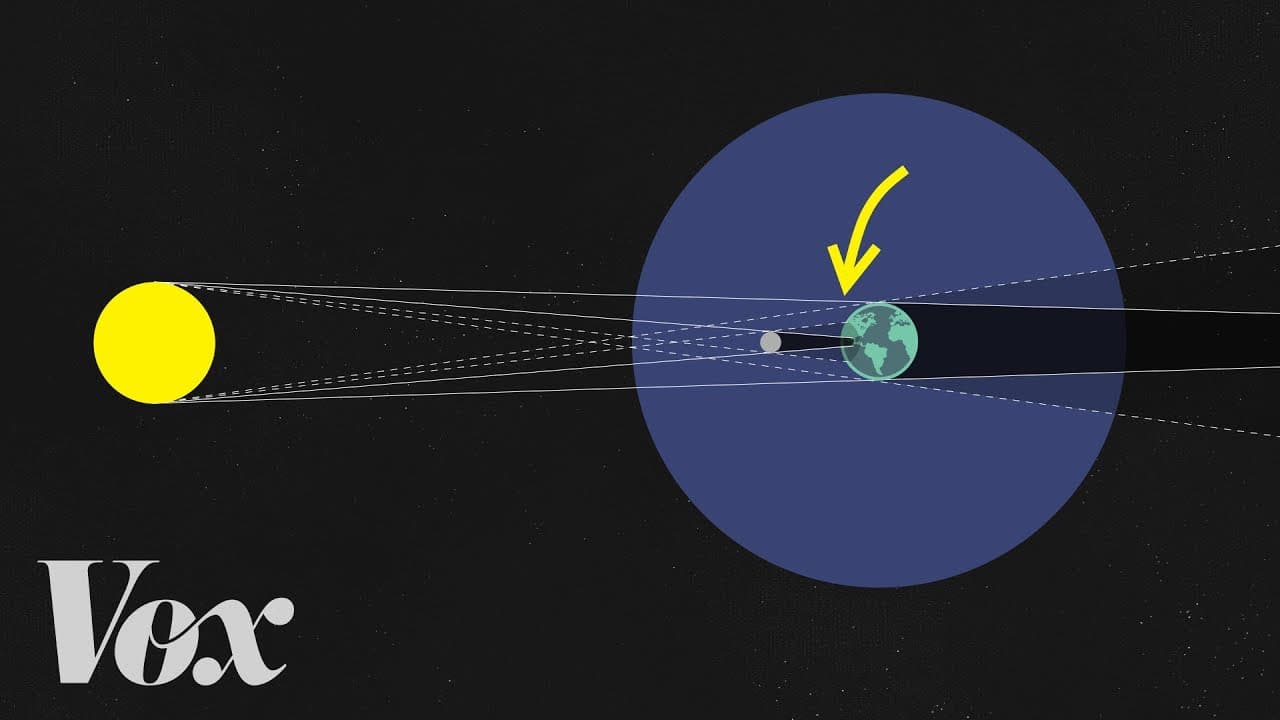
A solar eclipse happens when the moon’s shadow falls somewhere on the surface of Earth And a lunar eclipse is the opposite -- when the Earth’s shadow falls on the moon The two sections of the shadow, the dark umbra and the partially shaded penumbra, their placement determines which type of eclipse we can see from Earth. But not all eclipses are mad... Read More
Key Insights
- A solar eclipse occurs when the moon's shadow falls on Earth, while a lunar eclipse happens when Earth's shadow falls on the moon.
- Total solar eclipses are considered extraordinary due to their rarity and the unique view of the sun's corona they provide.
- The moon's orbit is tilted relative to Earth's orbit, preventing monthly eclipses despite its 29.5-day orbit around Earth.
- Eclipses occur when the moon's orbit crosses the sun's plane at nodes, aligning with the sun twice a year.
- Total lunar eclipses are more common than total solar eclipses, with the former lasting longer and being visible to more people.
- The apparent sizes of the sun and moon are similar due to the sun being 400 times larger and farther away, enabling total solar eclipses.
- The moon is slowly moving away from Earth, eventually leading to only partial and annular solar eclipses in the distant future.
- Early civilizations feared eclipses, but modern understanding has turned them into opportunities for awe and scientific study.
Install to Summarize YouTube Videos and Get Transcripts
Explore YouTube Video Summarizer or Get YouTube Transcript Extractor
Questions & Answers
Q: What causes a solar eclipse?
A solar eclipse occurs when the moon passes between the Earth and the sun, casting a shadow on Earth. This alignment blocks the sun's light, creating a shadow on the Earth's surface. The type of solar eclipse—total, partial, or annular—depends on the alignment and distance of the moon from Earth.
Q: Why are total solar eclipses rare?
Total solar eclipses are rare because they require a precise alignment of the sun, moon, and Earth. The moon's orbit is tilted relative to Earth's orbit, so this alignment only occurs when the moon's orbit crosses the sun's plane at specific nodes, happening approximately twice a year. Additionally, the path of totality is narrow, covering a small portion of Earth's surface.
Q: What is the significance of the sun's corona during a total solar eclipse?
The sun's corona is the outermost layer of its atmosphere, visible only during a total solar eclipse. It appears as a pearly glow around the sun and provides valuable scientific information about solar activity and the sun's magnetic field. Observing the corona helps scientists understand solar winds and their effects on space weather.
Q: How does the moon's orbit affect the occurrence of eclipses?
The moon's orbit is tilted about 5 degrees relative to Earth's orbit, preventing monthly eclipses. Eclipses occur when the moon's orbit intersects the sun's plane at nodes, aligning with the sun approximately twice a year. This alignment is necessary for both solar and lunar eclipses to occur, making them relatively infrequent events.
Q: What are the differences between solar and lunar eclipses?
Solar eclipses occur when the moon's shadow falls on Earth, while lunar eclipses happen when Earth's shadow falls on the moon. Solar eclipses are visible only in specific areas, with totality lasting a few minutes. Lunar eclipses are visible from anywhere on the night side of Earth and can last over an hour, often turning the moon red due to Earth's atmosphere scattering light.
Q: Why are total lunar eclipses more common than total solar eclipses?
Total lunar eclipses are more common because they occur when Earth's shadow completely covers the moon, visible from anywhere on the night side of Earth. In contrast, total solar eclipses require precise alignment and are only visible along a narrow path of totality on Earth's surface, making them less frequent and harder to witness.
Q: What is the future of solar eclipses on Earth?
In the distant future, only partial and annular solar eclipses will occur because the moon is gradually moving away from Earth at a rate of over 3 cm per year. This increasing distance will eventually prevent the moon from completely covering the sun, ending the occurrence of total solar eclipses on Earth.
Q: How did early civilizations perceive eclipses?
Early civilizations often viewed eclipses with fear, interpreting them as attacks on the sun or moon by dark forces. This perception was due to their lack of understanding of celestial mechanics. Today, with scientific knowledge, eclipses are celebrated as awe-inspiring natural events and opportunities for scientific exploration and understanding.
Summary & Key Takeaways
-
A solar eclipse is when the moon's shadow falls on Earth, and a lunar eclipse is when Earth's shadow falls on the moon. Total solar eclipses are rare and highly sought after due to the unique view of the sun's corona they provide, lasting only a few minutes.
-
The moon's orbit is tilted, preventing monthly eclipses, but they occur when the moon's orbit crosses the sun's plane. Total lunar eclipses are more common and visible to more people, lasting longer than total solar eclipses.
-
The alignment of the sun and moon allows total solar eclipses, but the moon's gradual movement away from Earth will eventually end them. Early civilizations feared eclipses, but they are now celebrated for their scientific and aesthetic value.
Read in Other Languages (beta)
Share This Summary 📚
Summarize YouTube Videos and Get Video Transcripts with 1-Click
Try YouTube Summary with ChatGPT & Claude or YouTube Transcript Generator
Explore More Summaries from Vox 📚




Summarize YouTube Videos and Get Video Transcripts with 1-Click
Try YouTube Summary with ChatGPT & Claude or YouTube Transcript Generator