Proof: Opposite angles of parallelogram congruent | Quadrilaterals | Geometry | Khan Academy
TL;DR
In this video, the content explains and demonstrates how to prove that opposite angles in a parallelogram are congruent.
Transcript
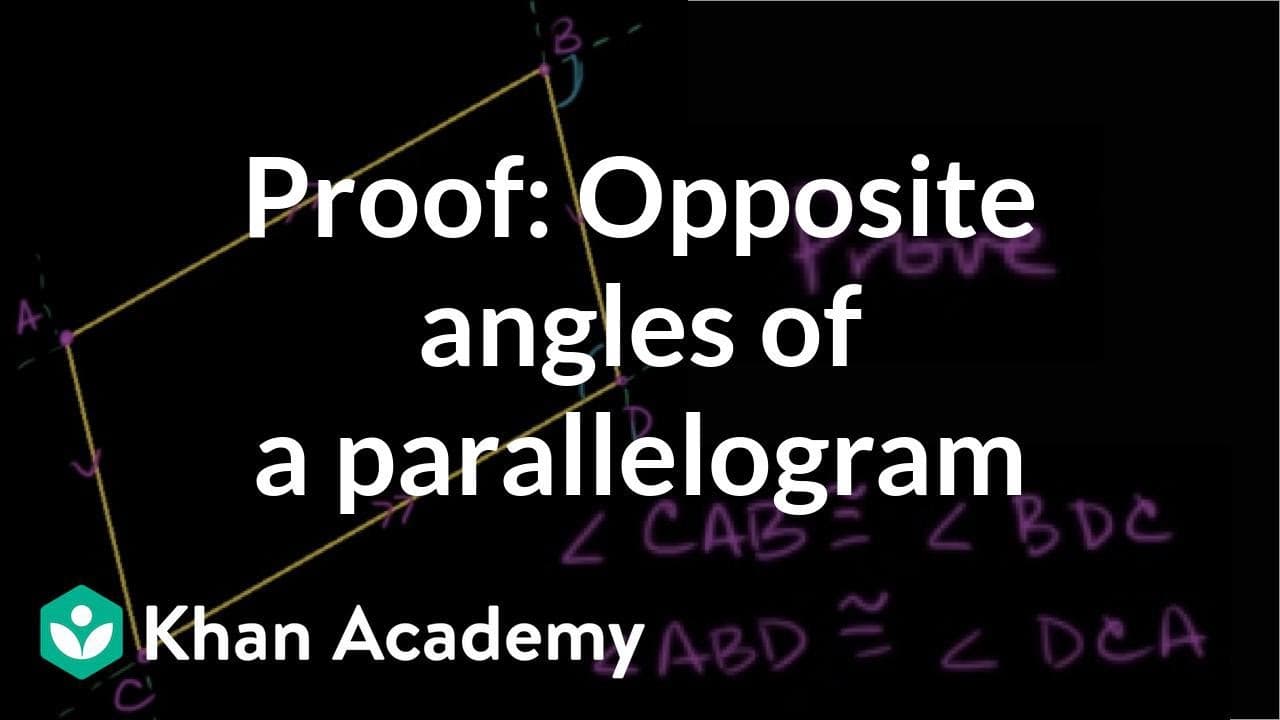
What I want to do in this video is prove that the opposite angles of a parallelogram are congruent. So for example, we want to prove that CAB is congruent to BDC, so that that angle is equal to that angle, and that ABD, which is this angle, is congruent to DCA, which is this angle over here. And to do that, we just have to realize that we have some... Read More
Key Insights
- 🫥 The congruence of opposite angles in a parallelogram can be proven through the use of parallel lines and transversals.
- 🔺 Alternate interior angles and corresponding angles play a crucial role in establishing the congruent relationships between the angles.
- 😫 Changing the perspective from one set of parallel lines and transversals to another allows for the identification of different sets of congruent angles.
Install to Summarize YouTube Videos and Get Transcripts
Explore YouTube Video Summarizer or Get YouTube Transcript Extractor
Questions & Answers
Q: How can we prove that opposite angles in a parallelogram are congruent?
By using the concepts of alternate interior angles and corresponding angles in transversals intersecting parallel lines, we can establish the congruence of opposite angles in a parallelogram. This can be done by identifying the relationships between the angles formed by the parallel lines and transversals.
Q: What role do parallel lines and transversals play in proving the congruence of opposite angles?
Parallel lines and transversals provide the necessary geometric elements for proving the congruence of opposite angles in a parallelogram. They create alternate interior angles and corresponding angles, which allow us to establish the congruent relationships between the angles.
Q: How does the change in perspective from the initial set of parallel lines and transversals to the new set of lines affect the proof?
The change in perspective from the initial set of parallel lines and transversals to the new set of lines is essential in proving the congruence of opposite angles. It helps identify different sets of alternate interior angles and corresponding angles, which ultimately establish the congruent relationships between the angles.
Q: Can you provide an example of the application of alternate interior angles and corresponding angles in proving the congruence of opposite angles?
Certainly! For example, when viewing BD and AC as the parallel lines, and AB as the transversal, we can conclude that angle EBD is congruent to angle BAC through the concept of corresponding angles. This, in turn, proves the congruence between angle BDC and angle CAB.
Summary & Key Takeaways
-
The video aims to prove that opposite angles in a parallelogram, such as CAB and BDC, as well as ABD and DCA, are congruent through the use of parallel lines and transversals.
-
By applying the concept of alternate interior angles and corresponding angles of transversals intersecting parallel lines, the congruence can be established.
-
The process involves identifying alternate interior angles and corresponding angles formed by the parallel lines and transversals.
Read in Other Languages (beta)
Share This Summary 📚
Summarize YouTube Videos and Get Video Transcripts with 1-Click
Try YouTube Summary with ChatGPT & Claude or YouTube Transcript Generator
Explore More Summaries from Khan Academy 📚



Summarize YouTube Videos and Get Video Transcripts with 1-Click
Try YouTube Summary with ChatGPT & Claude or YouTube Transcript Generator