How to Detect Parkinson's with Smell
TL;DR
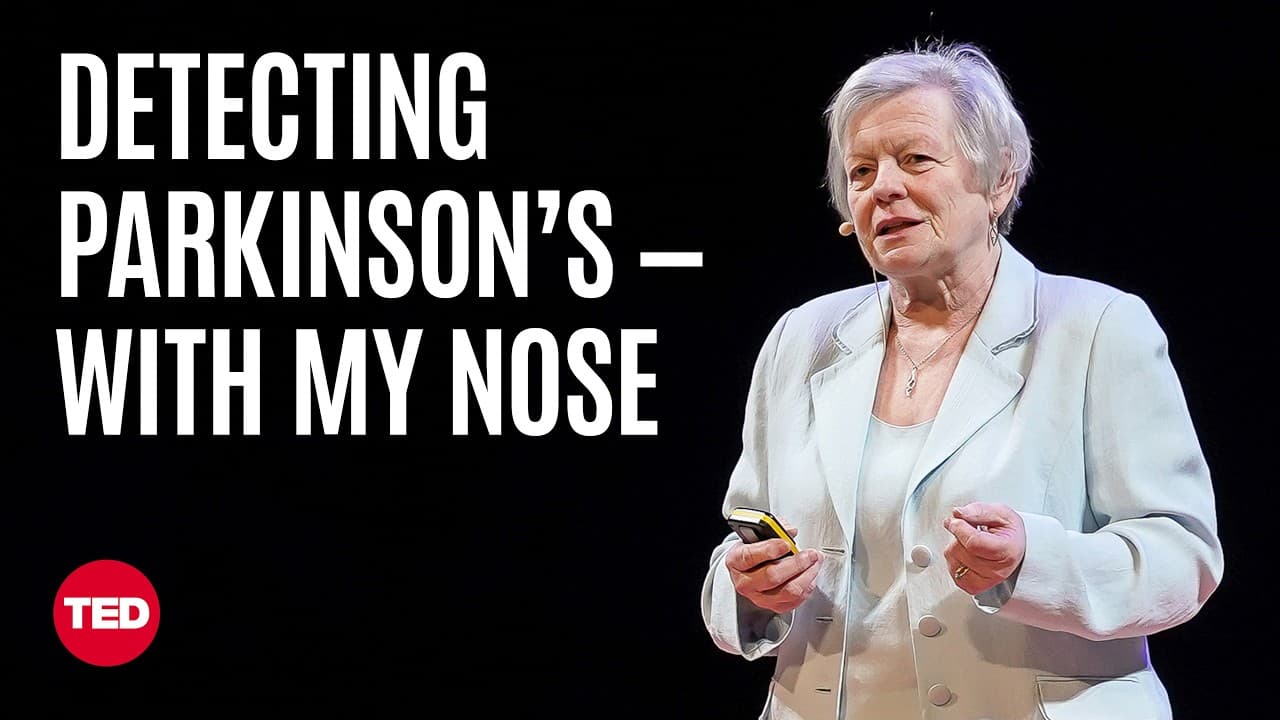
Joy Milne has a unique ability to detect Parkinson's disease through smell, a skill she discovered when her husband's scent changed years before his diagnosis. This discovery has led to the development of a non-invasive diagnostic test using smell to identify Parkinson's earlier, potentially improving patient outcomes.
Transcript
I’m going to start out by asking you: which superpower would you like to choose? Would it be flying? Would it be strength? Would it be speed? The national papers and media have ... said I have a superpower. However, I did not choose this superpower. I was born with a nose that can diagnose. I'm going to take you back to 1956. [You can tell nobody!]... Read More
Key Insights
- Joy Milne can detect Parkinson's disease through smell, a skill she discovered when her husband's scent changed.
- Her ability to smell Parkinson's is due to hereditary hyperosmia, a heightened sense of smell.
- Milne's discovery led to research and development of a non-invasive diagnostic test for Parkinson's using smell.
- The test involves swabbing the face or neck and analyzing the volatiles, identifying Parkinson's before traditional symptoms appear.
- Milne's work has contributed to understanding how Parkinson's affects the body's sebum, aiding in early diagnosis.
- The diagnostic test developed is simple, non-invasive, and aims to be available in hospitals worldwide.
- Milne continues to advocate for Parkinson's awareness and research, fulfilling a promise to her late husband.
- Her work highlights the potential for unconventional methods, like smell, in medical diagnostics.
Install to Summarize YouTube Videos and Get Transcripts
Explore YouTube Video Summarizer or Get YouTube Transcript Extractor
Questions & Answers
Q: How can smell be used to detect Parkinson's disease?
Smell can be used to detect Parkinson's disease through the identification of specific volatiles present in the sebum of individuals with the disease. Joy Milne, who has a heightened sense of smell, discovered this when she noticed a change in her husband's scent years before his Parkinson's diagnosis. This led to the development of a non-invasive test that swabs the face or neck to analyze these volatiles, allowing for early detection.
Q: What is hereditary hyperosmia?
Hereditary hyperosmia is a genetic condition characterized by an enhanced sense of smell. Individuals with this condition, like Joy Milne, can detect subtle changes in scents that others may not notice. This heightened olfactory ability allowed Milne to identify a distinct smell associated with Parkinson's disease, leading to the development of new diagnostic methods using smell.
Q: What is the significance of early Parkinson's diagnosis?
Early diagnosis of Parkinson's disease is crucial because it allows for intervention before significant neural damage occurs, which is often irreversible. Detecting the disease early can improve patient outcomes by enabling timely treatment and management of symptoms, potentially slowing disease progression and improving quality of life for those affected.
Q: How was the Parkinson's smell test developed?
The Parkinson's smell test was developed after Joy Milne's discovery of a specific scent associated with the disease. Researchers conducted studies using t-shirts worn by individuals with and without Parkinson's to identify the volatile compounds responsible for the scent. This led to the creation of a non-invasive diagnostic test that swabs the skin to detect these volatiles, providing an early indication of the disease.
Q: What role does sebum play in Parkinson's diagnosis?
Sebum, an oily substance produced by the skin, plays a key role in Parkinson's diagnosis through smell. Changes in the composition of sebum in individuals with Parkinson's produce distinct volatiles that can be detected by those with a heightened sense of smell, like Joy Milne. Analyzing these volatiles allows for the development of diagnostic tests that can identify the disease early.
Q: What impact has Joy Milne's discovery had on Parkinson's research?
Joy Milne's discovery of the ability to smell Parkinson's disease has had a significant impact on research by introducing a novel, non-invasive diagnostic method. Her work has led to the development of tests that can detect the disease earlier than traditional methods, potentially improving patient outcomes. It has also raised awareness about the potential of unconventional diagnostic tools in medical research.
Q: How does the non-invasive Parkinson's test work?
The non-invasive Parkinson's test works by swabbing the face or neck of an individual to collect sebum, which is then analyzed for specific volatile compounds associated with the disease. This method allows for early detection of Parkinson's by identifying these volatiles before traditional symptoms appear, providing a simple and effective diagnostic tool that can be used in hospitals worldwide.
Q: What are the future implications of the Parkinson's smell test?
The future implications of the Parkinson's smell test include widespread implementation in hospitals for early diagnosis, potentially leading to better management and treatment of the disease. It opens the door for further research into non-invasive diagnostic methods and highlights the importance of alternative approaches in medical diagnostics, ultimately aiming to improve the quality of life for those affected by Parkinson's.
Summary & Key Takeaways
-
Joy Milne discovered her ability to smell Parkinson's disease when her husband's scent changed years before his diagnosis. This skill, due to hereditary hyperosmia, has led to the development of a non-invasive test that uses smell to diagnose Parkinson's earlier, potentially improving patient outcomes by identifying the disease before traditional symptoms manifest.
-
The test developed from Milne's discovery involves swabbing the face or neck to analyze volatiles, which can indicate Parkinson's presence. This method allows for early diagnosis, addressing the irreversible neural damage that occurs before traditional symptoms appear, and aims to be implemented in hospitals globally.
-
Milne's work has significantly contributed to Parkinson's research and awareness, highlighting unconventional diagnostic methods. She continues to advocate for the disease, fulfilling a promise to her late husband and aiming to improve the lives of those affected by Parkinson's through early detection and intervention.
Read in Other Languages (beta)
Share This Summary 📚
Summarize YouTube Videos and Get Video Transcripts with 1-Click
Try YouTube Summary with ChatGPT & Claude or YouTube Transcript Generator
Explore More Summaries from TED 📚






Summarize YouTube Videos and Get Video Transcripts with 1-Click
Try YouTube Summary with ChatGPT & Claude or YouTube Transcript Generator