Recursive Factorial Function
TL;DR
Recursion is a powerful concept in computer science, allowing functions to refer to themselves and solve problems in a simpler way.
Transcript
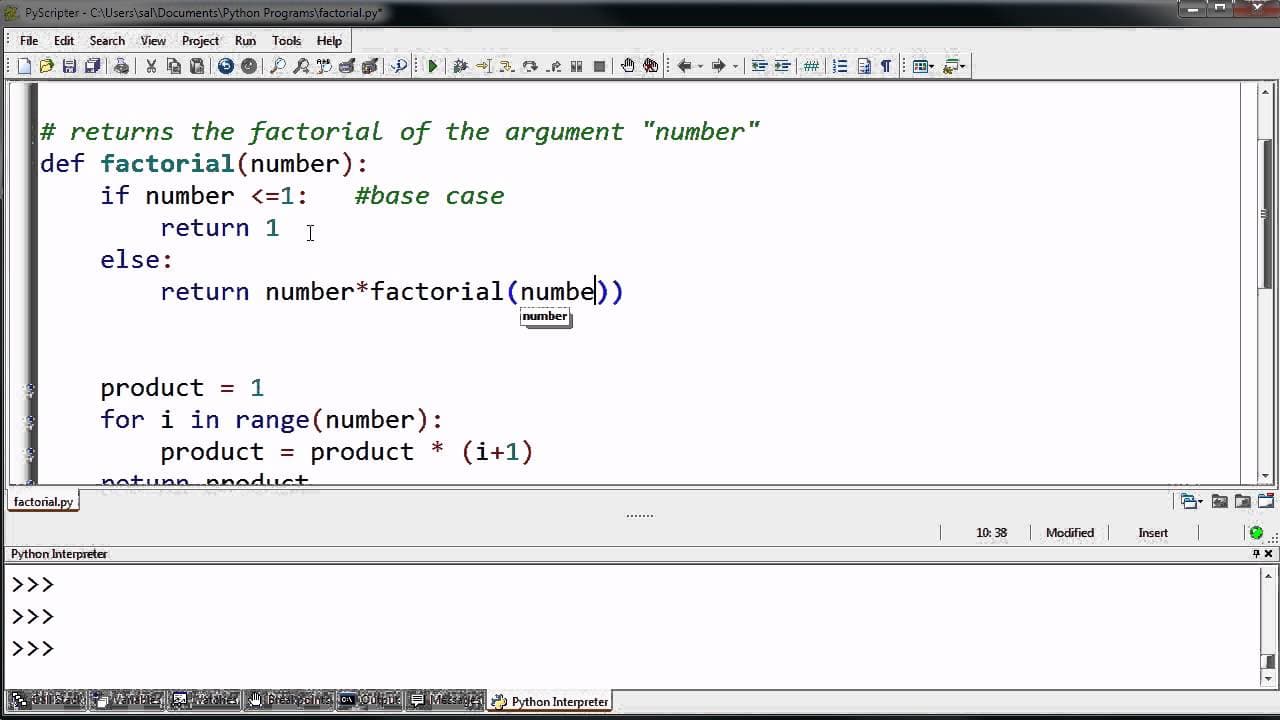
What I want to do in this video is introduce you to what I think is one of the neatest ideas in computer science, and that is recursion. So the way that we've defined this factorial function in the last few videos is actually an iterative definition. We are iterating through different values for this variable i, and then we're essentially taking th... Read More
Key Insights
- 👻 Recursion is a powerful concept in computer science, allowing for elegant and concise solutions to certain problems.
- ✋ The base case is crucial in recursion to define when the function should stop calling itself.
- 🍳 Recursion can simplify the solving of complex problems by breaking them down into smaller sub-problems.
- 💼 While recursion can be less efficient than iteration in some cases, it offers a more intuitive and elegant solution for certain problems.
- 🧑🎓 Understanding recursion is essential for computer science students and programmers, as it is widely used in various algorithms and data structures.
- ❓ Recursion can be used to solve problems in other domains, such as mathematics or linguistics.
- 🤔 Recursive thinking can help break down complex problems and improve problem-solving skills.
Install to Summarize YouTube Videos and Get Transcripts
Explore YouTube Video Summarizer or Get YouTube Transcript Extractor
Questions & Answers
Q: How is recursion different from iteration?
Recursion involves a function calling itself, while iteration involves the use of loops to repeatedly execute a piece of code. Recursion is often used when the problem can be broken down into smaller sub-problems.
Q: How does recursion make solving problems simpler?
Recursion allows you to solve complex problems by breaking them down into smaller, more manageable parts. By solving a smaller version of the problem and using the solution to solve the larger problem, recursion avoids the need for complex iterations.
Q: What is a base case in recursion?
A base case is a condition that, when met, stops the function from calling itself recursively. It is essential to prevent infinite loops and define a stopping point for the recursive process.
Q: Is recursion more efficient than iteration?
Recursion can sometimes be less efficient than iteration due to the overhead involved in function calls. However, certain problems are better suited for recursive solutions, and the choice between recursion and iteration depends on the specific problem at hand.
Summary & Key Takeaways
-
Recursion is a technique in computer science that involves defining a function by referring to itself.
-
It allows for a simpler and more elegant solution to certain problems by breaking them down into smaller, manageable parts.
-
The base case, where the function stops calling itself, is crucial to prevent infinite loops.
Read in Other Languages (beta)
Share This Summary 📚
Summarize YouTube Videos and Get Video Transcripts with 1-Click
Try YouTube Summary with ChatGPT & Claude or YouTube Transcript Generator
Explore More Summaries from Khan Academy 📚



Summarize YouTube Videos and Get Video Transcripts with 1-Click
Try YouTube Summary with ChatGPT & Claude or YouTube Transcript Generator