Study of physical and chemical properties of bismuth (URJCx)
TL;DR
Exploration of bismuth's physical and chemical properties through experiments.
Transcript
[Música] [Música] in this Last video We are Going To show interesting physical and Chemical properties related to theth Element in particular One aspect that We have discussed during this learning sequence is the low melting point of bmth It is well known that most of the application of bmth and its allows arise from its low melting Point in this F... Read More
Key Insights
- Bismuth has a low melting point, making it ideal for creating alloys and conducting experiments that involve melting and crystallization.
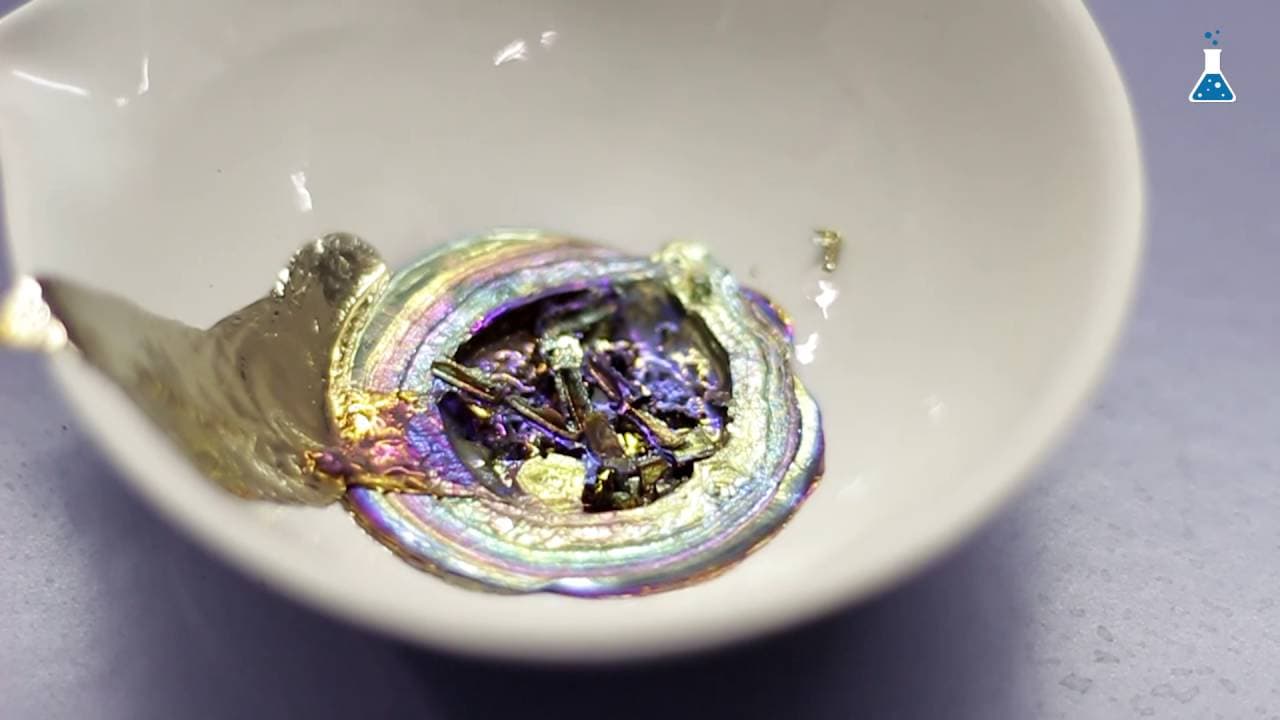
- The experiment demonstrates the process of melting bismuth and then slowly cooling it to observe crystal formation, with slower cooling resulting in larger crystals.
- High purity bismuth is used to ensure accurate experimental results, highlighting the importance of material purity in chemical experiments.
- Bismuth's chemical reactivity is explored through its oxidation with nitric acid, forming bismuth nitrate pentahydrate and releasing nitrogen dioxide gas.
- The experiment includes a comparison of reactions in dilute and concentrated nitric acid, demonstrating different oxidation products and gases emitted.
- Bismuth nitrate pentahydrate can be hydrolyzed by increasing the pH, resulting in the formation of a white suspension of bismuth oxide.
- The synthesis of bismuth nitrate pentahydrate is accelerated by heating, allowing for the rapid consumption of bismuth metal in the reaction.
- Decomposition of bismuth nitrate pentahydrate is demonstrated by heating, releasing nitrogen dioxide and oxygen gases, typical of some nitrites.
Install to Summarize YouTube Videos and Get Transcripts
Explore YouTube Video Summarizer or Get YouTube Transcript Extractor
Questions & Answers
Q: What is the significance of bismuth's low melting point?
Bismuth's low melting point is significant because it allows for easy melting and crystallization, making it useful in various applications such as creating alloys. This property is particularly advantageous for experiments that require observing crystal growth, as demonstrated in the video where bismuth is melted and cooled to form visible crystals.
Q: How does cooling rate affect bismuth crystal formation?
The cooling rate significantly affects bismuth crystal formation. In the experiment, it is shown that slower cooling results in the formation of larger crystals. This is because slower cooling allows more time for the atoms to arrange themselves into a well-defined crystal lattice, leading to larger and more distinct crystals.
Q: What is the role of nitric acid in the experiment?
Nitric acid plays a crucial role in the experiment by oxidizing bismuth metal to form bismuth nitrate pentahydrate. The reaction also releases gases, with different products depending on the concentration of nitric acid used. In dilute acid, colorless gas is produced, while concentrated acid results in the emission of brown nitrogen dioxide gas, highlighting the redox behavior of bismuth.
Q: Why is high purity bismuth used in the experiment?
High purity bismuth is used in the experiment to ensure accurate and reliable results. Impurities in the metal could interfere with the melting, crystallization, and chemical reactions, leading to inconsistent or misleading outcomes. By using high purity bismuth, the experimenters can observe the true properties and behaviors of the element without contamination effects.
Q: What gases are released during the decomposition of bismuth nitrate pentahydrate?
During the decomposition of bismuth nitrate pentahydrate, nitrogen dioxide and oxygen gases are released. This occurs when the compound is heated, causing the breakdown of the nitrate, a characteristic behavior of some nitrites, particularly those of alkaline earth metals. The nitrogen dioxide is easily identified by its distinctive brown color.
Q: How is bismuth nitrate pentahydrate hydrolyzed in the experiment?
Bismuth nitrate pentahydrate is hydrolyzed by increasing the pH of the solution. In the experiment, water is added in excess, which leads to the hydrolysis of bismuth 3+ cations, resulting in the formation of bismuth oxide. This process is indicated by the appearance of a white suspension, demonstrating the compound's reactivity to changes in pH.
Q: What is observed when bismuth is melted and cooled in the experiment?
When bismuth is melted and cooled in the experiment, crystal formation is observed. Initially, the metal is melted using a Bunsen burner, and as it cools, crystals begin to form at the bottom of the crucible. The size of these crystals is influenced by the cooling rate, with slower cooling resulting in larger crystals, allowing for a visual study of the crystallization process.
Q: What are the differences in gas emissions between dilute and concentrated nitric acid reactions?
The reactions of bismuth with dilute and concentrated nitric acid produce different gases. In dilute nitric acid, the reaction emits a colorless gas, while in concentrated nitric acid, the reaction releases brown nitrogen dioxide gas. These differences are due to the varying oxidation states and reaction environments, which affect the products formed during the redox reactions.
Summary & Key Takeaways
-
This video explores the physical and chemical properties of bismuth, focusing on its low melting point and ability to form crystals upon cooling. The experiment involves melting high purity bismuth and observing crystal growth as it cools. The slower the cooling process, the larger the crystals formed.
-
Chemical properties of bismuth are examined through its reaction with nitric acid, forming bismuth nitrate pentahydrate. The experiment compares reactions in dilute and concentrated nitric acid, producing different gases and demonstrating bismuth's redox behavior and reactivity.
-
The video also covers the hydrolysis of bismuth nitrate pentahydrate and its decomposition upon heating. Hydrolysis results in bismuth oxide formation, while heating the compound releases gases like nitrogen dioxide and oxygen, illustrating typical nitrite decomposition behavior.
Read in Other Languages (beta)
Share This Summary 📚
Summarize YouTube Videos and Get Video Transcripts with 1-Click
Try YouTube Summary with ChatGPT & Claude or YouTube Transcript Generator
Explore More Summaries from universidadurjc 📚





Summarize YouTube Videos and Get Video Transcripts with 1-Click
Try YouTube Summary with ChatGPT & Claude or YouTube Transcript Generator