How to solve Quadratic Equations by Completing the Square
TL;DR
Learn to solve quadratic equations with non-1 X^2 coefficient using completing the square method.
Transcript
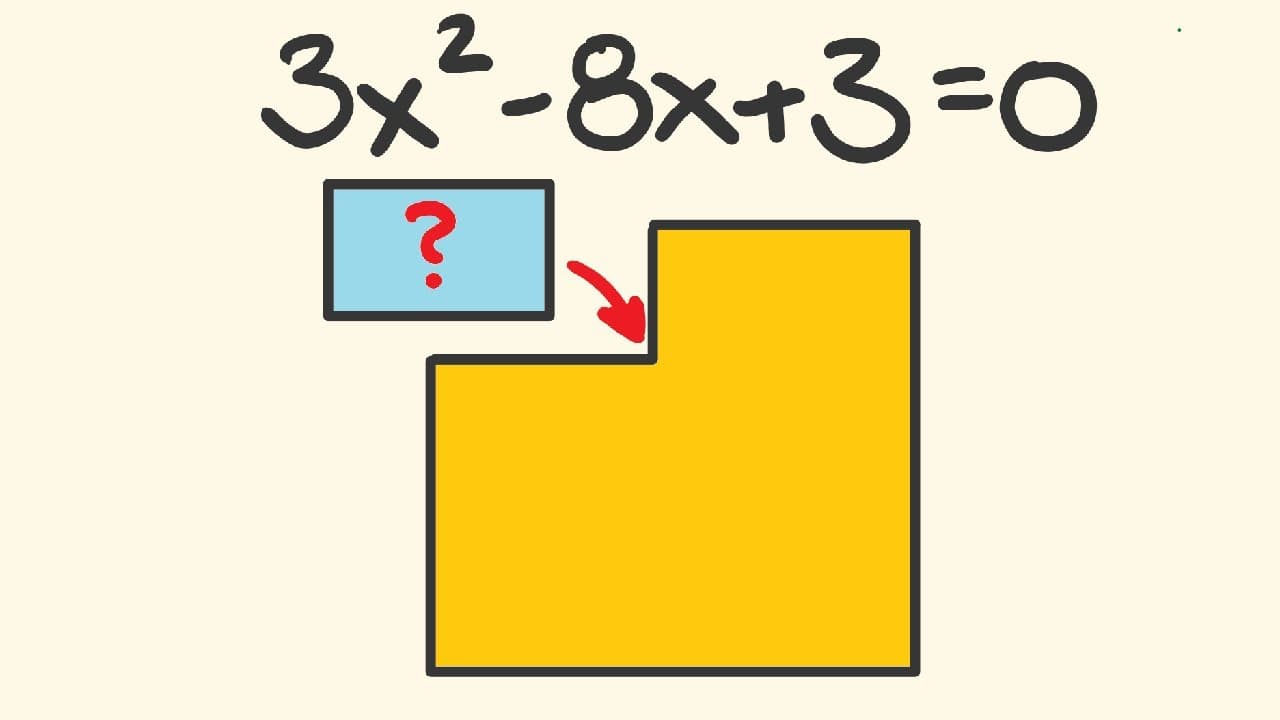
good day welcome to the tech maath Channel I'm Josh in this video we're going to have a look at how to solve quadratic equations through using the method of completing the square in particular where we have an X2 coefficient that is not equal to 1 so I'll give you an example of what I mean here say we were trying to solve the following question we ... Read More
Key Insights
- 🗂️ Dividing by the X^2 coefficient simplifies the equation for easier manipulation.
- ❎ Completing the square involves finding half of the X coefficient and squaring it.
- 💯 The method helps convert the equation into a perfect square form for solution extraction.
- ❎ Square roots are utilized to find the final solutions in completing the square method.
- ❎ Completing the square is particularly effective for quadratic equations with non-1 X^2 coefficient.
- 🫚 Simplifying the square root of the fraction helps in obtaining accurate solutions.
- ❓ Isolating X by manipulating the equation results in the final solutions.
Install to Summarize YouTube Videos and Get Transcripts
Explore YouTube Video Summarizer or Get YouTube Transcript Extractor
Questions & Answers
Q: How do you solve quadratic equations with a non-1 X^2 coefficient?
To solve such equations, divide the entire equation by the coefficient to make it equal to 1, then complete the square method to find the solutions.
Q: What is the process of completing the square in quadratic equations?
Completing the square involves finding half of the X coefficient, squaring it, adding it to both sides, simplifying the equation to isolate X for solutions.
Q: Why is completing the square method useful in solving quadratic equations?
This method helps to transform the quadratic equation into a perfect square form, making it easier to find the solutions using square roots.
Q: How does completing the square method differ from other methods of solving quadratic equations?
Completing the square method is useful when the X^2 coefficient is not 1, providing an alternative approach to factorization and the quadratic formula.
Summary & Key Takeaways
-
Solving quadratic equations with X^2 coefficient not equal to 1 using completing the square method.
-
Adjusting the equation by dividing by the coefficient to simplify.
-
Completing the square by finding half of the X coefficient, squaring it, and simplifying the equation for solutions.
Read in Other Languages (beta)
Share This Summary 📚
Summarize YouTube Videos and Get Video Transcripts with 1-Click
Try YouTube Summary with ChatGPT & Claude or YouTube Transcript Generator
Explore More Summaries from tecmath 📚

Summarize YouTube Videos and Get Video Transcripts with 1-Click
Try YouTube Summary with ChatGPT & Claude or YouTube Transcript Generator